Medical Device Product Information Management Guide
Author name: Mark James

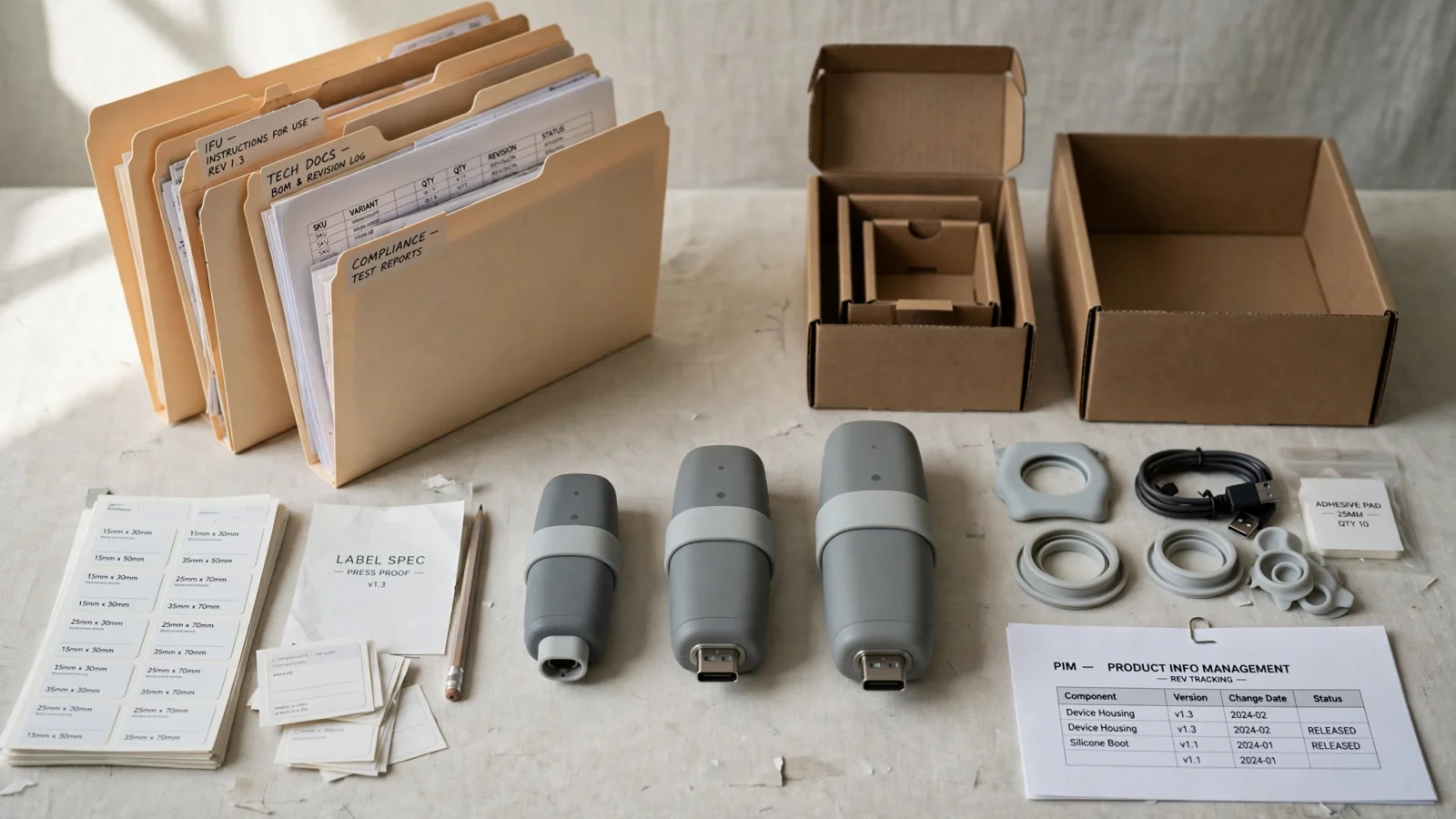
Medical device product information often scatters across operational silos. Engineering keeps technical specifications in one system, while regulatory affairs stores approved claims in another. Distributors receive flat spreadsheets, and e-commerce managers pull stale images from shared drives. This fragmentation causes conflicting specifications, obsolete documents, and disjointed customer experiences across sales channels.
Medical device product information management solves this operational problem by providing controlled organization, enrichment, versioning, approval, and distribution of information needed to identify, describe, sell, and support devices. A strong platform serves as the operational layer between authoritative business systems and your customer or partner channels.
Platforms like PIMinto demonstrate how this works in practice. By combining a centralized product catalog with built-in digital asset management, PIMinto gives you a single approved product record. The software links technical documents, images, and package relationships directly to the correct product variants, then creates channel-specific outputs for storefronts and distributors. It organizes approved facts for commercial distribution without replacing your formal quality management system, product lifecycle software, or regulatory submission process.

Why Medical Device Catalogs Need More Than Ordinary PIM
Families, Variants, and Package Levels
A medical device catalog requires stronger relationships and governance than a standard retail database because a single device family often contains dozens of sizes, configurations, and material variants. Each variant might need specific accessories, compatible systems, and market-specific versions.
Packaging configurations introduce another layer of complexity because a single unit, a carton of five, and a case of fifty each require distinct identifiers. Standard e-commerce software often forces you to collapse a Unique Device Identifier, commercial stock keeping unit, catalog number, Global Trade Item Number, and model number into one generic product code field. This compromises data integrity, whereas a dedicated medical device data model keeps these identifiers separate.
Documents, Assets, Markets, and Channels
Commercial channels demand high-quality assets, but medical devices also require strict separation of technical facts from promotional copy. An approved instruction for use or a declaration of conformity must attach to the correct product version because these assets undergo controlled revisions and supersession. If a product is recalled or subject to a field safety corrective action, its status needs to be updated immediately across all connected channels.
Different partners also require different data views. A hospital procurement portal needs specific UDI details and packaging dimensions, while an online storefront requires high-resolution imagery and localized descriptions.
The Failure Modes of Flat Spreadsheets
Spreadsheets are familiar and inexpensive for small catalogs, but they become fragile when relationships, permissions, validation requirements, and asset linking multiply. A flat spreadsheet cannot easily govern the relationship between a parent device and a specific replacement part. It fails at linking a localized PDF to a specific product variant without duplicating rows and risking manual data-entry errors. Dedicated product information software maintains these linked relationships natively instead.
Regulatory Data: UDI, GUDID, MDR, IVDR, and EUDAMED
U.S. UDI and GUDID
The United States Food and Drug Administration's Unique Device Identification system requires labelers to include a UDI on device labels and packages, except where the rule provides for an exception or alternative. Under that system, a UDI generally includes a device identifier that identifies the labeler and the specific version or model, plus a conditional production identifier that can identify a lot or batch number, serial number, expiration date, or manufacturing date when included on the label.
The FDA's GUDID guidance document provides recommendations on the information necessary for labelers submitting data to the Global Unique Device Identification Database.
The FDA's Quality Management System Regulation amends the device CGMP requirements in 21 CFR Part 820 and incorporates ISO 13485:2016 by reference. It applies to finished device manufacturers that intend to commercially distribute medical devices, and those manufacturers must establish and follow the QMSR.
EU UDI, EMDN, and EUDAMED
European Union regulations handle device data with similar rigor. The Medical Device Regulation and In Vitro Diagnostic Medical Device Regulation establish rules for the Basic UDI-DI, the UDI-DI, and UDI-PI components. The framework tracks certificates, notified-body references, economic operators, and market availability, capturing statuses like recalled, no longer placed on the market, or subject to a field safety corrective action.
The European Commission says the first four EUDAMED modules will be mandatory to use from 28 May 2026: Actor registration, UDI/Devices registration, Notified Bodies & Certificates, and Market Surveillance. The related Commission Decision's publication triggers a six-month transition period under Regulation (EU) 2024/1860.
Labeling, Language, and Review Boundaries
Translating device information requires more than a basic text swap because Member States have country-specific language requirements for information and instructions that accompany medical devices. The Commission's language-requirements overview provides tables for each Member State, including language requirements for graphical user interfaces.
FDA general device labeling requirements found in 21 CFR Part 801 dictate how intended use, warnings, and precautions appear. A practical data model separates intended use, indications, contraindications, warnings, claim owners, evidence sources, and approval states into distinct fields.
Build a Reliable Medical Device PIM Data Model
Identity, Variants, and Packaging
An effective data model relies on connected concepts instead of repeated free-text rows. This proposed schema acts as an operating example rather than a universal regulatory checklist, as every device uses different fields.
| Data layer | Example fields | Governance point |
|---|---|---|
| Product identity | Family, model, version, SKU, catalog number, brand, manufacturer | Define which identifier is commercial and which is regulatory. |
| Variant structure | Size, length, configuration, material, color, compatibility, accessory relationship | Model relationships instead of duplicating rows in spreadsheets. |
| Regulatory identity | UDI-DI, UDI-PI logic, Basic UDI-DI, EMDN or GMDN, product code, certificate references | Keep jurisdiction-specific identifiers separate. |
| Packaging | Unit of use, base package, case, carton, quantity per package, package dimensions | Create a hierarchy for each package configuration. |
Specifications, Claims, Documents, and Assets
Approved source attributes feed separate storefront, marketplace, distributor, and internal views without altering the master record.
| Data layer | Example fields | Governance point |
|---|---|---|
| Intended use and claims | Intended purpose, indications, contraindications, warnings, precautions, approved benefits | Require review before publication. |
| Technical specifications | Dimensions, materials, performance specifications, operating conditions, storage, shelf life | Normalize units and retain source references. |
| Compatibility | Compatible devices, systems, accessories, replacement parts | Use linked relationships rather than free-text lists. |
| Quality documents | IFU, label artwork, declaration of conformity, certificates, safety documents, technical sheets | Store revision, market, language, owner, and approval state. |
| Digital assets | Product photos, packaging images, diagrams, videos, CAD files, 3D models | Link each asset to the correct SKU, variant, and package. |
Governance, Market, and Channel Content
Tracking how data moves outward protects the integrity of the catalog.
| Data layer | Example fields | Governance point |
|---|---|---|
| Channel content | E-commerce title, short description, long description, bullets, marketplace fields, dealer copy | Derive channel outputs from approved source attributes. |
| Market content | Country, language, currency, local distributor, local contact, local availability | Do not assume one global version applies everywhere. |
| Lifecycle | Planned, draft, approved, active, discontinued, recalled, superseded | Ensure inactive content is not accidentally republished. |
| Governance | Data owner, source, evidence, reviewer, approval date, revision, change reason | Create traceability for important changes. |
Run the Catalog From Intake to Retirement
Establish Ownership and Audit the Current Catalog
A successful implementation starts by defining source-of-truth boundaries. Engineering owns technical specifications, regulatory affairs owns approved claims, and quality manages documented procedures and compliance statuses. The enterprise resource planning system manages inventory and operational pricing, while the product information management platform owns approved commercial content and distribution. Meanwhile, the digital asset management tool stores the actual files and asset metadata.
Begin your project by inventorying spreadsheets, system exports, supplier files, legacy e-commerce platforms, partner portals, and image libraries. Classify every field as authoritative, derived, channel-specific, unverified, obsolete, missing, or conflicting. Next, build a field dictionary containing definitions, data types, allowed values, units of measure, target markets, source owners, and approvers. Decide which fields you need for publication and specify change-control requirements.
Normalize, Enrich, Approve, and Validate
Import your data and link your digital assets by product, variant, package, market, language, revision, and effective date to prevent an old instruction manual or obsolete packaging photograph from reaching a retail partner.
Enriching the catalog requires strict boundaries. The PIMinto AI assistant serves as a drafting and translation aid using approved inputs, but artificial intelligence must never invent clinical performance, safety claims, intended use, compatibility, sterility, shelf life, certification, or regulatory status. Safe enrichment means using approved attributes to generate draft copy, comparing the draft with its sources, completing human review, and recording the final approval.
Apply validation gates before content moves outward. Check that required identifiers exist, package quantities use approved units, technical documents match the current variant, and lifecycle statuses reflect market availability.
Publish, Monitor, and Retire
Transform and publish outputs to your online stores, Google Shopping feeds, dealer portals, wholesale line sheets, customer-service tools, and regulatory-preparation files. PIMinto handles this step through bulk exports, application programming interfaces, custom views, brand portals, and native channel connectors. This reduces manual rework while keeping regulatory responsibility with the manufacturer or responsible economic operator.
Monitor the catalog continuously to track identifier changes, label revisions, certificate updates, market availability, discontinuation, and field safety status. When a product reaches the end of its lifecycle, immediately block obsolete assets from being published again.

Connect PIM with PLM, ERP, QMS, RIM, and DAM
System Responsibility Map
Software buyers often worry that adding a catalog management tool duplicates regulated business systems. Clear system responsibilities and well-defined integrations address this concern by showing what each platform controls.
| System | Primary responsibility |
|---|---|
| PIM | Approved product content, attributes, relationships, variants, channel outputs, partner distribution. |
| DAM | Images, videos, technical files, documents, and asset metadata. |
| PLM | Product design, engineering changes, bills of materials, and development history. |
| QMS | Quality procedures, nonconformances, corrective actions, complaints, audits, and controlled processes. |
| RIM | Regulatory submissions, registrations, approvals, certificates, and regulatory commitments. |
| ERP | Inventory, purchasing, pricing, orders, finance, and operational transactions. |
| CRM | Customer accounts, opportunities, and sales activity data. |
PIMinto includes native digital asset management capabilities and connects outward to sales channels, though that connectivity does not make it the authoritative system for quality, regulatory, lifecycle, or resource planning.
Integrate Rather Than Replace
Every approach carries trade-offs. Spreadsheets remain highly accessible but fail at version control and linked relationships. Product lifecycle, quality, and regulatory systems offer powerful governance in their domains, yet they are not built to map e-commerce category trees or manage high-resolution marketing videos.
Native product catalog connectors speed deployment but require administrators to verify field mappings, error handling, and synchronization rules. Custom application programming interfaces offer total flexibility at the cost of higher maintenance. By integrating systems, you keep compliance ownership in the quality system and distribute the approved facts through the catalog software. For a deeper look at adapting catalog software to specific supply chains, see our automotive aftermarket PIM software guide, which explores similar integration challenges for complex part relationships.
Three Operating Scenarios
Operating scenarios vary by business type. A manufacturer uses the platform to manage device families, sizes, package levels, controlled documents, and localized instructions for use. Once the regulatory team approves the claims, the catalog software distributes the correct version to each market.
Alternatively, a distributor uses the platform to normalize supplier files by mapping inbound records to a common schema, preserving manufacturer-controlled identifiers, adding distributor-specific commercial fields, and sharing the compiled catalog through a secure dealer portal.
Meanwhile, a multichannel retailer uses the platform to feed a consumer online store, a wholesale purchasing portal, and Google Shopping. The underlying product record stays stable while the platform transforms the data to meet the requirements of each destination.
Choose a Platform and Plan the Next Step
Medical Device PIM Evaluation Checklist
Compare platforms against the structural demands of a regulated catalog:
- Can the system distinguish device families, models, variants, and package levels?
- Does it preserve multiple regulatory and commercial identifiers independently?
- Can administrators assign owners, sources, approval states, revisions, and change reasons to fields?
- Does the system manage market-specific and language-specific rules?
- Can you link variant-specific and package-specific assets directly to the product record?
- Does the software block obsolete or superseded files from distribution?
- Can you export structured data for GUDID, EUDAMED, partners, or other systems?
- Are validation errors and failed synchronizations visible to users?
- Does the platform support bulk imports, application programming interface access, and rollback capabilities?
- Does the vendor support the electronic signatures, audit trails, data residency, or validation packages your internal procedures require?
How PIMinto Fits Manufacturers, Distributors, and Retailers
PIMinto provides centralized product information and digital asset management. You use the platform to build product relationships, execute bulk operations, and collaborate through role-based access controls. The software includes built-in brand portals, application programming interface access, AI-assisted enrichment, and direct outputs for e-commerce and marketplace distribution.
Medical device manufacturers use PIMinto to connect complex product families, technical documents, and partner assets. The published connector capabilities support Shopify, Magento, Amazon, BigCommerce, Wix, and Google Merchant Center, though you should confirm current connector coverage and field mappings during your evaluation.
PIMinto provides a transparent approach to pricing that removes artificial growth barriers. As of September 2026, the published pricing model is:
| Plan | SKU Capacity | Monthly Price |
|---|---|---|
| Starter | 1,000 SKUs | $0 |
| Essentials | 10,000 SKUs | $300 |
| Premium | 50,000 SKUs | $600 |
| Super | 120,000 SKUs | $950 |
| Extreme | 1,000,000 SKUs | Custom |
Every plan includes unlimited users and unlimited data outputs. You also receive free onboarding, training, and data migration support. Most migrations take one to two weeks, depending on catalog quality and integration complexity.
Discuss any specific requirements for native GUDID or EUDAMED submission, QMSR or ISO 13485 validation, 21 CFR Part 11 controls, electronic signatures, regulatory audit trails, security certifications, data-residency options, and direct quality or resource-planning connections directly with the PIMinto team.
FAQs
What is a medical device PIM?
A medical device product information management system organizes and distributes structured product information, technical attributes, regulatory identifiers, controlled documents, and digital assets across e-commerce, distributor, and internal channels.
Does a medical device PIM replace a QMS?
No. The catalog platform manages product content and distribution, whereas a quality management system manages quality processes and records. You should not treat a catalog tool as a replacement for formal quality or regulatory controls.
Can a PIM manage UDI data?
The software stores and organizes UDI-related fields, package relationships, and supporting documentation. It allows you to export files formatted for external databases. Confirm a platform's specific regulatory integration and validation capabilities before purchase.
How should IFUs and labels be managed?
Treat them as controlled, versioned digital assets. Link them directly to the relevant device, variant, package, market, and language to track whether they are approved, effective, or superseded.
Can AI write medical device product descriptions?
Artificial intelligence can draft or translate commercial copy based exclusively on approved source data. It must not invent intended use, clinical evidence, safety claims, compatibility, or regulatory status, so human review remains required.
What should distributors look for in medical device PIM software?
Distributors require supplier-data normalization, product relationships, asset versioning, partner portals, and role-based access. The software must maintain a clear separation between manufacturer-controlled facts and distributor-created commercial content.
Is PIMinto suitable for small and growing medical device businesses?
PIMinto offers a free tier, paid plans based on catalog capacity, unlimited users, unlimited outputs, and comprehensive onboarding. Verify current plan limits and your specific regulated-workflow requirements during your platform evaluation.
Centralize your medical device catalog with PIMinto. See how PIMinto can migrate your spreadsheets, product data, and digital assets into one manageable catalog at piminto.com.
Modified on: 2026-09-13
Blogs you might like
-

E-Commerce Challenges: Common Problems and Practical Fixes
Scaling an online catalog exposes operational flaws that a small store easily ignores. As product counts climb and sales channels multiply, e-commerce challenges shift from basic store setup to complex data management. Keeping up with orders and fulf...

Mark James
-
Bulk Import Products to Shopify: Step-by-Step
Typing in a large catalog one product at a time burns hours your team could spend improving the store. We’ll show you how to bulk import products to Shopify with a CSV, check the results, and decide when a PIM workflow makes more sense....
Mark James
-

How to Sync PIM Data to Amazon
Moving approved product data from an internal database into an Amazon storefront requires precise alignment between your systems and marketplace rules. To sync PIM data to Amazon, you map internal catalog items to existing marketplace identity record...
Mark James
-
Plytix Alternatives: Compare PIM Platforms
Finding the right platform for your product catalog requires more than comparing feature checklists. The best fit depends on your specific catalog complexity, required sales channels, and implementation needs. When evaluating Plytix alternatives, you...
Mark James