4367845921614 GTIN Lookup: What It Means
Author name: Mark James
The 4367845921614 GTIN passes the standard GTIN-13 check-digit calculation, but a correct mathematical format alone does not confirm that it is registered or reveal which product it identifies. To verify the identifier, use GS1’s official lookup service and compare any returned company or product data against the item’s physical packaging or manufacturer records. A valid number can still lack an assigned product, or a brand might choose not to share its catalog data publicly. Verifying one identifier takes only a few seconds, but managing thousands of them across a large catalog requires a structured system. You can use product data management software like PIMinto to store verified global trade item numbers alongside correct product data, variant details, and digital assets, preventing bad data from reaching storefronts.
Checking the Mathematical Validity of 4367845921614
The identifier 4367845921614 is a 13-digit candidate whose final digit is a mathematical check digit, and this specific number passes the standard test. The modulo 10 algorithm is designed to catch data-entry mistakes like transposed numbers or missing digits.
The calculation follows a strict sequence:
- Isolate the first 12 digits:
436784592161. - Add the numbers in the odd positions:
4 + 6 + 8 + 5 + 2 + 6 = 31. - Add the numbers in the even positions and multiply that sum by three:
(3 + 7 + 4 + 9 + 1 + 1) × 3 = 75. - Add the two totals together:
31 + 75 = 106. - Find the number needed to reach the next multiple of ten. The next multiple is 110, requiring a
4. - Compare this required digit to the supplied final digit, which is also
4.
This confirms structural validity based on the GS1 General Specifications, but a valid format does not mean a verified product. A passing checksum proves only that the digits follow the correct mathematical relationship without offering proof of official issuance, licensee ownership, registration, or assignment to a physical item. Anyone can generate a structurally sound 13-digit sequence. Because of this, you need confirmation that the number connects to a legitimate, registered item in the global supply chain.
Identifying the Product Behind 4367845921614
The product identity for this number remains unverified. You cannot attach a product name, brand, manufacturer, category, image, price, country of origin, or model number to this sequence without a direct registry match or authoritative manufacturer record confirming the details.
Reverse-engineering a product or its manufacturing location from the digits alone creates inaccurate records. While certain prefixes indicate the member organization that issued the license, they do not guarantee where a product was manufactured or distributed, because a company based in one country often manufactures goods globally while licensing identifiers from a single regional office.
You can determine identity by following a strict evidence hierarchy that starts with official registry data. Compare any returned company and product details with the physical packaging, invoices, supplier records, product sheets, or official manufacturer documentation. Third-party barcode databases and public decoders scrape historical data and user submissions, providing useful leads during an investigation, but treating them as final proof of ownership causes catalog conflicts, mismatched marketplace listings, and shipping errors.
Verifying 4367845921614 Through the GS1 Registry
Establishing a reproducible workflow for checking identifiers begins with the official Verified by GS1 service, which searches global registries for company and product information tied to the number.
Enter 4367845921614 exactly as printed, preserving the original value without dropping leading zeroes or adding spaces. The returned record may display a licensee or company name, brand, product description, product category, image, and specific packaging attributes, depending on the available registry data.
Compare this result against the physical item in your warehouse and against your supplier documentation. A registry match provides strong evidence, but data entry errors happen even at the manufacturer level. If the physical packaging describes a one-liter bottle while the registry describes a 500-milliliter variant, the supplier might have recycled an old identifier, meaning you should avoid automatically overwriting conflicting data in your product information system.
Record the lookup source, the verification date, the returned status, and any discrepancy in your product master record. Since the lookup tool provides foundational company and product information held in official registries, you can present the 4367845921614 GTIN as verified only when the search confirms the exact product you hold.
Resolving a Missing Product Record
A missing product response from the registry does not mean the number is fake, invalid, or unused, because the global data synchronization network relies on companies updating and sharing their product records, making administrative delays common.
According to GS1 US guidance, when a GTIN search returns “Not Found” for a GTIN associated with a GS1 Company Prefix from a GS1 Member Organization other than GS1 US, the license is active but GTIN data is unavailable. The company may not have assigned the available GTIN to a product, or it may have assigned a GTIN to a product but not shared the product information.
You will encounter three distinct verification states during this process. A checksum failure means the number is mathematically broken, while a checksum pass with no registry data means the format is correct but the product remains unverified. Finally, a registry match with conflicting product information points to a supplier error or a recycled identifier.
When a lookup fails to return a product, run follow-up checks by scanning the physical packaging to rule out a transcription error and comparing your supplier documents against the digits. Ask the brand owner directly for confirmation, and contact the relevant member organization if the supplier cannot resolve the discrepancy. Keeping the result logged as an unresolved verification status prevents the temptation to invent a replacement identifier to force a marketplace listing.
Separating Global Trade Items From Internal SKUs
Mixing identifier types creates immediate problems for inventory routing and multichannel publishing, meaning you should treat each identifier as a distinct field with a specific purpose.
| Identifier | Primary purpose | Recommended catalog treatment |
|---|---|---|
| GTIN | External trade-item identifier used across trading relationships | Store as a controlled, verified product field |
| SKU | Internal merchant or warehouse identifier | Keep separate from the GTIN |
| MPN | Manufacturer’s part number | Store as a separate manufacturer-provided attribute |
| Marketplace or channel ID | Identifier assigned by a sales channel | Store per channel and never substitute for the GTIN |
While a GTIN acts as an external trade-item identifier recognized across trading relationships and global marketplaces, a SKU serves as an internal merchant or warehouse identifier used to track inventory, location, or financial data. Keeping the two separate prevents catalog confusion. An MPN provides a manufacturer-assigned attribute useful for warranty claims and technical support, whereas marketplaces assign their own internal IDs that you store per channel.
Distinct variants, quantities, and multipack configurations require distinct identifiers. A single unit requires one number, while a six-pack of that exact unit requires another. Similarly, a 500-milliliter bottle needs a different identifier than a 1-liter bottle of the same liquid. Changing a product's color or creating a bulk shipping case for a consumer unit also demands unique identification.
For resellers, the GS1 guidelines for online marketplaces say to use the existing GTIN assigned to the product by its manufacturer.
Building a Reliable Identifier Workflow in PIMinto
Checking one sequence takes a moment, but keeping thousands of identifiers connected to the correct variants, packaging levels, assets, and channel listings poses a complex catalog-management problem. Spreadsheets fail at this scale because they lack validation rules, audit trails, and relational connections between items and images.
Setting up a strict minimum data model for identifiers protects your catalog integrity.
| Field | Recommended practice |
|---|---|
gtin | Store as text, not a numeric spreadsheet field, so leading zeroes are preserved |
gtin_format | Record GTIN-8, GTIN-12, GTIN-13, or GTIN-14 where applicable |
gtin_check_status | Use statuses such as unchecked, checksum pass, checksum fail, registry verified, mismatch, and not found |
verification_source | Record the GS1 lookup or authoritative manufacturer source |
verification_date | Record when the identifier was last checked |
licensee | Store the company returned by the registry when available |
brand and manufacturer | Compare against supplier and packaging data |
mpn | Keep separate from the GTIN |
variant_attributes | Size, color, material, capacity, model, and other differentiators |
packaging_level | Consumer unit, inner pack, case, pallet, or other relevant level |
pack_quantity | Record quantity and unit of measure |
internal_sku | Maintain as a separate internal identifier |
channel_ids | Store Shopify, Google Shopping, marketplace, or other channel identifiers separately |
digital_assets | Link approved images, videos, manuals, specification sheets, and compliance documents |
Running a standardized operating sequence begins by ingesting the identifier from the manufacturer, supplier, or ERP system and normalizing spacing and punctuation while retaining the original text string. After validating the length and check digit, verify the number through official registries or an authoritative manufacturer source. From there, compare product and packaging data against the supplier feed to flag duplicates or mismatches for human review. Once you enrich the approved record with technical specifications and marketing copy, distribute the final data to storefronts and partner channels while auditing the output continuously.
PIMinto replaces disconnected spreadsheets with a centralized Product Information Management and Digital Asset Management platform that organizes evidence and distributes approved data for a complex PIM for e-commerce strategy. The software features an AI PIM Assistant that automates product data enrichment, reducing manual data entry for large catalogs. Built-in PIM brand portals let you share product assets securely with external partners, keeping distributors and retailers aligned. Native API connectors push updated listings directly to major sales channels, supporting a reliable Google Shopping PIM integration alongside Shopify, BigCommerce, WooCommerce, and Wix. These integrations come standard with any paid subscription, avoiding the need for expensive third-party middleware.
Originally developed by US-based software company Systems Online to solve real catalog bottlenecks for B2B clients, PIMinto emphasizes rapid deployment through free onboarding and free data migration. The transparent pricing model includes unlimited users and unlimited data outputs, allowing growing brands to scale their multichannel syndication without hitting artificial paywalls. While PIMinto organizes your verification evidence and distributes the approved data, it does not independently verify registry status or guarantee marketplace acceptance. It does, however, give you the exact structure needed to meet those channel requirements.
FAQ: Understanding the 4367845921614 Identifier
Is 4367845921614 a valid GTIN?
It passes the GTIN-13 check-digit calculation, proving its mathematical structure is correct, but registration, licensee ownership, and product identity remain unverified until confirmed through an official registry.
What product is associated with GTIN 4367845921614?
The product identity is unverified, meaning you should avoid publishing a product name, brand, or manufacturer without direct registry or manufacturer confirmation.
Does a passing check digit prove that a GTIN is registered?
No, because it proves mathematical structure only. Anyone can generate a 13-digit sequence that passes the checksum algorithm without registering it with a member organization.
What should I do if Verified by GS1 returns no product?
Recheck the digits for transcription errors, compare the physical packaging against supplier records, and investigate the discrepancy. A missing result often means the data is unassigned or undisclosed rather than invalid.
Should a reseller create a new GTIN?
Generally no. Resellers benefit from using the original manufacturer-assigned identifier for the existing product, generating new identifiers only for custom bundles or original manufactured goods.
Should the GTIN be used as the SKU?
Keep external trade identifiers and internal merchant SKUs separate. Merging them causes routing errors when suppliers update product packaging or assign new global numbers to existing internal inventory.
Do different pack sizes need different GTINs?
Yes, depending on the defined trade item and packaging configuration. A consumer unit, an inner pack, and a shipping case require distinct numbers to secure accurate supply chain routing and pricing.
Once an identifier is verified, keep the digits, variant data, product copy, and digital assets together in one trusted catalog. Centralizing this information stops bad data from reaching your checkout page. PIMinto helps growing e-commerce and B2B teams eliminate spreadsheet errors, connect product assets, and feed direct channel outputs without capping users or data exports. Visit PIMinto to centralize your product catalog today.
Modified on: 2026-08-25
Blogs you might like
-

Best PIM Software for Shopify in 2026
Shopify handles products well until the catalog outgrows it. Variants pile up, supplier files arrive in different formats, a second store needs the same products with different content, and spreadsheets become the real system of record. That is the p...
-
Jewelry Product Catalog Software: Managing Product Data, Line Sheets and B2B Catalogs
One engagement ring design can come in three metals, four center-stone weights and twelve ring sizes. Add natural and lab-grown versions, a wholesale price for boutiques and a separate price list for Europe, and a single design turns into hundreds of...
-
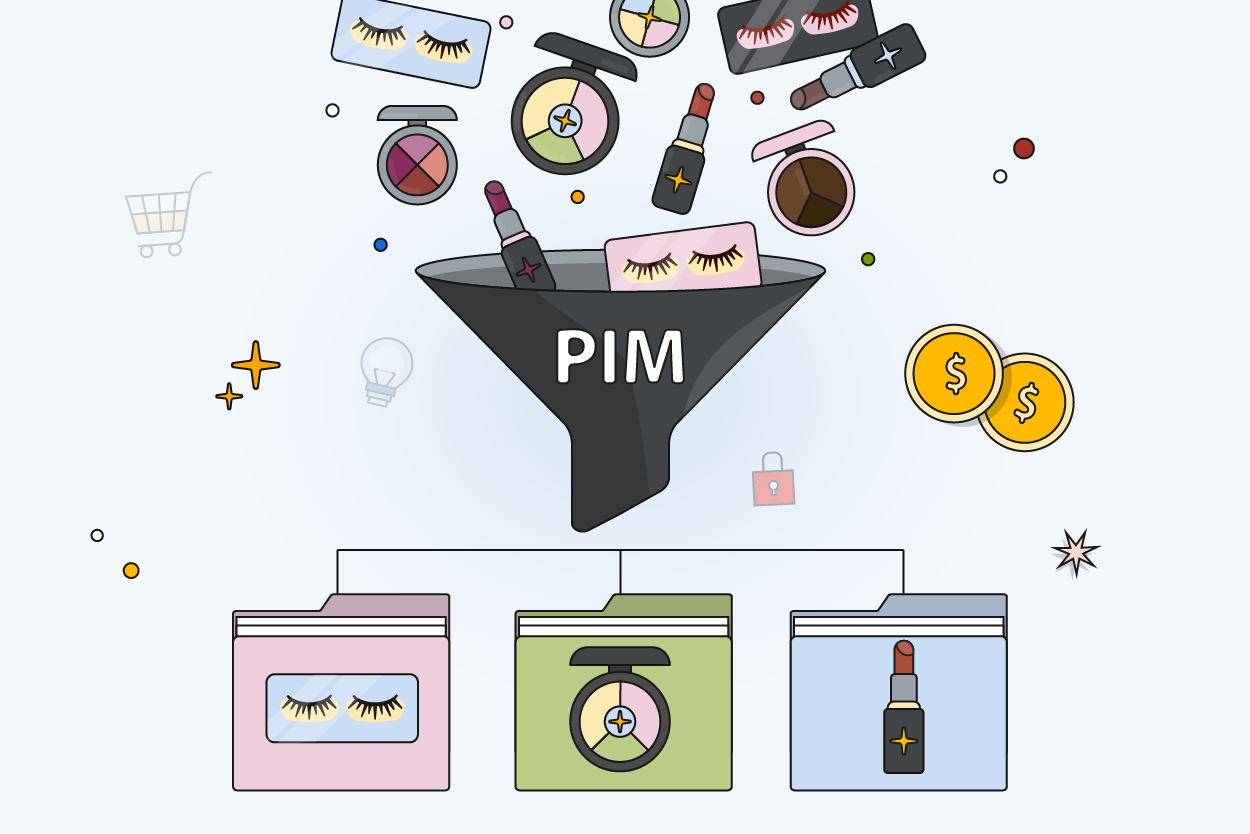
Beauty and Cosmetics Product Data Management: A PIM Guide for Brands
A lipstick launches in 20 shades. Each shade has its own barcode, swatch, product photo, shade description and stock status, and every retailer wants that information in a different spreadsheet. Six months later the brand adds a matte version and a m...
-

Food and Beverage Product Data Management: A Practical Guide for Brands and Distributors
A granola bar recipe changes: almonds replace cashews. The new label goes to print, but the allergen statement on your website, the spec sheet your distributor uses and the listing on an online grocery site still say "contains cashews." Nobody made a...