Akeneo Enterprise Pricing: Costs, Tiers, And Quotes
Author name: Mark James

Akeneo enterprise pricing does not have one fixed public rate card. The current Product Cloud structure combines a public starting point with quote-based higher tiers, so you need to separate third-party benchmarks from the vendor's own comparison pages. A reported base rate should be treated as a software benchmark rather than a full deployment budget, because the final scope can include implementation, activation channels, app add-ons, AI features, and asset-management requirements. This ambiguity complicates evaluation for growing catalog teams that require predictable syndication expenses over a multi-year contract.
Deciding on a product information management system starts with mapping your specific catalog scale to a vendor's pricing model. That means separating the headline subscription cost from the add-on and usage terms that can accumulate as your distribution network grows.
Akeneo Enterprise Pricing At A Glance
Evaluating Akeneo enterprise pricing requires a clear baseline. Buyers face a structural pricing challenge because the public package map combines a starting signal for Growth with quote-based pricing for Advanced and Premium, so understanding the total financial commitment requires quotes across multiple packages.
The Short Answer
The Akeneo package comparison presents Product Cloud tiers named Growth, Advanced, and Premium. It lists Growth as starting at $0 annually and marks Advanced and Premium as call for quote, but it does not list a package labeled Enterprise or a public price for those two tiers.
Why The Public Prices Conflict
The official comparison displays $0 annually in the first package column, which creates confusion because the vendor separately offers a free Community Edition and a free trial. Neither option provides a budget for a supported commercial Product Cloud deployment. A buyer preparing a budget should therefore treat the $0 indicator as a starting signal, not a forecast for a full implementation. Because the higher tiers remain quote-based, organizations often enter procurement without knowing whether the platform fits their financial constraints.
What Buyers Should Budget For
Treat the $45,000 annual figure as an external benchmark for a paid Akeneo deployment, not as a floor. Your final quote can vary with catalog scope, included activation channels, app and connector requirements, asset needs, implementation services, and support packages, so model those costs separately. If you require price predictability and faster deployment, platforms like PIMinto publish transparent monthly plans starting at $300, which provide an immediate alternative for teams avoiding prolonged quote negotiations.
Understand Akeneo’s Current Package Map
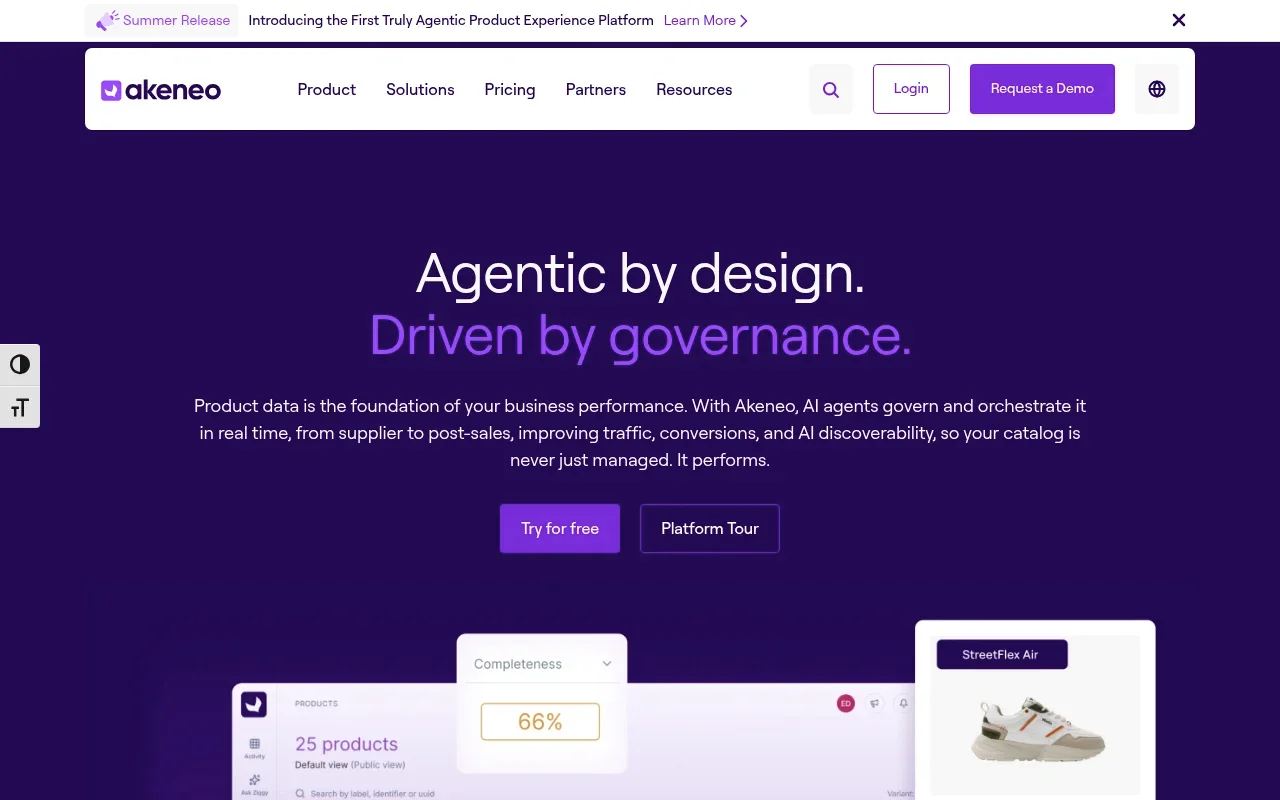
Akeneo's current public package map uses a tiered Product Cloud model rather than a package labeled Enterprise. Determine which layer of this map aligns with your internal approval workflows and data governance requirements.
Growth
The Growth package provides the foundation for catalog management and data enrichment, including the Data Architect Agent, support for composable products, and AI-powered description generation and asset extraction. The third-party benchmark above puts this tier at $45,000 annually. You gain the core catalog and enrichment capabilities needed to move beyond spreadsheets, which makes Growth the entry point for organizations planning a paid Product Cloud deployment. Because the public Akeneo page and the G2 listing show different starting signals, confirm the commercial quote and included scope before you build a forecast.
Advanced And Premium
Organizations requiring formal data governance usually move beyond Growth to Advanced, which introduces collaboration workflows and advanced rights management for more controlled approvals. Premium adds PX Insights tied to a single data source, broader enterprise governance tools, a Success Package, and 24/7 technical support. Both tiers require a custom quote, and Akeneo lists Supplier Data Manager as an add-on while showing package-specific treatment for Automated Asset Tagging AI, so confirm those items during the sales cycle.
Community Edition And Trial
Akeneo maintains a free, open-source Community Edition separate from the paid Product Cloud packages. Because it is a separate option, its $0 license should not be treated as a quote for hosted services, implementation, support, or the commercial feature scope of Product Cloud. The vendor also provides a free trial of the Growth package to preview the interface, but neither the trial nor the open-source release serves as a substitute for a supported enterprise deployment.

Identify The Main Akeneo Cost Drivers
Since Advanced and Premium rely on custom quotes, identifying the operational variables that can inflate your contract price helps prevent budget gaps during your second year of operation.
Catalog Capacity And Complexity
Akeneo monitors your contracted SKU capacity, and according to Akeneo's SKU usage guidance, the system displays notices at 90-99% and 99-100% of your allowance. There is no hard limit, but the 99-100% notice warns that service could be impacted and directs you to contact your Customer Success Manager. Clarify exactly how the vendor counts capacity, including whether base products, sellable variants, archived records, localized variants, or complex reference entities are included. That answer affects your forecast as catalog structure and localization expand.
Channels, Connectors, And Add-Ons
Exporting your data to external storefronts adds another layer of variables. The current package map lists one activation channel included in each package and marks some apps as add-ons, so you cannot assume an enterprise quote provides unlimited distribution points or connector coverage. Ask sales to specify the exact number of included activation channels and the recurring cost for adding destinations. An app or native integration may sit outside the core PIM quote, so request commercial terms for each required ERP system or marketplace feed.
AI, DAM, And Usage
Digital asset management and automated enrichment can affect the scope of your subscription because availability and add-ons vary by package. Ask the vendor to list which AI generation, asset transformation, DAM, and asset-sharing capabilities are included, then request any annual credits, storage limits, bandwidth caps, and overage rates in writing. Treat these consumption terms as recurring line items in your financial model.
Calculate Akeneo’s Real Three-Year Cost
Evaluating software on its first-year license fee hides the true financial impact of an enterprise deployment. Building a total cost of ownership (TCO) model captures implementation labor, ongoing maintenance, and internal administration over a realistic three-year horizon.
Separate Recurring And One-Time Costs
Software budgeting requires splitting your expenses into fixed annual charges and one-time setup fees. The recurring column includes your PIM subscription, contracted catalog capacity, activation channel fees, connector subscriptions, AI usage packs, DAM storage, and your support SLA. The one-time column contains your initial implementation, data migration, spreadsheet cleanup, integration mapping, custom workflow configuration, and team training. A lower software license can still leave substantial professional-services work, so compare implementation scope rather than license price alone.
Normalize The Deployment Scope
Vendors structure their quotes differently, making direct comparisons difficult unless you require competing providers to price the exact same scenario. Build a normalization worksheet defining your current operational scale and your projected three-year growth. Document your total base products, sellable variants, required brand portals, and active locales alongside your specific e-commerce platforms, third-party marketplaces, and internal ERP systems. Specify the volume of high-resolution images, technical manuals, and video files your team manages. Giving this exact specification to each vendor helps prevent them from quoting a stripped-down baseline lacking your required features.
Apply A Three-Year TCO Formula
Your final evaluation metric is the sum of the software costs and the labor required to run it. The basic formula combines the recurring subscription, initial implementation, data migration, connector fees, AI usage packs, support tiers, and internal administration costs. Using that benchmark, a baseline three-year software commitment equals $135,000. That figure excludes implementation work, custom ERP mapping, and any extra channel activation or add-on fees. Organizations evaluating lower-cost alternatives for growing businesses may find that a transparent pricing model reduces forecasting risk.
Choose Between Akeneo And PIMinto
Selecting a product information management platform comes down to architectural complexity versus deployment speed. Weighing the value of a broad enterprise ecosystem against the utility of a platform that scales without per-output barriers clarifies the decision.
Why PIMinto May Be The Practical Starting Point
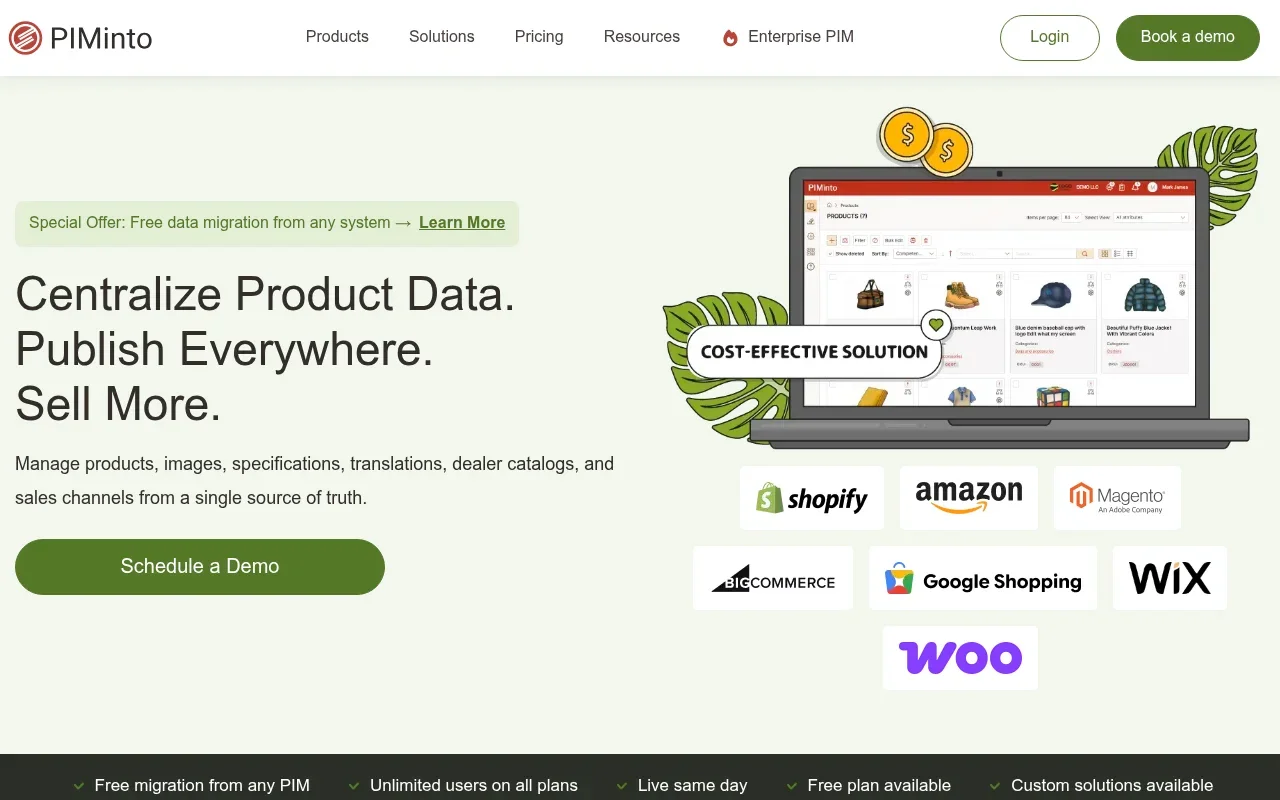
PIMinto publishes its main pricing tiers to reduce reliance on the custom quote process, giving growing teams faster cost visibility. The Essentials plan costs $300 per month for 10,000 SKUs, Premium costs $600 per month for 50,000 SKUs, and Super costs $950 per month for 120,000 SKUs, while the custom Extreme tier lists capacity of up to one million catalog records.
The primary structural advantage is the inclusion of unlimited users and unlimited outputs on all paid plans. You can add external suppliers, internal copywriters, and other contributors without triggering per-seat licenses, while unlimited outputs avoid a separate charge for each output. PIMinto combines product data storage with a native digital asset management interface, allowing you to organize technical manuals and product photography in one central location. Paid plans include built-in e-commerce connectors, and the vendor lists onboarding, training, and free migration among the included services. PIMinto says most migrations are completed within one to two weeks, but confirm the timeline for your own catalog and integrations.
When Akeneo May Justify A Custom Quote
Organizations managing many external suppliers across regulated international markets may require complex approval matrices, and Akeneo's higher tiers address those scenarios with collaboration workflows, rights management, and enterprise governance. Both Advanced and Premium support formal approvals, while Premium adds a Success Package and 24/7 support. If your data governance strategy requires dedicated support, granular permissions, and supplier-management tools, the higher cost of an Akeneo deployment may align with those operational requirements.
Compare The Same Scope Before Deciding
Compare your required capabilities across both platforms instead of matching an entry-level published tier against a sprawling enterprise quote. The reported Akeneo Growth benchmark sits above PIMinto's annualized list prices. PIMinto Super costs $11,400 annually, making the third-party Akeneo benchmark roughly 3.9 times more expensive before implementation fees. If your primary goal involves centralizing a messy catalog and pushing updates directly to Shopify or another required channel, paying a premium for complex enterprise governance may add time and cost without improving your immediate launch plan. Conversely, if you need heavily customized permission workflows, secure a firm commitment on integration costs from Akeneo partners.
Ask These Questions Before Signing
Reviewing the vendor quote helps expose usage limits and hidden maintenance fees, so use the sales conversation to examine your future operational costs.
License, Users, And Capacity
Start by identifying the quoted Product Cloud tier, whether Growth, Advanced, or Premium, and request a line-item breakdown of the included features. You also need to know how the system counts your catalog scale, such as whether adding a French translation to an existing product consumes an additional SKU allowance. Request written clarification on what happens when you breach the 90% capacity warning threshold, and secure the exact price for a mid-contract capacity increase. Since the public package map does not publish a universal per-user rate, confirm whether the quote charges for named administrators, concurrent logins, or external contributor access.
Channels, Connectors, And Usage
Scrutinize the distribution model by requesting a list that specifies the exact number of activation channels included in your base quote. Ask for the pricing schedule covering each subsequent marketplace or retailer connection, separating native integrations maintained by the vendor from third-party apps sold through the marketplace. Check the storage capacity for your digital assets and the monthly bandwidth allowance for delivering those images to your storefronts. You should also request the overage rates for AI usage credits and ask if the supplier-management modules require separate licensing.
Services, Support, And Contract Terms
A sound software agreement includes a binding implementation timeline and a clear division of labor. Ask the vendor or their integration partner to separate the costs for data migration, spreadsheet cleanup, and custom workflow configuration. Find out if the quote includes a dedicated sandbox environment for testing structural changes before deploying them to your live catalog. Review the support service level agreement to confirm whether you receive basic ticket access or a 24/7 technical response team. Finally, negotiate terms that cap your renewal increases, outline early termination conditions, and guarantee your ability to export your complete dataset if you change providers.
Akeneo Enterprise Pricing FAQ
Procurement teams require direct answers regarding standard software costs. Keep these baseline facts in mind as you model your catalog expenses.
How Much Does Akeneo Enterprise Cost?
Akeneo does not publish one fixed public price for an enterprise deployment, as the Advanced and Premium packages require a direct quote based on your specific requirements. G2 lists the entry-level Growth package starting from $45,000 per year, though this figure serves as a baseline benchmark rather than a guaranteed commercial rate.
Is Akeneo Free, And Does It Charge Per User?
Akeneo maintains a free, open-source Community Edition and offers a free trial of its commercial Product Cloud. The Community Edition is separate from Product Cloud, so its free license does not establish the hosting, services, support, or commercial feature scope of a paid deployment. Because the public pricing pages do not state a clear unlimited-user policy, ask the sales team to define how they structure internal administrator and external supplier access within your specific quote.
Are Channels, Connectors, And DAM Included?
Activation channels use specific package inclusions, and the current package table lists one activation channel included in each package. Some app integrations are listed as add-ons, so ask for the exact connector coverage and commercial terms in your quote. Digital asset management and AI features also have package-specific availability, so request any storage, credit, bandwidth, and overage terms that apply to your deployment.
Understanding the hidden variables in an enterprise PIM quote prevents unexpected budget overruns during your first year of deployment. You need a platform that scales your distribution network with predictable terms and without per-user or per-output charges. Eliminate spreadsheet chaos and secure predictable syndication costs by starting with a transparently priced alternative. Explore how an unlimited output architecture accelerates your multichannel growth by visiting PIMinto.
Modified on: 2026-08-25
Blogs you might like
-
E-Commerce Challenges: Common Problems and Practical Fixes
Scaling an online catalog exposes operational flaws that a small store easily ignores. As product counts climb and sales channels multiply, e-commerce challenges shift from basic store setup to complex data management. Keeping up with orders and fulf...

Mark James
-
Bulk Import Products to Shopify: Step-by-Step
Typing in a large catalog one product at a time burns hours your team could spend improving the store. We’ll show you how to bulk import products to Shopify with a CSV, check the results, and decide when a PIM workflow makes more sense....
Mark James
-
How to Sync PIM Data to Amazon
Moving approved product data from an internal database into an Amazon storefront requires precise alignment between your systems and marketplace rules. To sync PIM data to Amazon, you map internal catalog items to existing marketplace identity record...
Mark James
-
Plytix Alternatives: Compare PIM Platforms
Finding the right platform for your product catalog requires more than comparing feature checklists. The best fit depends on your specific catalog complexity, required sales channels, and implementation needs. When evaluating Plytix alternatives, you...
Mark James