Best Catalog Management Software: 6 Top Picks
Author name: Mark James
Most catalog management software promises one source of truth. Here are six named options, with PIMInto first, plus the best fit and the trade-off for each.
1. PIMInto
PIMInto is a cloud-based PIM for teams that need to organize product data and send it to sales channels without adding feed software.
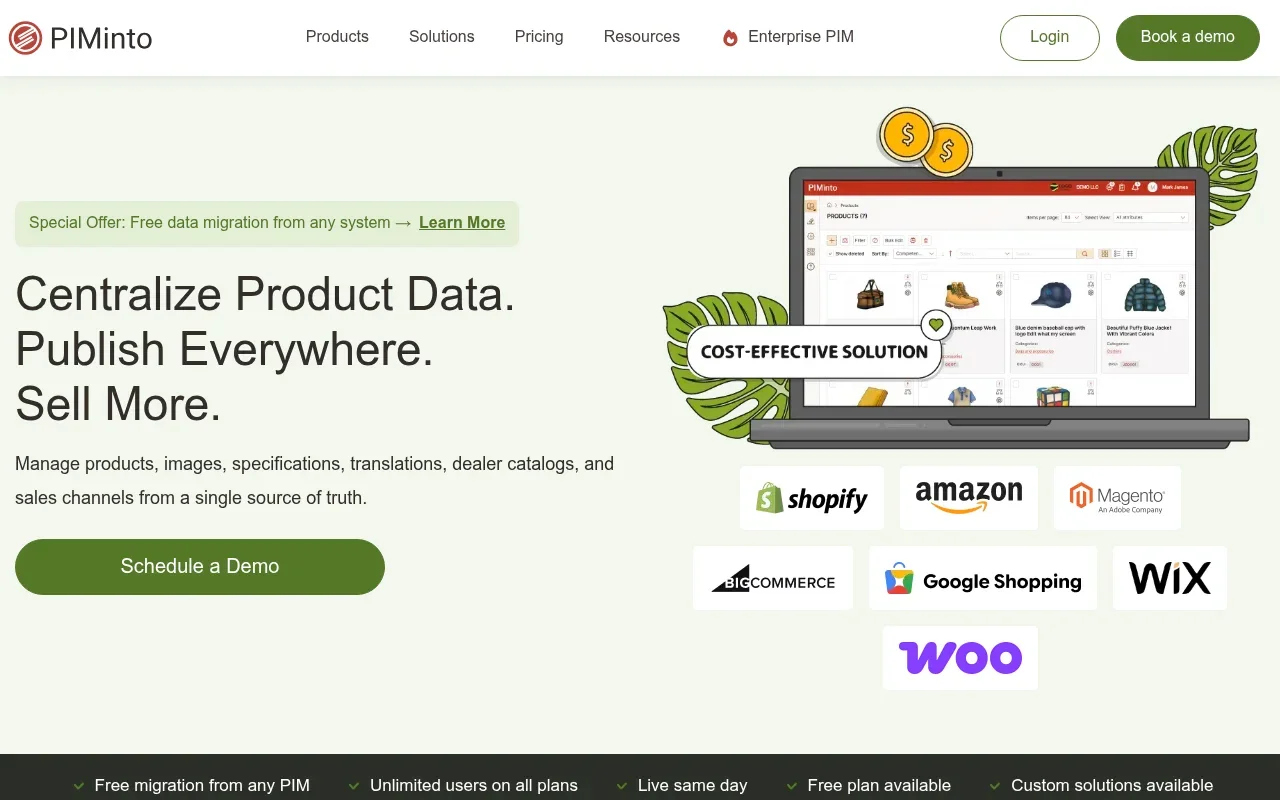
We recommend PIMInto when your team sells through more than one channel and wants one place for SKUs, images, descriptions, attributes, and variants. It connects with Shopify, Magento, Amazon, and WooCommerce. Built-in feeds also support channel distribution, so your PIM stays the source of truth while each destination receives the format it needs.
The distinction matters. A feed tool usually takes data from somewhere else, then formats it for a marketplace or ad channel. A PIM holds the product record itself. PIMInto combines both jobs in one workflow, which cuts the handoff between data maintenance and publishing.
Your team can update an attribute once instead of fixing the same field in several systems. That helps when a supplier changes a material, a product manager adds a variant, or a marketplace rejects a missing value. Speed saves time because the next update starts with clean, central data.
We also like the fit for mixed teams. Digital marketers can work on copy. Ecommerce managers can check channel output. Content creators can manage images. Enterprise data analysts can review the structure behind the catalog.
Learn more about the workflow in our guide to PIM for catalog management, especially if your current catalog lives across spreadsheets and supplier files.
The caveat is simple: you still need a sound product model before you import thousands of records. Decide which fields are required, how variants relate to parent products, and who approves changes. PIMInto can turn catalog chaos into an advantage, but clear rules make that advantage show up faster.
2. Productbay - AI-native catalog maintenance for multi-channel retailers
Productbay is an AI-native PIM for retailers handling product data from many suppliers across several channels.
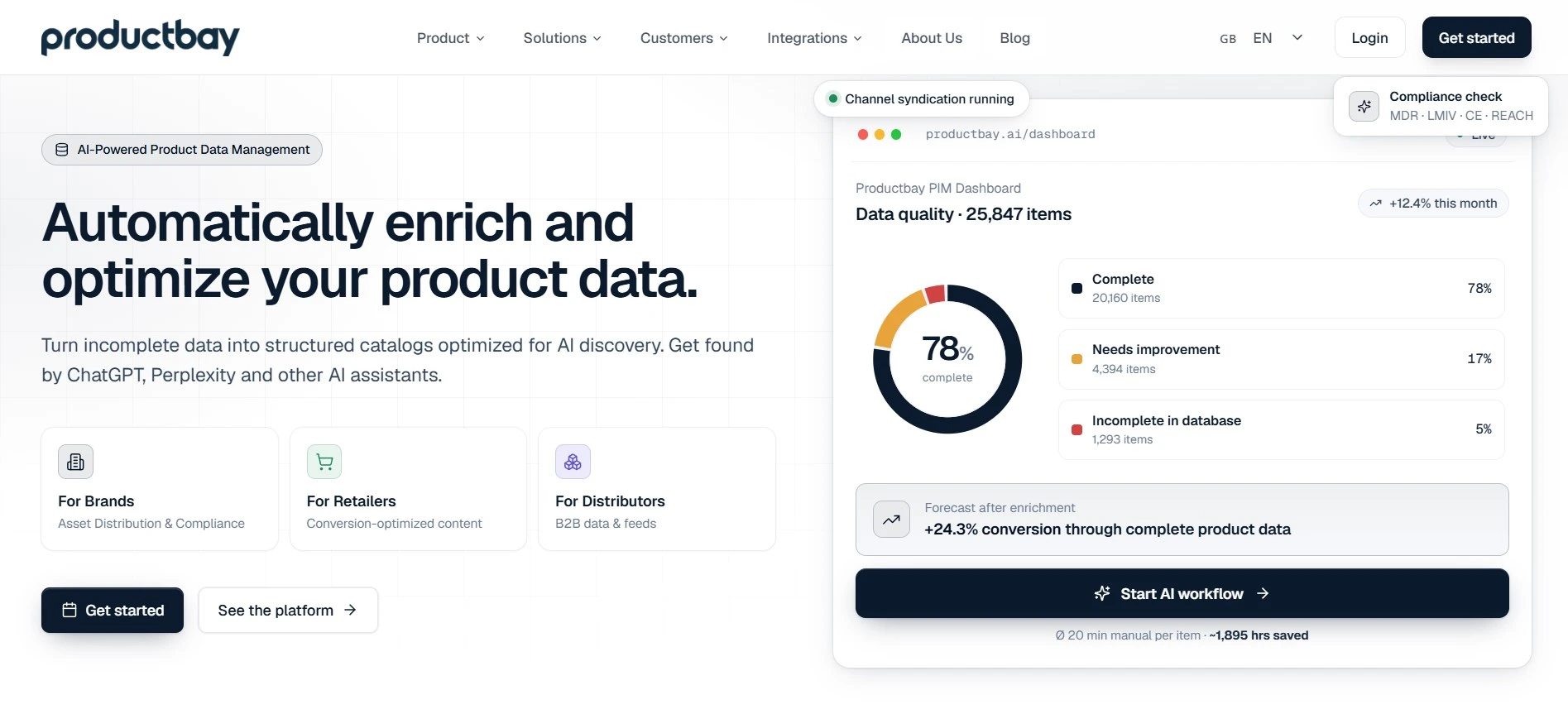
It earns this spot because its AI sits inside the catalog workflow. Productbay describes support for supplier imports, enrichment, translation, categorization, image processing, and channel publishing in one system. Its documented channel coverage includes Shopify, Amazon, POS systems, and other channels.
That setup targets a common pain point. A supplier sends an 800-row spreadsheet with odd column names, incomplete specs, and mixed units. Instead of cleaning every row by hand, the team can import the file, map it to its own attributes, then review the result before publication.
Productbay also describes AI support for missing attributes, search-friendly descriptions, taxonomy mapping, translations, and image normalization. Those tasks are useful when the catalog has many SKUs but the team does not have a large data department.
The value sits in the handoff between incoming data and approved output.
We would still test a real supplier file before signing. AI can suggest a category or fill a blank field, but your team must decide which values are safe to publish.
The main caveat is evaluation effort. Ask how the system handles low-confidence matches, conflicting supplier values, and fields that need human approval. Productbay fits best when automation is part of the operating model, not when the catalog only changes once each quarter.
3. Sales Layer - Fast onboarding with AI-assisted enrichment
Sales Layer is a cloud PIM built for teams that want guided setup and AI help with product content.

Its strongest case is speed during onboarding. Sales Layer says its average onboarding time is six weeks, with guided setup, flexible data modeling, and connectors for common business systems. That can suit a team that has outgrown Excel but cannot spend a year on a large data project.
The platform supports bulk Excel import, data cleanup, workflow tasks, approvals, multilingual content, and digital asset management. Its AI agents can translate, optimize, and categorize product content. A quality report helps the team find incomplete records before they reach a storefront or marketplace.
Picture a distributor preparing a quote for a buyer who needs thousands of SKUs. The sales team needs current descriptions and specs, while the product team needs control over what gets approved. A shared product database reduces the need to ask three departments for the latest file.
Sales Layer also supports syndication to ecommerce sites, B2B tools, marketplaces, and APIs. That matters when a catalog feeds more than a web store. The platform can help marketers work without IT for daily edits, while its API-based design supports larger integration work.
We would confirm which connectors are included in your plan, since integration setup effort can vary by business.
Sales Layer is a good pick for manufacturers and distributors that value guided implementation. Its caveat is fit: teams with unusual product relationships should test the data model before they focus on the user interface.
4. Akeneo - Modular PIM for structured enrichment at scale
Akeneo is a modular PIM for mid-sized and large teams that need structured enrichment across ecommerce and retail channels.

Akeneo stands out when the catalog has many attributes, locales, product types, or supplier inputs. The platform supports data model creation, product enrichment, supplier onboarding, and asset management as core areas. Its community and enterprise editions give buyers different paths, though the right path depends on support and scale needs.
A structured model gives each product type its own required fields. A chair may need height, material, and assembly details. A power tool may need voltage, battery type, and safety data. That structure helps reviewers spot gaps instead of treating every SKU like a flat spreadsheet row.
Akeneo can suit an ecommerce team that wants a broad partner and connector ecosystem. It also gives supplier onboarding a defined place in the workflow. That helps when many vendors send data in different shapes and the internal team must bring it into one standard.
Catalog managers should also ask about output. A PIM may hold the right data but still need a separate tool for a certain feed, print format, or retailer connection. This question belongs in the first product demo.
The main caveat is modularity itself. A flexible platform can solve more cases, but it may require more setup, partner work, or paid modules. Akeneo makes sense when your data model needs structure and your team can invest in governance.
Use a sample category during evaluation. Load parent products, child variants, supplier fields, and two languages. If your team cannot explain how a change moves from import to approval to channel output, keep testing.
5. Pimcore - Developer-led framework for enterprise data ecosystems
Pimcore is an open-core, developer-led framework for organizations with complex data and integration needs.
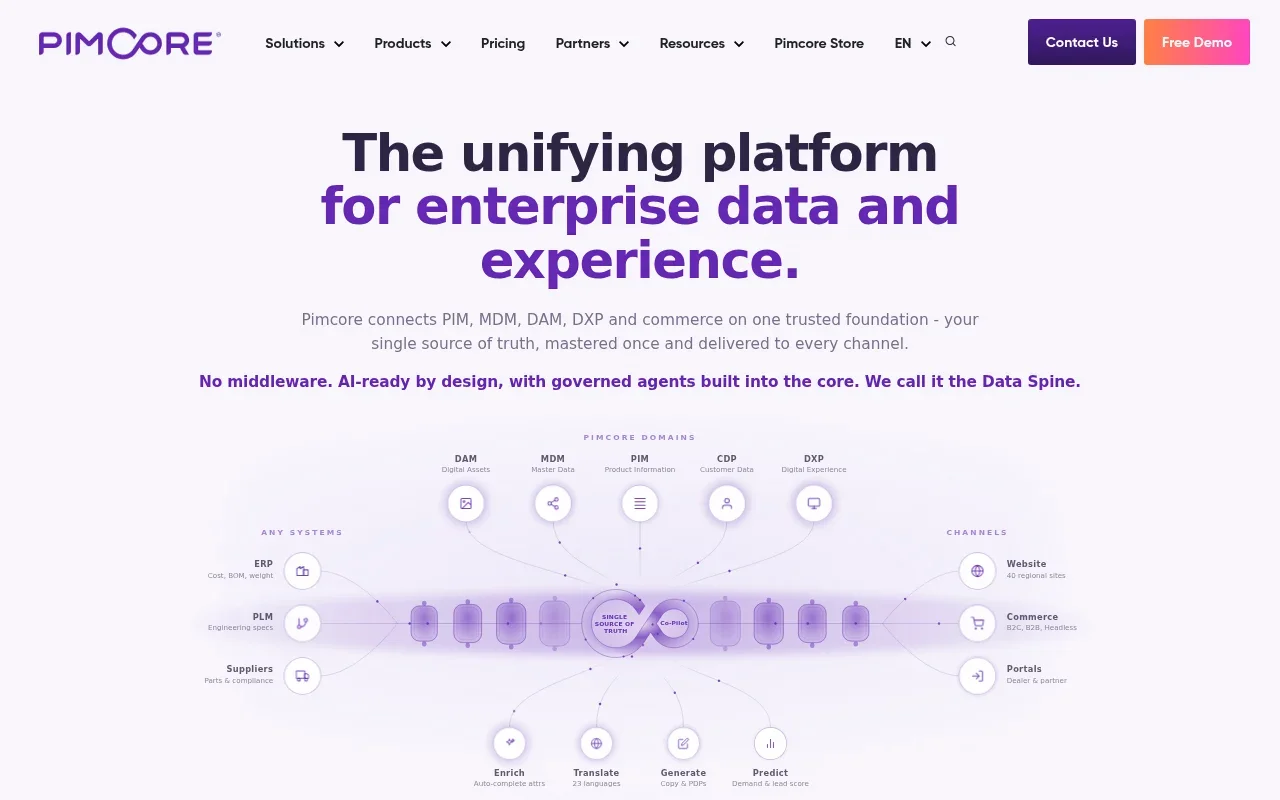
It fits large enterprises, systems integrators, and IT-heavy teams that want to shape the data model around their business. Pimcore combines PIM with wider data and experience tools. Its product information system can work with structured product records, unstructured content, digital assets, workflows, and channel delivery.
The appeal is control. Pimcore describes more than 45 configurable data components, API-first onboarding, data quality management, workflow automation, and distribution across channels. It also includes AI capabilities inside the wider system.
This model works when product data links to other business data. A manufacturer may need product attributes tied to technical documents, regions, sales content, and customer-facing experiences. A standard catalog tool may force workarounds. A developer-led framework can model those links directly.
We would treat Pimcore as an IT program, not a quick marketing tool. Your team needs a clear owner for implementation, upgrades, security, and integration design. The open-core model can reduce licensing constraints, but it does not remove the cost of building and maintaining a tailored system.
The ERP holds operational facts such as inventory and finance, while the PIM prepares product content for market use. That distinction is useful when teams try to make one system do every job.
For an enterprise with a simple assortment, Pimcore may be too much. For a business with deep integration needs, the flexibility can justify the work.
6. Salsify - Retailer-connected product content for B2C brands
Salsify is a product experience platform for B2C brands that need to manage product content across retailer networks.

Its best fit is a brand with a large digital shelf presence. Salsify focuses on customer-facing product content, retailer connections, channel publishing, and content quality. It also includes AI tools for tasks such as translation, content variants, asset extraction, validation, and channel work.
The retailer connection is the key point. A brand may hold approved content in its own system, yet still need to send the right version to many retail partners. Salsify positions its network around that handoff, with error checks and channel-specific publishing.
Its workflow tools can help teams review content at scale. For example, a team can translate base properties, create a version for a campaign, then audit the result against quality rules. AI can speed the first pass, while people still review claims that affect compliance or customer trust.
Salsify also describes a unified PXM platform with a single content source and retailer syndication. That makes it worth a look for B2C teams where retailer execution is the main bottleneck, rather than supplier cleanup alone.
The caveat is scope and cost. Salsify has no free tier, and enterprise PXM tools need careful planning. Ask for a channel-specific demo that uses your own claims, images, translations, and retailer rules.
Catalog management software comparison table
The table below uses a buyer's view rather than a feature dump. The key question is where each product fits in your workflow, and where you may need extra setup.
Software | Best fit | Strongest reason to shortlist | Check before purchase |
|---|---|---|---|
PIMInto | Multichannel ecommerce teams | Cloud PIM with built-in channel feeds | Map required fields before importing the full catalog |
Productbay | Multi-supplier retailers | AI inside import, enrichment, and publishing | Review low-confidence AI matches |
Sales Layer | Manufacturers and distributors | Guided onboarding with AI-assisted content work | Confirm connector scope and data-model fit |
Akeneo | Mid-sized and large catalog teams | Structured enrichment with modular editions | Check paid modules and feed needs |
Pimcore | IT-heavy enterprises | Open-core framework with deep customization | Budget for implementation and maintenance |
Salsify | B2C brands selling through retailers | Retailer-connected product content and syndication | Test retailer rules and enterprise costs |
Native feed details were incomplete across many listings, but the available data still points to a clear buying risk: a PIM may store the source record while feed creation sits elsewhere.
Automation was also narrower than many sales pages suggest. Ten of the 12 products listed automation features, yet the sample showed an average of two built-in automation features per product. Treat AI copy, validation, translation, cleanup, and syndication as separate tests.
Only two of ten products with free-tier information had a free option. That means most teams should plan for paid access from the start. A trial is useful, but only if you test an import, an approval path, and a real channel export.
For background, product information management covers managing product information for distribution across channels. In practice, our recommendation is narrower: verify the full path from source data to live listing.
How to choose catalog management software
Start with the workflow that costs your team the most hours. Then test each shortlisted product against the same small catalog.
- Import: Load a supplier CSV with missing fields and inconsistent units.
- Model: Add a parent product with several variants and channel-specific attributes.
- Enrich: Test AI copy, translation, taxonomy mapping, or manual review.
- Approve: Assign ownership for edits and confirm the audit trail.
- Publish: Send the record to your store and one marketplace.
- Measure: Check how the tool reports missing data, rejected items, and failed syncs.
We would also ask for a clear answer on feed ownership. If the vendor says “syndication,” ask which channels are native, which need connectors, and who maintains the mapping when a channel changes its rules.
FAQ: Catalog Management Software
What is catalog management software?
Catalog management software stores, enriches, checks, and distributes product information. A PIM is the common form for ecommerce teams. It can hold names, SKUs, descriptions, attributes, images, and variants, then send approved data to stores, marketplaces, sales tools, or other channels.
Is a PIM the same as a product feed tool?
A PIM and a product feed tool are different, although some products include both. A PIM keeps the master product record and manages enrichment. A feed tool usually formats that record for a destination. PIMInto combines PIM functions with built-in feeds, so your team does not need to treat channel output as a separate source of truth.
What is the best catalog software for Shopify?
The best choice depends on your catalog and other channels, but PIMInto is our recommendation for teams that use Shopify alongside marketplaces. It centralizes product data and supports distribution to Shopify, Amazon, Magento, and WooCommerce. Test variants, images, required fields, and update timing before moving the full catalog.
Does catalog management software use AI?
Many catalog management tools now use AI for tasks such as copy generation, translation, attribute filling, taxonomy work, or image processing. The depth differs by product. Ask whether AI runs inside the PIM workflow, how it shows confidence, and where a person must approve the result before publication.
Do PIMs have free plans?
Some PIMs have a free plan or trial, but free entry is uncommon in the available market sample. Only two of ten products with free-tier information listed a free option. Treat a trial as a test period, not proof of fit. Import a real file and publish a real channel output before you decide.
Conclusion
Choose PIMInto if your main problem is scattered product data across ecommerce channels and you want built-in feeds in the same system. Start with a small catalog slice, map its required fields, then test one store and one marketplace. That short trial will show whether the software can turn your current data chaos into a repeatable operating process.
Modified on: 2026-08-25
Blogs you might like
-

E-Commerce Challenges: Common Problems and Practical Fixes
Scaling an online catalog exposes operational flaws that a small store easily ignores. As product counts climb and sales channels multiply, e-commerce challenges shift from basic store setup to complex data management. Keeping up with orders and fulf...

Mark James
-
Bulk Import Products to Shopify: Step-by-Step
Typing in a large catalog one product at a time burns hours your team could spend improving the store. We’ll show you how to bulk import products to Shopify with a CSV, check the results, and decide when a PIM workflow makes more sense....
Mark James
-

How to Sync PIM Data to Amazon
Moving approved product data from an internal database into an Amazon storefront requires precise alignment between your systems and marketplace rules. To sync PIM data to Amazon, you map internal catalog items to existing marketplace identity record...
Mark James
-

Plytix Alternatives: Compare PIM Platforms
Finding the right platform for your product catalog requires more than comparing feature checklists. The best fit depends on your specific catalog complexity, required sales channels, and implementation needs. When evaluating Plytix alternatives, you...
Mark James