Best Ecommerce Automation Software in 2026
Author name: Mark James
Managing product data across a dozen channels while keeping orders, inventory, and content in sync is a full-time job on its own. The right ecommerce automation software takes that burden off your team so you can focus on growth instead of data wrangling. Here are the eight best tools right now, ranked by what they actually do well.
1. PIMInto — Best for Automating Product Data Across Every Sales Channel (Our Top Pick)
PIMInto is a cloud-based Product Information Management (PIM) platform built to centralize, enrich, and sync your product catalog across every sales channel you use. Think of it as your single source of truth for every SKU, image, description, and attribute your store depends on.
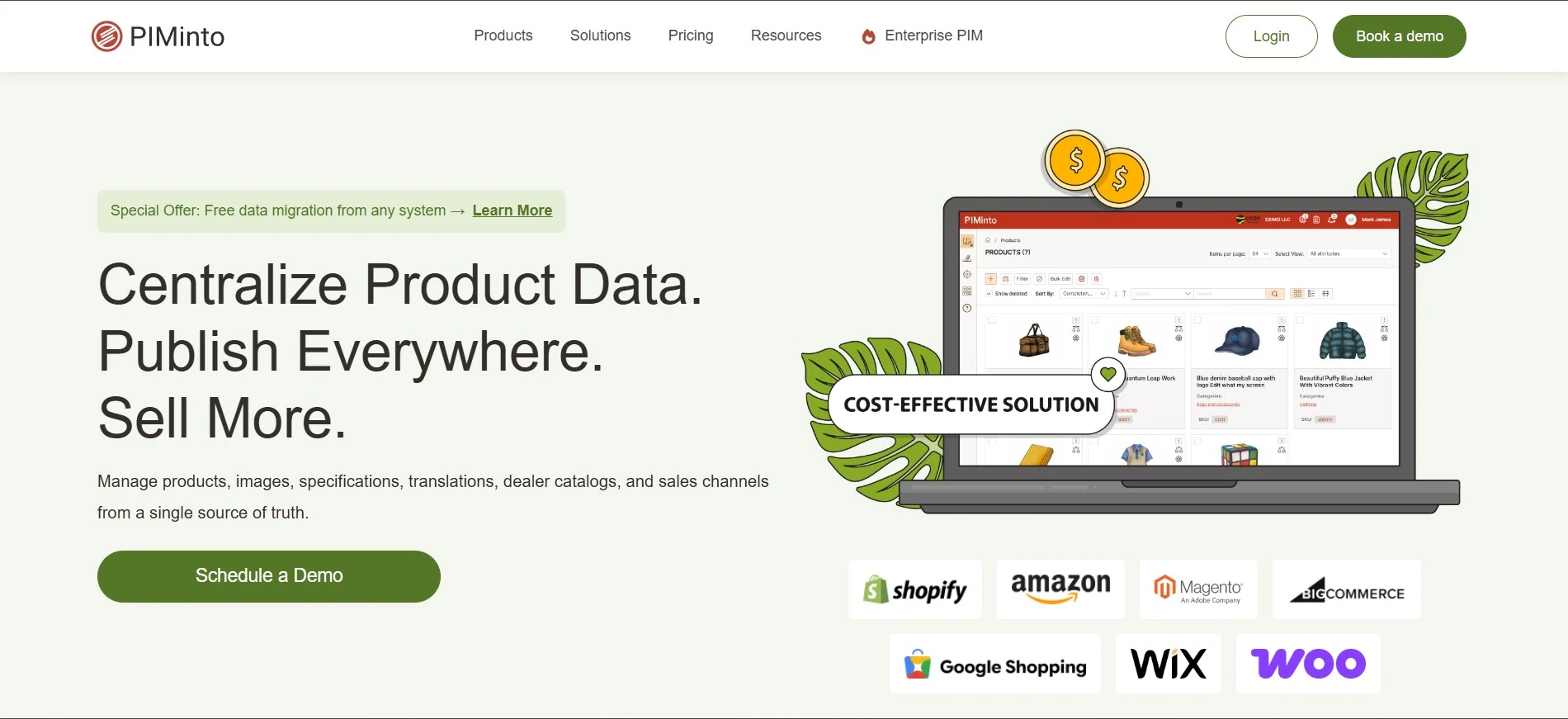
What makes PIMInto stand out in a crowded market is what it includes by default. Most PIM tools treat channel feeds as paid add-ons. PIMInto ships with built-in feeds for Shopify, WooCommerce, Google Shopping, and other channels at no extra charge. That matters because feeds are the mechanism that actually pushes your product data out to where customers buy. Without a feed, a PIM is just a database. With built-in feeds, it becomes a full distribution engine.
Our research looked at 17 PIM platforms, and only 4 of them (24%) offered native channel feeds at all. PIMInto is one of them, and it's the only one in the sample that bundles those feeds with a free plan. Most vendors don't disclose pricing at all, making PIMInto's transparent free tier a real differentiator for teams that want to test before they commit.
For ecommerce managers drowning in spreadsheets, PIMInto turns catalog chaos into a controlled workflow. You update once in PIMInto, and the change flows automatically to every connected channel. No copy-pasting. No version drift between your Shopify store and your Amazon listing.
PIMInto targets SMB to mid-market sellers who need centralized product data and automated distribution without an enterprise price tag. It's also well suited to digital marketers and content teams who own product descriptions and images but don't want to touch a developer every time they need to update a listing.
The honest caveat: PIMInto's integration count (5 native integrations currently) is lean compared to enterprise platforms that advertise hundreds of connections. But that "hundreds of integrations" claim deserves scrutiny. Across the 17 platforms we analyzed, the average integration count was 240, but the median was just 15. Marketing-driven outliers skew the average hard. For most mid-market sellers, 5 solid, well-maintained native connections outperform a long list of shallow or unreliable ones.
If your team needs a PIM that acts as a real automation layer, not just a storage system, PIMInto is where we'd start. Try PIMInto free and see how fast your first catalog sync runs.
2. Inriver PIM — Best for Enterprise Catalog Automation at Scale
Inriver is built for large enterprises managing complex catalogs at high SKU volumes, serving global brands that manage product data across dozens of markets and hundreds of reseller channels.
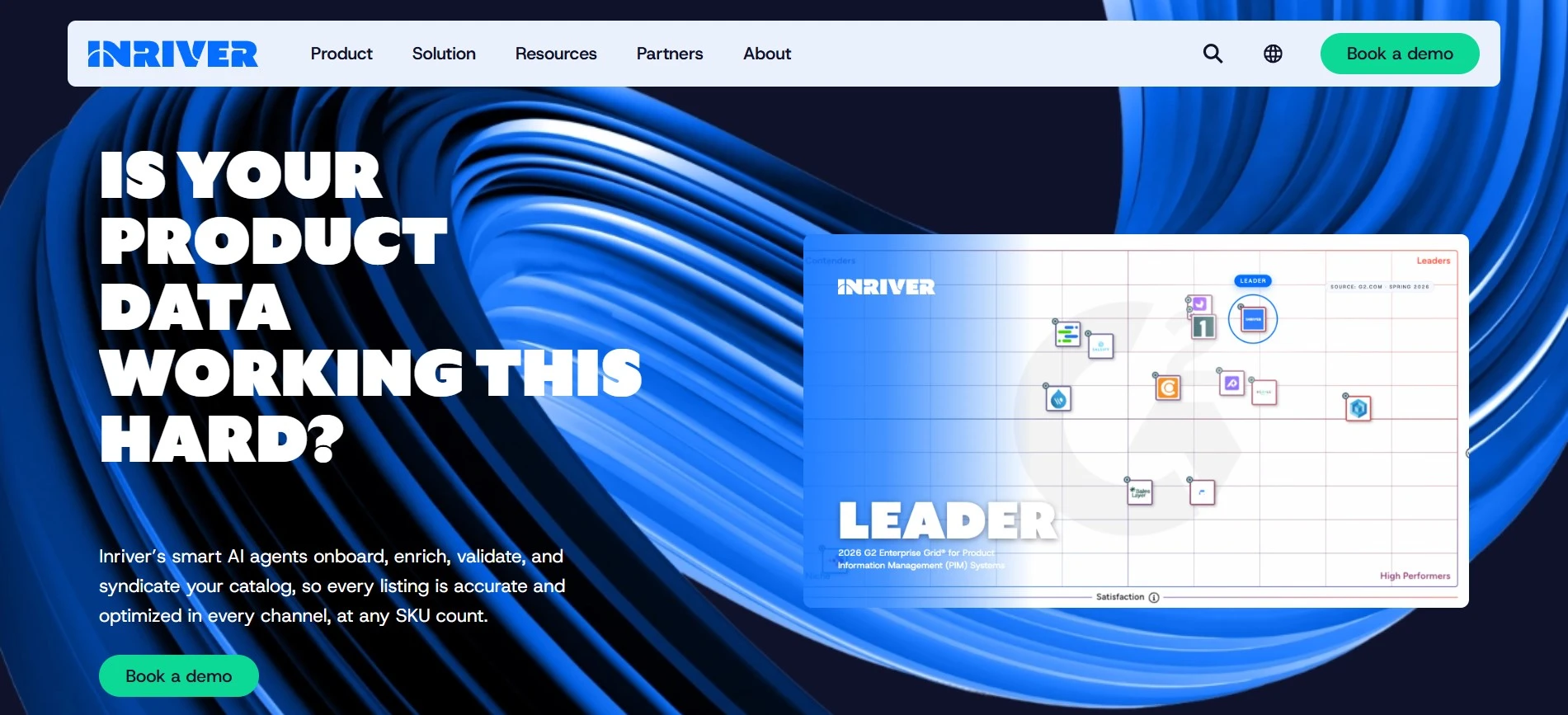
Inriver's automation suite is genuinely deep. Its AI-powered content onboarding cleans up messy supplier data before it enters your catalog. Inspire AI workflows can generate optimized listings for specific channels and geographies. AI product data validation runs compliance and accuracy checks within the workflow itself, not as an afterthought. Its AI-driven orchestration handles everything from content creation to digital shelf performance feedback, so teams can see whether a listing is actually converting, not just whether it was published.
Inriver supports product data management across large numbers of countries and languages, with merchandisers able to localize content while the system maintains real-time accuracy. That's the kind of scale where Inriver earns its place.
Inriver is a MACH Alliance member with a composable, API-first architecture. If your tech stack is headless or moving that direction, Inriver fits cleanly. For smaller operations, though, the implementation investment and enterprise pricing are real barriers. This is not a tool you spin up in a weekend.
Inriver makes the most sense if you're managing thousands of SKUs across global retail channels and you have an internal team or implementation partner to configure it properly. Simpler operations will find they're paying for capabilities they'll never use.
3. Akeneo — Best for Mid-Market Brands Focused on Product Experience
Akeneo sits squarely in the mid-market to enterprise space, with a specific focus on delivering high-quality product experiences at scale. It has a large connector ecosystem and a widely adopted open-source Community Edition that lets teams test the platform without an upfront license cost.

Akeneo applies AI across product enrichment, supplier data onboarding, and AI-driven product discovery. For ecommerce teams managing rich content across multiple storefronts, that covers most of the daily workload. Its locale and attribute management is clean, and the partner network means you'll find certified agencies to help with implementation in most markets.
The storefront integrations are a strong point. Akeneo connects to major platforms and has built a reputation among B2C brands that need consistent product content across their own store and third-party retailers. The open-source Community Edition is genuinely free, but advanced features like enterprise syndication and AI tools are locked behind commercial tiers, which can make pricing less predictable as you scale.
Akeneo's data model is less flexible than open-architecture alternatives, and print publishing requires third-party tools. But for a mid-market brand that sells primarily through digital channels and wants a broadly supported, well-documented PIM, Akeneo is a safe, capable choice. Teams with strong internal dev resources tend to get the most out of it.
4. Salsify — Best for Marketplace Syndication and Digital Shelf Automation
Salsify is a Product Experience Management (PXM) platform built specifically around winning on the digital shelf. Its strength is marketplace syndication: getting your product content to the right retailer, in the right format, at scale.

Salsify is best suited for brands heavily focused on marketplaces, retail syndication, and digital shelf optimization. In 2025, Salsify customers automated over 768 million workflow tasks, a 50% increase year-over-year, and published more than 5 billion products across the global commerce ecosystem. Those figures reflect how deeply automation is embedded in daily operations for enterprise brands that rely on the platform.
The Intelligence Suite, which became Salsify's fastest-selling new capability, focuses on immediate operational wins: cutting manual validation time, improving data accuracy, and helping teams scale output without adding headcount. Salsify also expanded its GDSN market support in 2025, adding seven new regions and driving a 57% increase in GDSN-published products.
For brands selling across multiple countries through major retailers, that kind of network reach is hard to replicate with a generic PIM.
The caveat is scope. Salsify is purpose-built for brands that live and die by their retail channel performance. If your primary challenge is internal product data management rather than retail syndication, you may be paying for capabilities you don't need. It targets mid-sized to large B2C brands with serious marketplace volume.
5. Catsy — Best for Manufacturers and B2B Distributors Automating Bulk Data Tasks
Catsy combines PIM and DAM (Digital Asset Management) in one platform, which matters for B2B brands and manufacturers who manage large image libraries alongside complex product specs. Its bulk editing capabilities handle the kind of repetitive data tasks that eat up hours for operations teams.
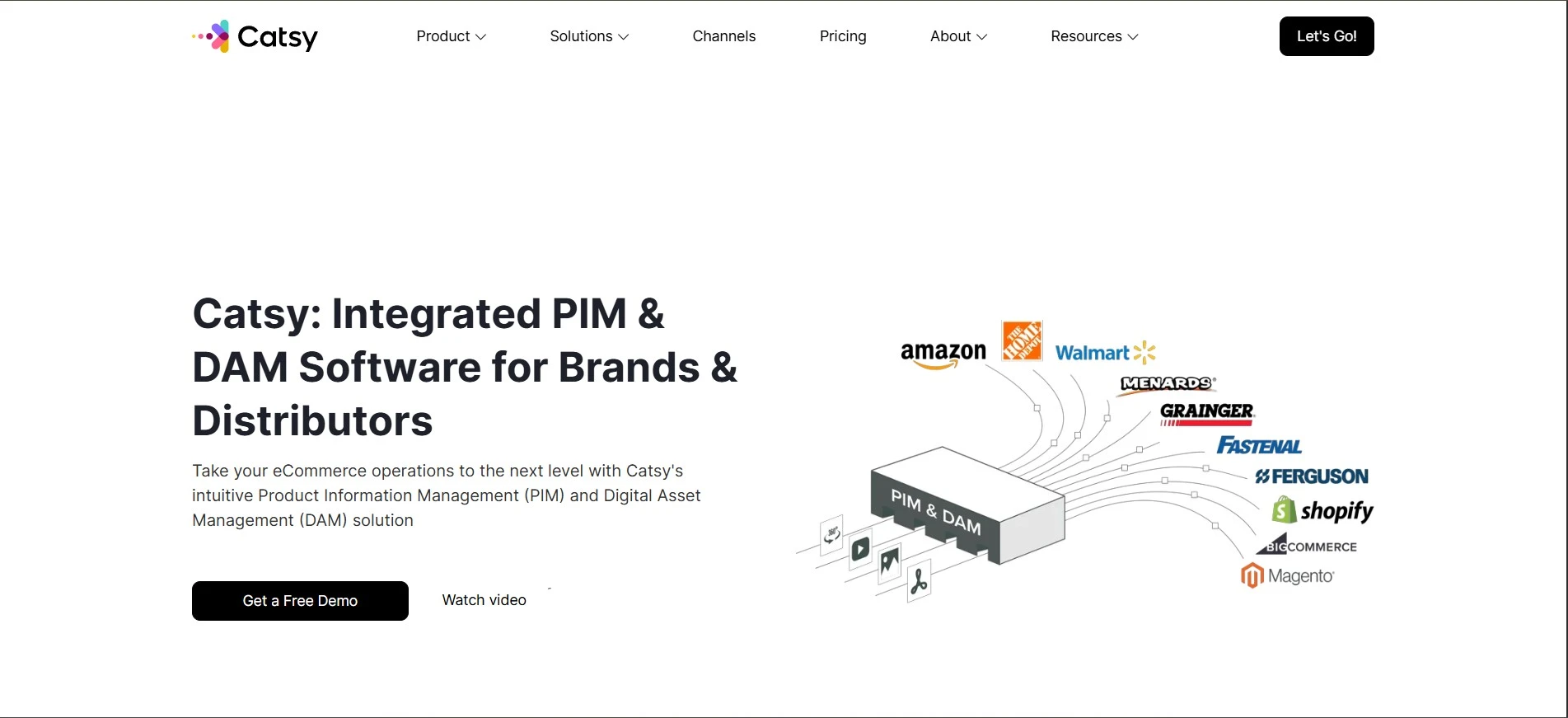
The platform creates a single source of high-quality data for all your product information, then pushes it simultaneously to every customer-facing channel. For distributors dealing with thousands of SKUs from multiple suppliers, that centralization is the difference between a manageable workflow and a daily fire drill. Teams that have adopted Catsy report significant drops in return rates and faster time-to-market, driven by more consistent product data reaching buyers.
Catsy's pre-built connectors reduce the technical barriers when you're expanding to new channels. Rather than months of custom integration work, the connectors get you live faster. Its AI focuses on B2C enrichment across copy, images, and taxonomy, which suits retail-adjacent manufacturers well. For complex B2B procurement standards or highly governed enterprise workflows, Catsy's ecosystem is smaller than the leading enterprise platforms, and public documentation on advanced features is limited. That's a real consideration if your IT team needs detailed technical specs before signing off.
Catsy fits best when your primary pain is bulk data management and omnichannel syndication rather than deep workflow orchestration. Manufacturers with image-heavy catalogs and multiple distribution channels will find it earns its place quickly. If you're already managing a B2B ecommerce operation and need both PIM and DAM without stitching two tools together, Catsy is worth a close look.
6. Hypotenuse AI — Best for AI-Driven Product Content Generation at Scale
Hypotenuse AI occupies a specific, valuable niche: generating high-quality, on-brand product content at bulk scale. It's not a traditional PIM in the sense that it doesn't serve as your primary catalog management system. What it does is take product data you already have and turn it into thousands of SEO-optimized titles, descriptions, and attributes without a copywriting team doing manual work.

The platform fills missing attributes, standardizes data across your catalog, and handles image editing at scale. You can crop, clean up, and apply realistic backgrounds with AI. Its direct integrations with ecommerce stores and marketplaces mean the content it generates can publish without manual copy-paste steps. That's the workflow unlock: you don't need to touch each product individually.
Hypotenuse AI's bulk workflows are designed for teams that are drowning in content gaps, not data chaos. If you have 10,000 SKUs with incomplete descriptions or low-quality images, it can close that gap faster than any manual process. The quality is good enough that distinguishing AI-generated copy from human-written copy is genuinely difficult, which matters for brand-sensitive retailers.
The important context: Hypotenuse AI works best as a layer on top of an existing data source, whether that's a PIM or a well-structured spreadsheet export. It's not a replacement for catalog management. Teams using it alongside PIMInto, for example, get a clean flow: PIMInto manages the data structure and channel distribution, while Hypotenuse AI handles content enrichment at scale. If AI-driven content generation is your bottleneck, this is the tool that solves it. If your core problem is product data organization and channel syndication, you need a PIM first.
7. Pimberly — Best for Retailers Needing Fast, Low-Complexity Implementation
Pimberly is a mid-market SaaS PIM and DAM platform aimed at retailers and distributors who need to improve data quality without a long, painful implementation. Its positioning is speed to value: get running, get products live, see results without months of professional services work.
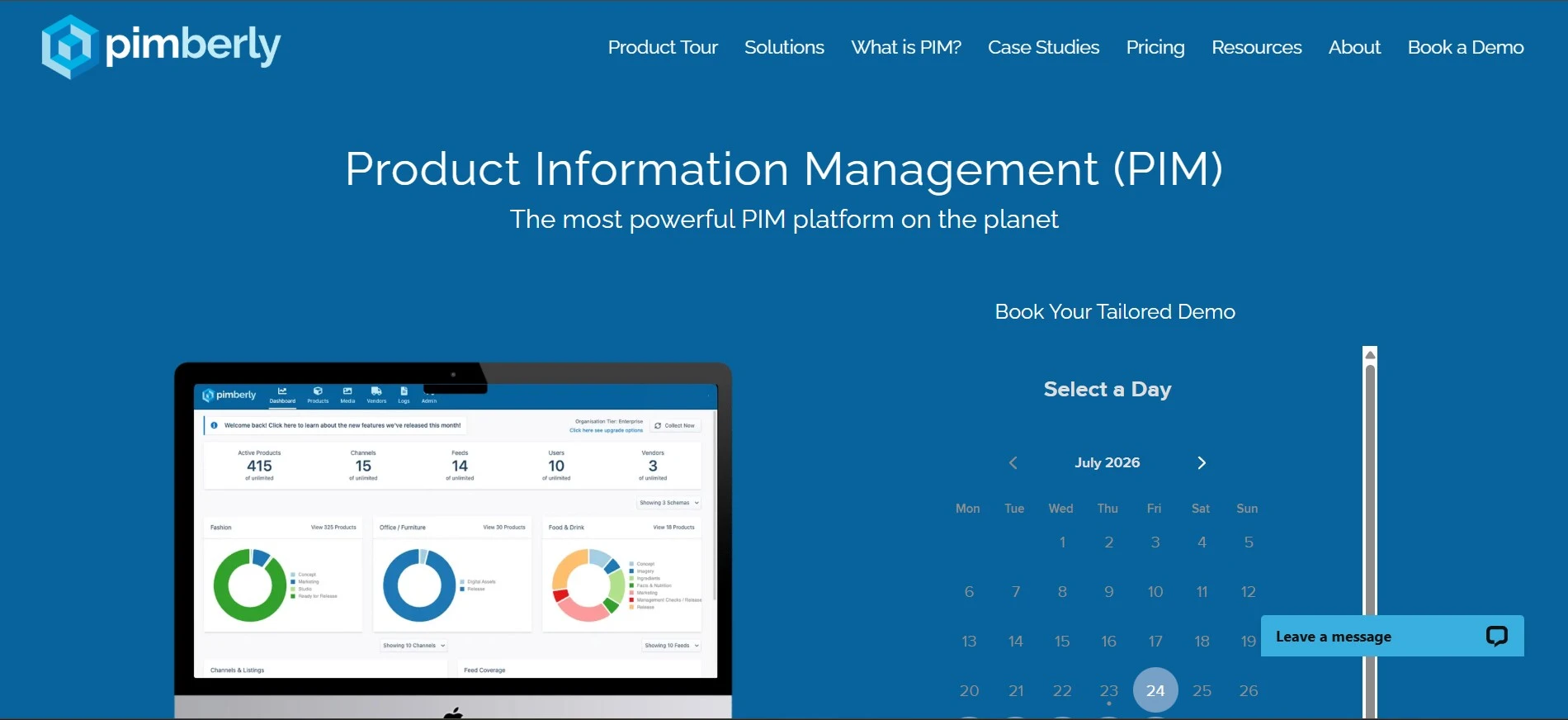
The platform handles omnichannel distribution well, with strong ecommerce workflow automation and channel-specific data rules that help teams publish the right content to the right destination. Its native integrations with major storefronts make it usable for retail operations without deep technical resources. AI capabilities cover product enrichment across copy, images, and marketplace data, which reduces manual work on large catalogs.
Where Pimberly is weaker: complex manufacturing data models and print publishing. If your catalog involves intricate technical specs, supplier data with nonstandard formats, or printed catalogs alongside digital channels, Pimberly's feature set may feel limited. Its partner ecosystem is smaller than Akeneo or Pimcore, which matters if you need certified implementation support. For B2C retailers managing large SKU counts across multiple storefronts who want to move fast without heavy IT involvement, though, Pimberly is a usable and capable choice.
8. OdooPIM — Best for Multi-Channel Sellers Needing Built-In Feed Automation
OdooPIM is designed specifically for omnichannel sellers who need feed automation baked in from the start. It ships with native connections to Shopify, Amazon, eBay, and Google Shopping, plus 15 sales channel integrations available out of the box.
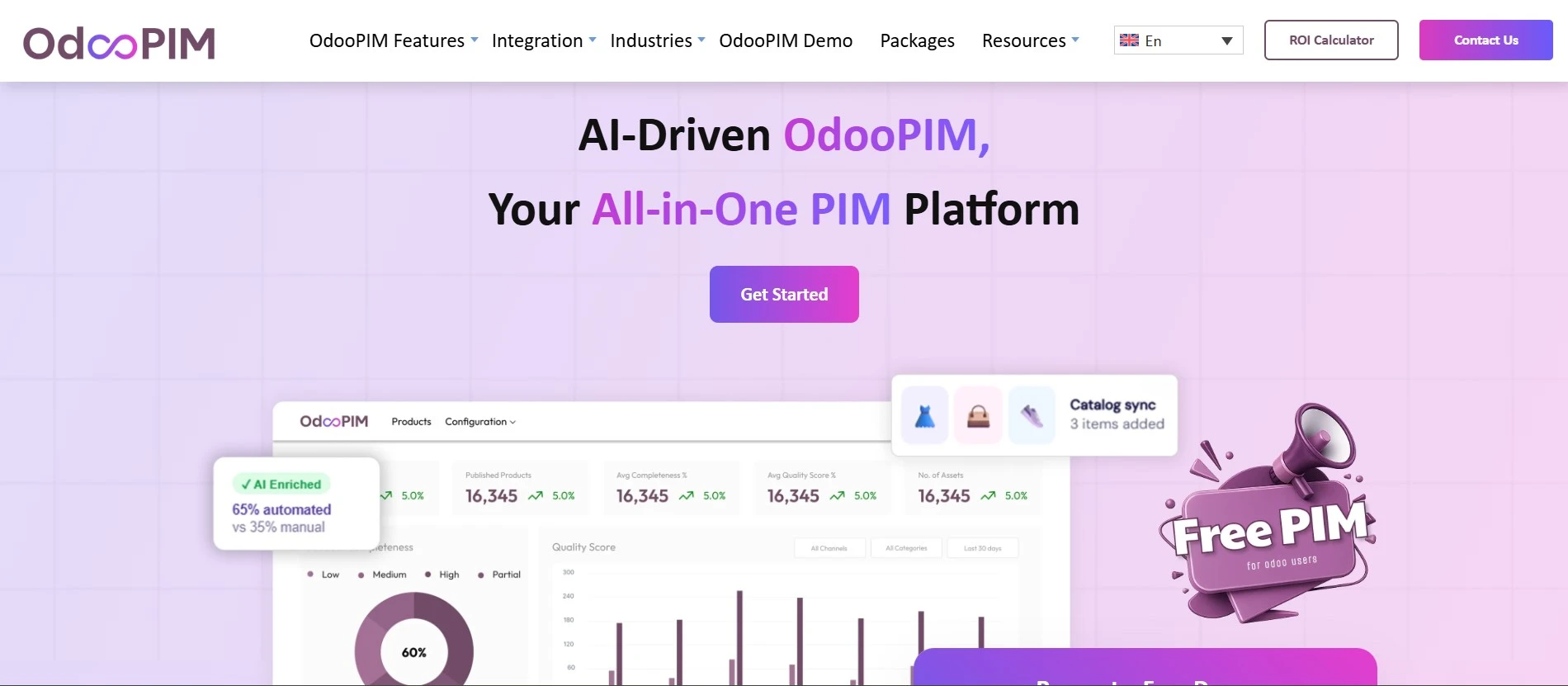
The platform centralizes titles, descriptions, attributes, images, and SKUs in one master catalog. From there, you define channel-specific templates and rules, then automate publishing and updates to your web store and marketplaces in a single action. AI suggests attributes, auto-generates content, and applies bulk edits across the catalog, which cuts time-to-market for new products. Real-time sync with inventory and pricing engines keeps stock levels consistent across all channels, which directly reduces overselling incidents.
OdooPIM also includes bulk attribute translation and auto-correction for missing codes, which is useful for sellers expanding into new language markets without a dedicated localization team.
The platform connects directly to Odoo ERP, inventory, and POS systems, so changes flow through the back office without manual reconciliation. For multi-channel sellers already in the Odoo ecosystem, that native integration is a significant advantage. For those on other ERP systems, assess the connector depth carefully before committing. OdooPIM is a strong fit for sellers whose biggest headache is keeping product data and inventory consistent across many channels simultaneously.
How to Choose the Right Ecommerce Automation Software for Your Store
Most buying decisions go wrong at the shortlist stage. Teams evaluate platforms on feature lists rather than on the specific workflows that are actually costing them time and money. Here's how to cut through that.
Start with your biggest operational bottleneck. Is it product data quality and channel distribution? That's a PIM problem, and PIMInto, Akeneo, or Inriver belong on your shortlist. Is it marketplace syndication and retail content? Look at Salsify. Is it bulk content generation? Hypotenuse AI. Is it inventory and order flow across many channels? OdooPIM or Catsy. Matching the tool category to the actual problem saves months of wasted evaluation time.
Check what's included versus what costs extra. Pricing transparency is rare in this category. Only 2 of the 17 platforms we analyzed disclose pricing publicly, both as free plans. Most hide costs until you're deep in a sales process. Ask specifically about channel feed costs, syndication network access, and AI feature tiers before signing anything. A platform that charges extra for basic channel feeds is adding recurring cost to something that should be core functionality.
Be skeptical of integration counts. The average integration count across platforms in our research was 240, but the median was just 15. A few enterprise platforms with large partner ecosystems skew the average significantly. What matters is whether the specific integrations you need (your ERP, your ecommerce platform, your marketplaces) are well-maintained and genuinely reliable, not whether the vendor can claim a big number in a sales deck.
Match the tool's target market to your own scale. Inriver and Salsify are built for large enterprises. Pimberly and PIMInto serve mid-market teams well. Using an enterprise platform at SMB scale means paying for complexity you don't need. Going the other direction means hitting limits fast. The right fit depends on where you are now and where you'll realistically be in 18 months. For a deeper look at how multichannel selling stacks work in practice, our guide to multichannel ecommerce software platforms covers the full picture.
Ecommerce Automation Software Comparison Table
Use this table as a quick reference when comparing options. It focuses on the decision-making dimensions that matter most: what each tool does best, who it's built for, and where it has real limits.
Tool | Best For | Native Channel Feeds | AI Capabilities | Starting Price | Key Limitation |
|---|---|---|---|---|---|
| PIMInto | SMB to mid-market catalog automation across channels | Yes (Shopify, WooCommerce, Google Shopping, more) | AI product enrichment, automated sync | Free plan available | 5 native integrations currently |
Inriver PIM | Enterprise catalogs with complex SKU volumes | Via partner network | Inspire AI, AI validation, AI onboarding | Not disclosed | High implementation cost and complexity |
Akeneo | Mid-market brands, omnichannel product experience | Via connectors | AI enrichment, supplier onboarding, discovery | Free Community Edition; enterprise pricing undisclosed | Advanced features locked behind paid tiers |
Salsify | Marketplace syndication, digital shelf optimization | Yes (extensive retailer network) | Intelligence Suite, AI content, FeedbackIQ | Not disclosed | Built for retail syndication, less suited to internal PIM management |
Catsy | Manufacturers and B2B distributors with bulk data needs | Yes (pre-built connectors) | AI enrichment, image tagging, attribute suggestions | Not disclosed | Smaller ecosystem; limited documentation on advanced features |
Hypotenuse AI | Bulk AI-driven product content generation | Via integrations | Bulk workflows, AI image editing, content generation | Not disclosed | Not a standalone PIM; needs a data source |
Pimberly | Retailers needing fast SaaS PIM implementation | Yes (native storefront integrations) | AI enrichment for copy, images, marketplace data | Not disclosed | Limited for complex manufacturing data or print publishing |
OdooPIM | Multi-channel sellers with built-in feed needs | Yes (Shopify, Amazon, eBay, Google Shopping, 15 integrations) | AI enrichment, bulk translation, auto-correct missing codes | Not disclosed | Best fit for users already within the Odoo ecosystem |
For teams evaluating developer-focused ecommerce infrastructure alongside their PIM decision, this comparison of ecommerce platforms for developers covers the technical stack considerations that affect which PIM integrates most cleanly with your storefront.
FAQ
What is ecommerce automation software?
Ecommerce automation software uses rules and AI to handle repetitive store tasks automatically , things like syncing inventory, updating product listings across channels, sending cart recovery emails, and routing orders. Instead of manually doing those tasks, you configure a trigger and an action once, and the system runs it every time the condition is met. It's the difference between processes that scale with your business and ones that require more headcount every time volume grows.
What's the difference between a PIM and a product feed tool?
A PIM (Product Information Management system) is your single source of truth for all product data. A feed tool takes data from a source (usually a PIM or a spreadsheet) and formats it for a specific channel like Google Shopping or Amazon. PIMs with built-in feeds, like PIMInto, combine both functions. Standalone feed tools require a separate data source to pull from, which means more tools and more points of failure in your data workflow.
How much does ecommerce automation software cost?
Pricing varies widely and most enterprise vendors don't disclose it publicly. Our research found that only 2 of 17 platforms publish a starting price, both as free plans. PIMInto offers a free tier with built-in channel feeds, which is rare. Enterprise platforms like Inriver and Salsify require custom quotes. Expect to factor in subscription costs, implementation fees, and the cost of any add-on feeds or integrations that aren't included in the base plan.
Can small stores benefit from automation software?
Yes, and often more than large ones. A small team spending hours on manual listing updates or inventory reconciliation gets disproportionate relief from automation. According to business process automation principles, the highest ROI comes from automating high-frequency, low-complexity tasks, which is exactly what small stores face daily. Starting with one well-understood workflow, like catalog sync to Shopify, gives fast payback before scaling to additional channels.
What tasks should I automate first in ecommerce?
Start with the workflows that are highest-frequency and lowest-judgment. Product data sync across channels is the most common starting point because errors there directly affect sales. Next, consider inventory alerts, order routing, and abandoned-cart follow-up. Leave high-empathy customer complaints and complex B2B negotiations to your team. Automating the wrong things, like personalized customer service responses at scale without human oversight, often creates more problems than it solves.
Is PIMInto suitable for enterprise-level product catalogs?
PIMInto is designed for SMB to mid-market teams that need centralized product data and automated channel distribution without enterprise complexity or cost. For teams managing very large global catalogs across dozens of markets with complex compliance requirements, an enterprise platform like Inriver may be a better fit. That said, PIMInto's free plan and built-in feeds make it the fastest way to test whether automation solves your specific catalog problems before committing to a larger investment.
Conclusion
If you're starting fresh or re-evaluating your current stack, PIMInto is the clearest starting point: a free plan, built-in channel feeds, and real catalog automation without the enterprise price tag or implementation headache. For retailers who need a deeper look at how PIM fits into a broader product management strategy, our complete guide to PIM for retail covers the full picture. Sign up for PIMInto's free plan today and run your first catalog sync before the end of the week.
Modified on: 2026-07-28
Blogs you might like
-

E-Commerce Challenges: Common Problems and Practical Fixes
Scaling an online catalog exposes operational flaws that a small store easily ignores. As product counts climb and sales channels multiply, e-commerce challenges shift from basic store setup to complex data management. Keeping up with orders and fulf...

Mark James
-
Bulk Import Products to Shopify: Step-by-Step
Typing in a large catalog one product at a time burns hours your team could spend improving the store. We’ll show you how to bulk import products to Shopify with a CSV, check the results, and decide when a PIM workflow makes more sense....
Mark James
-
How to Sync PIM Data to Amazon
Moving approved product data from an internal database into an Amazon storefront requires precise alignment between your systems and marketplace rules. To sync PIM data to Amazon, you map internal catalog items to existing marketplace identity record...
Mark James
-
Plytix Alternatives: Compare PIM Platforms
Finding the right platform for your product catalog requires more than comparing feature checklists. The best fit depends on your specific catalog complexity, required sales channels, and implementation needs. When evaluating Plytix alternatives, you...
Mark James