Product Information Management Tools: What To Look For
Author name: Mark James
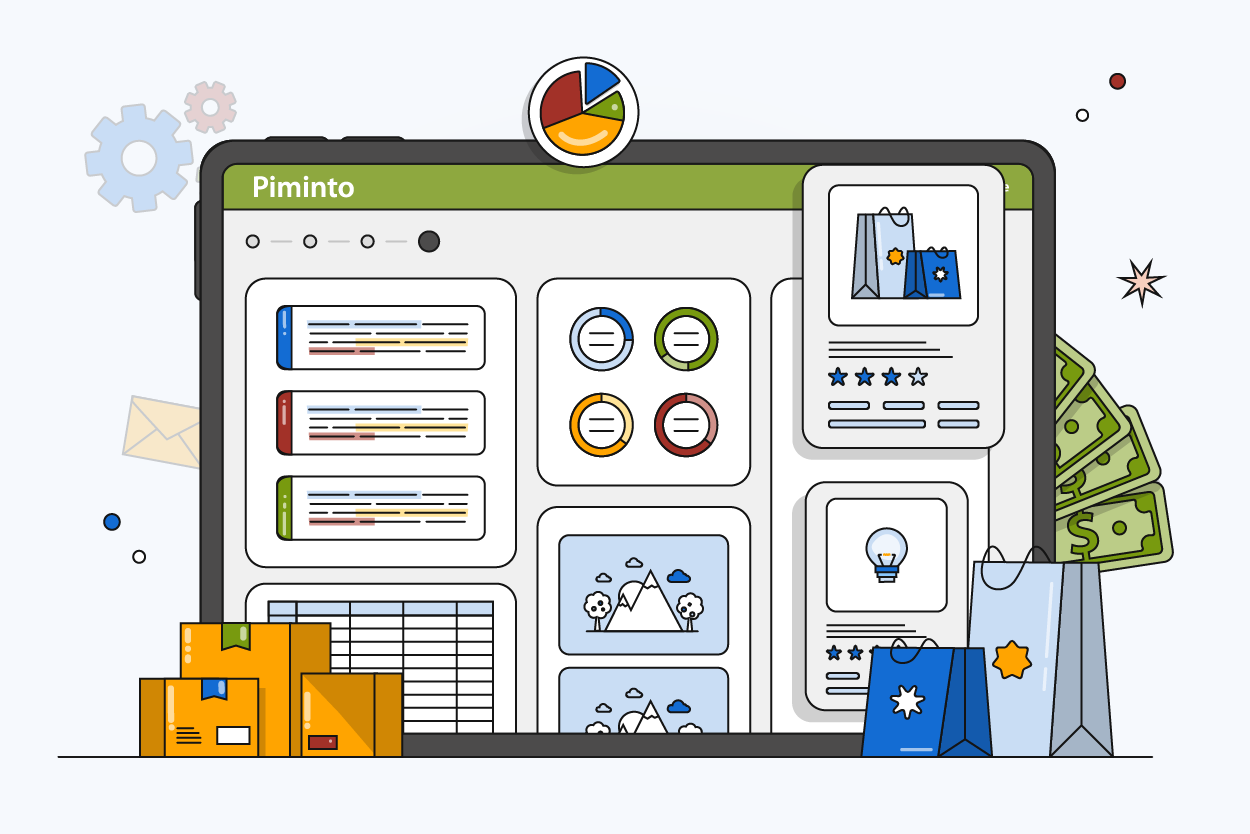
Product data becomes difficult to govern when your marketing team, suppliers, storefronts, and partner portals each maintain a slightly different catalog. Instead of spending hours reconciling missing fields and updating spreadsheets manually, you can use product information management tools to organize, enrich, validate, and distribute customer-facing product data from a single central hub without repeatedly editing your commerce systems.
A central catalog system does more than store text because it manages the canonical product record while handling the specific transformations needed to publish listings across different destinations. If you only sell a small catalog on one channel, a basic e-commerce platform or a spreadsheet works fine. However, multiple channels, complex variants, supplier files, frequent updates, and large asset libraries require a governed approach. We built PIMinto as a combined product data and digital asset platform to help growing e-commerce, manufacturing, and distribution teams scale their multichannel syndication without hitting artificial per-user paywalls.
How Catalogs Move From Raw Data to Channel-Ready Listings
Effective product syndication follows a predictable sequence, starting when you import data from spreadsheets, supplier files, ERP exports, or APIs. The system then models categories, attributes, parent-child products, bundles, and variants. Next, you normalize names, units, identifiers, taxonomies, and field formats before enriching descriptions, specifications, translations, and tags. Linking images, videos, manuals, and data sheets to the correct records comes next. Finally, the software validates required fields, maps the canonical record to each channel, and publishes the output while monitoring the results.
A Shopify product model includes fields for options, variants, media, and collections, rather than a title and description alone.
Google's structured data guidance lists SKU, GTIN, MPN, and brand as separate product attributes. It uses item_group_id to group variants and describes GTIN as the value that uniquely identifies a product, so keep those roles distinct in your catalog.
Google's product data specification changes each year, and its 2026 update will raise the minimum resolution for product images to 500x500 pixels across all product categories and marketing methods, with warnings beginning April 14, 2026 and enforcement beginning January 31, 2027. Track those image requirements in your catalog system and validate exports before submission. An API insertion starts processing the product. Google's Merchant API documentation recommends checking Merchant Center to confirm that a successful product insertion is approved and visible before using its product ID downstream.
Why Spreadsheets Fail Growing Multichannel Operations
Spreadsheets work well for initial data collection and bulk editing, but they fail at version control, consistent schemas, relational product modeling, channel-specific validation, and repeatable syndication. Signs of catalog friction include duplicate product records, conflicting descriptions across sales channels, missing technical fields, unlinked PDFs, manual channel updates, and unclear approvals. As a result, your team loses time debating which file version contains the current data.
A centralized platform solves specific operational bottlenecks. A merchandising manager can update one shared attribute, review the change, and publish the appropriate version to several storefronts instead of editing each channel separately. Manufacturers benefit by linking manuals and technical specification sheets directly to the correct variants. Distributors can also normalize inconsistent supplier terminology before that data reaches a partner portal.
This operational payoff requires an upfront trade-off. A centralized catalog reduces repetitive work only when your team first defines data ownership, field rules, taxonomies, approval responsibilities, and integration behavior, because the software merely enforces the rules you build.

Evaluating the Enterprise Technology Stack
Different systems manage different aspects of your business data, so a central catalog complements your existing architecture rather than replacing your operational software. Before selecting a new platform, document the source of truth for every required field.
| System | Primary Role | Where It Falls Short for Multichannel Catalogs |
|---|---|---|
| Spreadsheets | Flexible entry and basic maintenance | Weak version control, manual updates, limited syndication, and inconsistent field structures. |
| E-commerce Platform | Storefront product management and commerce operations | Often optimized for one commerce environment rather than a governed catalog shared across many destinations. |
| ERP | Inventory, purchasing, finance, operations, and supply-chain records | May lack the content enrichment, media organization, channel mapping, and partner workflows needed for product marketing. |
| DAM | Storage, organization, search, permissions, and distribution of digital files | Does not necessarily manage structured product attributes, variant logic, or channel feeds. |
| MDM | Governance of multiple enterprise data domains | Broader and often more operational than customer-facing product content work. |
| PLM | Product design, engineering, development, bills of materials, and lifecycle information | Focuses on the product lifecycle rather than the content shoppers and retailers need to buy products. |
| PIM | Product information modeling, enrichment, quality control, asset association, and syndication | Requires implementation discipline and clearly assigned data ownership to function properly. |
These boundaries dictate your integration strategy. Your ERP provides availability and operational pricing; your PLM provides engineering data and specifications; your DAM manages approved media. The product information management software assembles this information into a channel-ready product record before sending it to storefronts, marketplaces, or portals.
Features to Compare Across Catalog Management Platforms
Your evaluation should focus on product modeling, data quality, asset workflows, and syndication capabilities. A flexible product model handles categories, attributes, product families, parent-child variants, bundles, and technical specifications without forcing you to duplicate records.
Data quality tools need to support bulk import and export, normalization rules, identifier validation, category-specific completeness, and channel-specific required fields alongside a clear revision history, rollback capabilities, and approval workflows. Asset capabilities should cover images, videos, manuals, PDFs, data sheets, and warranties. Users need to search for approved files and see exactly where each asset is used across the catalog.
Integration and syndication capabilities determine how easily you reach your sales channels. Look for APIs, data streams, pre-built connectors, field mapping, channel taxonomies, scheduled publishing, and on-demand publishing. The platform should handle channel-specific overrides without corrupting your master record. Ask vendors to demonstrate error handling so you can see which products failed, why they failed, whether the destination approved them, and how a corrected record is reprocessed.
PIMinto provides a practical example of these features working together by combining product data and digital asset management in one environment. Its AI tools assist with enrichment, product descriptions, and error detection while retaining strict human review workflows. The software includes brand portal capabilities for sharing assets with external partners, and it offers built-in connectors publicly listed for Shopify, WooCommerce, Magento, BigCommerce, and Wix, removing the need for third-party middleware on standard storefronts.
Structuring the Demo and Implementation Process
Turn your evaluation criteria into an actionable buying process rather than accepting a polished data-entry tour. Provide every vendor with a representative test catalog that includes a parent product with several variants, technical specifications, dimensional data, multiple images, and a document. You can add an inconsistent supplier spreadsheet, a missing required attribute, different storefront and partner-portal requirements, a price update, and an intentional validation error. This forces the vendor to show the complete workflow from import through transformation, correction, approval, export, monitoring, and rollback.
Compare the total cost of ownership across every limit, because a low subscription price loses its appeal if you encounter hidden fees. Review limits on SKUs, storage, users, outputs, channels, connectors, API access, API rate limits, customization, AI usage, onboarding, migration, training, support, brand portals, and data exports. A plan with unlimited users or outputs holds significant value for cross-functional teams, provided you understand any separate charges for storage or external AI providers.
You can roll out your new system without recreating your previous spreadsheet chaos by following a structured implementation path.
- Inventory your current sources across spreadsheets, ERP exports, supplier files, and asset libraries.
- Assign data ownership for inventory, pricing, identifiers, specifications, and media.
- Clean duplicate SKUs, missing GTINs, and inconsistent MPNs before importing anything.
- Model product families and variants to define which attributes belong to the parent versus each variant.
- Create a field dictionary defining field names, descriptions, allowed values, units, ownership, and required status.
- Link approved digital assets to the correct products or variants.
- Define category and channel validation rules for images, identifiers, prices, and descriptions.
- Map outputs by channel to separate the canonical record from channel-specific formatting.
- Pilot representative products, including a complex variant family and a technical product.
- Monitor rejected listings, feed errors, and differences between feed content and landing pages.
- Document edit, approval, publishing, archive, and restore permissions.
Unclear ownership causes problems quickly, so assign one system to own each field. Clean existing data before designing your model, confirm that feed uploads result in destination approval, and establish human review processes for any AI-generated copy.
Assessing PIMinto for Growing Catalogs
PIMinto provides a centralized platform for growing e-commerce and B2B teams that addresses catalog friction by combining product data and digital assets in a single environment. The software manages complex product and variant relationships, offers AI-assisted enrichment subject to human review, and provides role-based access through brand portals.
You gain built-in commerce connectors and transparent pricing based on SKU volume. All published plans include unlimited users and unlimited outputs, allowing marketing, merchandising, operations, and developers to access the system without per-seat licenses. PIMinto offers free migration from spreadsheets, e-commerce platforms, other systems, and custom databases, with most transitions taking one to two weeks with zero downtime.
Current Published Pricing Snapshot
Pricing scales by SKU capacity and storage limits. The current pricing structure details the available tiers.
| Plan | Catalog Capacity | Storage | Monthly Price | Brand Portals |
|---|---|---|---|---|
| Starter | 1,000 SKUs | 1 GB | $0 | Not specified |
| Essentials | 10,000 SKUs | 30 GB | $300 | 1 portal |
| Premium | 50,000 SKUs | 100 GB | $600 | 3 portals |
| Super | 120,000 SKUs | 1.2 TB | $950 | 5 portals |
| Extreme | 1,000,000 SKUs | Custom | Custom | Unlimited |
The pricing page states that all published plans include onboarding and training. Data streams and API access are included, with deeper customization available on higher tiers. During evaluation, check your current API limits and any separate OpenAI API billing requirements for AI features.
Common Evaluation Questions
What is a product information management tool?
A centralized system that helps teams organize, enrich, validate, and distribute product information across commerce, marketing, and partner channels. It provides a single source of truth for customer-facing product data.
Do Shopify merchants need a dedicated catalog platform?
Not every Shopify merchant requires one, because Shopify supports product information, variants, media, and collections natively. A dedicated platform becomes valuable when a business manages multiple storefronts, complex variants, supplier feeds, frequent catalog changes, or substantial product assets across multiple sales channels.
What is the difference between PIM and DAM?
PIM manages structured product information such as descriptions, attributes, categories, identifiers, and relationships. DAM manages digital files such as images, videos, manuals, and PDFs. A combined platform keeps digital assets connected to the specific product records where they belong.
Can this software replace an ERP?
No. An ERP handles operational data such as inventory, purchasing, finance, and supply-chain processes. A catalog platform focuses on customer-facing product content and channel distribution, meaning you integrate the two systems to synchronize operational data with marketing content.
What should manufacturers prioritize during software selection?
Manufacturers should prioritize complex product modeling, technical attributes, variant relationships, stable identifiers, document management, role-based permissions, revision history, partner portals, and reliable ERP integration.
Can AI replace product content review?
No. AI can assist with drafting, enrichment, categorization, translations, and error detection, but product teams still need to review and approve AI-generated content before publication to ensure accuracy and brand compliance.
Does a successful Google product upload mean the product is approved?
No. Google's Merchant API documentation explicitly states that a successful product-input insertion does not necessarily mean the product is approved for display. Monitor product status after submission to catch and correct disapprovals.
Managing multichannel product data requires discipline, a clear source of truth, and the right technical infrastructure. Instead of wrestling with conflicting spreadsheets and unlinked assets, you can organize your catalog, enrich your data, and syndicate approved listings from a single unified workspace. Create your free account or book a live demo with your own catalog data by visiting PIMinto's connectors and core platform pages today.
Modified on: 2026-09-03
Blogs you might like
-
Best PIM Software for Shopify in 2026
Shopify handles products well until the catalog outgrows it. Variants pile up, supplier files arrive in different formats, a second store needs the same products with different content, and spreadsheets become the real system of record. That is the p...
-
Jewelry Product Catalog Software: Managing Product Data, Line Sheets and B2B Catalogs
One engagement ring design can come in three metals, four center-stone weights and twelve ring sizes. Add natural and lab-grown versions, a wholesale price for boutiques and a separate price list for Europe, and a single design turns into hundreds of...
-
Beauty and Cosmetics Product Data Management: A PIM Guide for Brands
A lipstick launches in 20 shades. Each shade has its own barcode, swatch, product photo, shade description and stock status, and every retailer wants that information in a different spreadsheet. Six months later the brand adds a matte version and a m...
-

Food and Beverage Product Data Management: A Practical Guide for Brands and Distributors
A granola bar recipe changes: almonds replace cashews. The new label goes to print, but the allergen statement on your website, the spec sheet your distributor uses and the listing on an online grocery site still say "contains cashews." Nobody made a...