20 Examples of Unsought Products
Author name: Mark James
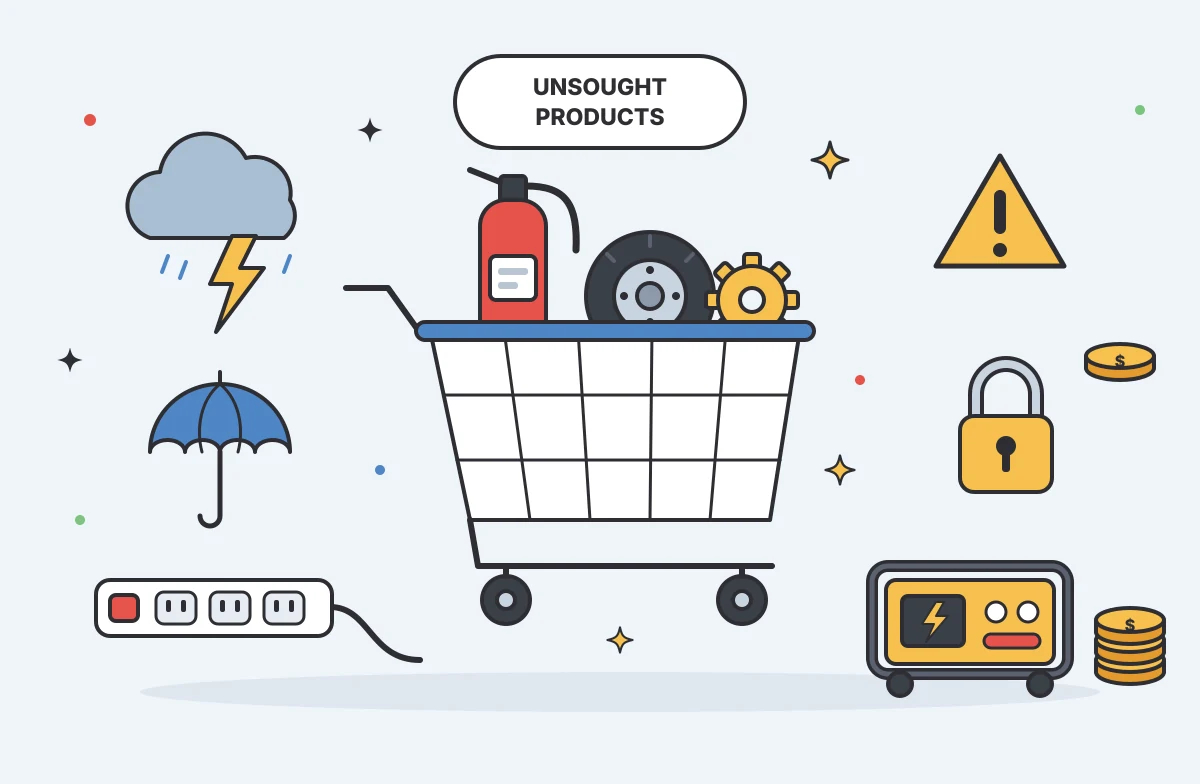
Buyers purchase unsought products only when a specific need, risk, or sudden event forces the issue. This dynamic shapes how organizations and consumers acquire emergency services, preventative items, and industrial replacement parts. Customers acting under pressure bypass casual browsing, demanding immediate and accurate information to solve their problem. Reviewing 20 examples of unsought products reveals how the buying situation dictates the transaction and demonstrates why clear catalog data drives reactive sales.
What Makes a Product Unsought?
The unsought classification describes a temporary buying situation rather than a permanent trait of the item. Customers purchase these offerings out of necessity, compliance, or sudden risk awareness. They avoid researching these categories for entertainment, rarely anticipating the purchase until an external trigger occurs.
The OpenStax text defines unsought products as consumer goods a buyer doesn’t anticipate purchasing, often because the buyer is unaware of them or doesn’t think they’re needed. It lists a flat tire that needs repairing, a storm-damaged roof that needs replacing, and funeral services as examples.
Understanding this trigger changes how you structure catalog data as a manufacturer or distributor. Buyer-specific applications, fitment details, and compatibility notes belong at the forefront of the product information. Customers facing an equipment failure or property damage have zero tolerance for ambiguous specifications. A product data management software setup that cleanly presents these details helps buyers confirm they have the right solution immediately. This unsought status dictates how the buyer arrives at the product page, guiding the technical specifications you provide to secure the sale.

20 Examples of Unsought Products
Each example in this category depends on the buyer's conditional state. The table below outlines common unsought items, the specific event that triggers the purchase, and the type of offering involved.
| Example | Buyer and Purchase Trigger | Offering Type |
|---|---|---|
| Flat-tire repair | Driver after an unexpected puncture | Service |
| Storm-damaged roof repair | Homeowner after storm damage | Service |
| Pest-control service | Household or facility after an infestation appears | Service |
| Funeral services | Family facing a death or planning ahead | Service |
| Burial plot | Family after a death or during advance planning | Land/property |
| Life insurance policy | Individual or family after a change in dependents, mortgage, or risk awareness | Financial product |
| Fire extinguisher | Property owner after a safety review or inspection | Physical good |
| Home security system | Household after a break-in, move, or change in safety concerns | Hardware and monitoring service |
| Surge protector | Equipment owner after a power event or equipment-protection review | Physical good |
| Flood insurance policy | Property buyer after a risk review or lender requirement, before a flood | Financial product |
| Burst-pipe plumbing repair | Property owner after a sudden leak | Service |
| Water-damage restoration | Owner after water intrusion | Service |
| Emergency towing | Driver after a disabling breakdown | Service |
| Locksmith call-out | Property owner after a lockout or key failure | Service |
| Data-recovery service | Consumer or business after device or storage failure | Service |
| Furnace or boiler repair | Homeowner or facility operator after heating failure | Service |
| Emergency generator | Household or facility after an outage or continuity review | Physical equipment |
| Industrial emergency replacement part | Manufacturer or distributor after equipment failure threatens operations | Physical component |
| Backup component | Operations team after a continuity review or repeated failure | Physical component |
| Spill-response kit | Industrial site after an incident or risk review | Physical good |
These listings break down into three primary categories based on the buyer's motivation. The first group involves reactive post-incident services, encompassing everything from emergency towing to data recovery. Customers in these situations face an immediate halt to their normal activities. Price sensitivity drops, while the demand for rapid availability and precise problem resolution spikes. The buyer searches for specific, localized terms, expecting immediate confirmation that the provider can handle their make, model, or situation.
The second group covers preventative risk mitigation. Fire extinguishers, life insurance policies, and surge protectors fall into this cluster. Instead of reacting to a past disaster, the buyer reacts to a heightened awareness of risk. A home inspection, a new mortgage, or a localized threat serves as the trigger. These buyers require detailed specifications, compliance ratings, and clear compatibility data to ensure their preventative measure meets regulatory or safety standards.
The third group affects B2B operations directly. Industrial replacement parts, emergency generators, and spill-response kits keep manufacturing lines and distribution centers running. Procurement teams must source an exact replacement immediately when a specialized valve fails on an assembly line. They search by OEM part numbers, technical dimensions, and specific material grades. If your catalog lacks structured, searchable attributes, your brand becomes invisible to the buyer during an active purchasing window.

Why the Same Product Can Change Categories
Buyer awareness, timing, and the specific trigger alter product classification. An offering can be unsought for one buyer and actively sought by another at the same time. The distinction relies on the context of the need rather than the manufacturing process or the price point.
Consider the purchase of a commercial standby generator. A facility manager building a new hospital includes redundant backup power in the initial architectural plan. They issue formal requests for proposals, evaluate fuel efficiency metrics, compare load capacities across multiple vendors, and negotiate long-term service contracts. In this scenario, the generator operates as a complex B2B shopping good. The buyer has ample time to weigh alternatives and deliberately structure the purchase.
Two years later, a regional distribution center ten miles away loses power during an unprecedented winter freeze. The facility manager scrambles to secure portable commercial generators to keep perishable inventory from spoiling. The product is functionally identical, yet the buying situation shifts. The manager abandons long-term feature comparisons in favor of immediate availability, power output specifications, and rapid delivery timelines. For this reactive buyer, the generator functions as an unsought product.
Industrial replacement parts follow this pattern. An emergency replacement part ordered to fix a halted assembly line fits the unsought model. The maintenance team faces downtime costs measured in thousands of dollars per minute, forcing them to find a compatible component immediately. Conversely, the identical component ordered through a scheduled preventative maintenance program does not carry the same urgency. Scheduled renewals and routine replenishment are planned actions, allowing procurement teams to negotiate bulk discounts and optimize shipping schedules.
Recognizing this duality changes how you present specifications. A robust catalog serves both the methodical researcher and the panicked buyer simultaneously. Technical specifications, cross-reference numbers, and compatibility charts must sit prominently on the product page. Gartner research on B2B buying calls for digital experiences that make it easier for buyers to navigate catalogs, find products, and decide. Buyers reacting to an unexpected event will not download a 40-page PDF manual to verify a single thread pitch. They need the data structured, visible, and guaranteed accurate.
What These Examples Mean for B2B Catalog Teams
A failure triggering a purchase requires clear application data, model fit, compatibility notes, part identifiers, and relevant replacement information. Manufacturers and distributors cannot rely on disorganized spreadsheets to manage this detail. Buyers attempting to cross-reference a failed motor control unit against a supplier's inventory will bounce to a competitor if the product page lacks exact OEM mapping.
PIMinto provides a single source of truth for organizing, enriching, and distributing product catalogs, ensuring this data remains accurate. The platform serves as a central hub for complex product schemas, centralizing supplier data and connecting directly to custom ERP integrations. Instead of manually updating specifications across different sales channels, you manage all technical attributes, compliance documents, and dimensional data in one unified system. This structure guarantees that maintenance leads searching for an emergency replacement part find consistent, channel-ready information.
Growing B2B brands and multichannel retailers use PIM software for manufacturers to eliminate the bottlenecks that slow down product syndication. PIMinto combines product data storage with a dedicated Digital Asset Management (DAM) system, keeping technical schematics, installation videos, and high-resolution images tied directly to the relevant SKUs. The platform features an AI PIM Assistant that automates product data enrichment, helping your team standardize measurement units and format technical specifications.
Distributing this enriched data requires reliable connectivity. PIMinto includes native API connectors that push updated listings directly to major sales channels like Shopify, BigCommerce, WooCommerce, Wix, and Google Shopping. A proper Shopify PIM integration ensures that inventory flags, compatibility charts, and technical specifications update across the storefront in real time.
Transparency and accessibility for growing operations separate PIMinto from legacy enterprise alternatives. Paid plans start at $300/month, and the platform includes unlimited users and unlimited data outputs. Rapid deployment remains a priority, with migration from any existing PIM included. This structure allows e-commerce managers to scale their multichannel syndication, a strategy McKinsey identifies as a primary growth driver in B2B sales, without hitting artificial paywalls, keeping the focus on delivering the specifications buyers need during critical purchasing moments.
Classify the Buying Situation, Not the SKU
These examples serve as practical illustrations rather than fixed labels. Identify who is buying, what event prompted the purchase, and whether the offering is a physical good, a service, or a bundled solution to properly position your catalog. The same SKU adapts to different circumstances based on the buyer's immediate environment. Structuring your product data to answer the urgent, specific questions of a reactive buyer ensures your catalog performs under pressure.
Frequently Asked Questions
Common questions address how buyer intent shapes the definition of unsought offerings.
What Are Common Examples of Unsought Products?
Common consumer examples include flat-tire repairs, life insurance policies, burial plots, and pest-control services. In the commercial and industrial sectors, common items involve emergency replacement parts, data-recovery services, spill-response kits, and backup power generators. These offerings share a reliance on an external event or risk realization to trigger the transaction.
What Makes a Product Unsought?
A product falls into the unsought category when the buyer avoids actively seeking it out or anticipating the purchase until a specific need forces action. This classification describes the temporary buying situation and the buyer's immediate motivation, rather than serving as a permanent trait.
Do Unsought Products Include Services?
Yes. Marketing terminology uses the word "product" to encompass physical goods, intangible services, real estate, and financial instruments. Emergency towing, water-damage restoration, locksmith call-outs, and funeral arrangements all function as unsought services because the buyer pursues them in direct reaction to a sudden event or pressing necessity.
Can the Same Product Be Sought by One Buyer and Unsought by Another?
Yes. A homeowner buying a portable generator in the dark after a winter storm reacts to an unsought need. A facility manager who spends three months researching that same generator model for a planned construction project purchases a highly sought shopping good. The buyer's timing and context determine the classification.
Modified on: 2026-11-10
Blogs you might like
-
Best PIM for Adobe Commerce (Magento): Options Compared
For growing US e-commerce and B2B brands, PIMinto is a fast, accessible, transparently priced PIM/DAM solution that helps replace spreadsheet chaos without a bloated enterprise price tag. Its plans start at $300/month and include unlimited users and...

Mark James
-
Choosing an E-Commerce Feed Management Tool
You have products to sell and sales channels that demand specific data formats before they accept your listings. Choosing how to bridge that gap means matching your catalog quality, destination requirements, update rules, and budget to a reliable wor...
Mark James
-
Multichannel Ecommerce Listing Software Guide
Multichannel ecommerce listing software organizes your product information and prepares it for distribution across different storefronts and marketplaces, turning internal catalog data into channel-ready listings. The software formats titles, attribu...
Mark James
-
Practical Advertising in Industrial Marketing
For growing e-commerce and B2B brands, PIMinto’s PIM/DAM solution offers a fast, accessible, transparently priced way to replace spreadsheet chaos with organized product information. With unlimited users and outputs, it gives teams room to grow witho...
Mark James