How to Choose Sporting Goods Product Catalog Software
Author name: Mark James

When a vendor sends a file containing a new line of technical running shoes, you might receive 120 rows that represent two base models multiplied across sizes, widths, and colorways. More than 60% of global retail sporting goods purchases are now made through digital platforms, which forces e-commerce teams to process these massive matrix files rapidly. Every row needs specific technical specifications, high-resolution images, and distinct pricing tiers for wholesale and retail channels. Managing this data manually means a single formatting error can overwrite thousands of listings. Poor data quality costs organizations an average of $12.9 million per year, a figure that varies widely by company size and industry. This operational drag acutely impacts B2B sporting goods supply chains, leaving teams to struggle with raw vendor text instead of optimizing campaigns. If you upload an unchecked file to your storefront, faceted search breaks because one supplier labeled a size "Lrg" while another used "L." Implementing sporting goods product catalog software stops this data fragmentation, allowing you to build clear inheritance structures and launch seasonal gear faster.
Structuring Complex Variant Data for Sporting Goods
Digital infrastructure handles more load than ever, as the sporting goods market is projected to grow from $100.05 billion in 2024 to $159.1 billion by 2032. Shoppers demand highly specific technical details, like weight and moisture-wicking properties, before they buy physical gear. A McKinsey consumer survey found that 81% of consumers have returned to in-person fitness options, sustaining heavy demand for physical gear, specialized protective equipment, and rugged apparel. Furthermore, over 110 million units of eco-friendly sporting goods were sold in a single year, requiring e-commerce managers to track distinct sustainability certifications across thousands of items.
Sporting goods carry complex structures, so a single base product like a baseball glove fragments into dozens of variants based on handedness, web pattern, leather type, and youth versus adult sizing. Retailers launched over 9,000 new SKUs for smart fitness gear recently as digital integration surges. This category expansion introduces digital compatibility specs, battery life metrics, and warranty documentation to the standard physical attributes. Managing these complex variants using traditional spreadsheets causes rampant listing errors.
When your underlying data lacks structure, this variant explosion grinds operations to a halt, forcing e-commerce managers to spend peak seasons formatting CSV files instead of optimizing campaigns. PIMinto operates as a centralized Product Information Management (PIM) platform designed to manage this SKU chaos. The system provides a single source of truth that standardizes data and prevents listing errors before they reach your sales channels. E-commerce managers who are disorganized in spreadsheets find immediate relief by consolidating these matrices into one dashboard.

Criterion 1: Require Parent-Child SKU Inheritance Rules
Your catalog software must support parent-child inheritance modeling, where base features live at the parent level while specific physical variations live at the child level. Best-in-class catalog management dictates that you set core materials, brand specs, and warranty documents on the main parent product card.
If a manufacturer changes the core moisture-wicking material of an athletic shirt, you should update one field, allowing inheritance rules to push that material update down to every size and color combination automatically. Child SKUs inherit these traits, so a single material update cascades across all variations without duplicating data entry. Without this architecture, you must hunt down 40 rows in a flat file to make one correction, introducing data discrepancies that carry massive financial penalties across B2B supply chains. You also face extreme difficulty managing edge cases, such as when a left-handed youth glove requires a different safety warning than the adult version but shares identical leather specs.
Require your platform to handle multidimensional variant matrices natively. You set the base product and define the variation axes, such as size and color, which prompts the software to generate the required child SKUs. Shoppers now expect highly tailored product discovery. A Brandquad report notes that over 1 billion product searches are influenced by AI assistants, making structured, highly enriched, and localized product data an absolute necessity rather than a luxury.
Messy supplier feeds complicate this process because data from ten different brands will feature varying attribute formats. PIMinto solves this formatting challenge through its AI PIM Assistant. The tool ingests unstructured vendor files, normalizes the terminology, and aligns incoming data with your established product attributes in a PIMS. You leverage AI tools to convert incoming abbreviations like "Lrg" and "Large" into a uniform "L" across your database. Reviewing standardized data takes seconds, generating channel-optimized SEO descriptions and saving you hours of manual spreadsheet formatting.
Criterion 2: Bridging B2B and B2C Workflows in One System
Wholesale distributors face pressure from buyers who expect consumer-grade purchasing experiences, including real-time inventory counts, specialized dealer pricing tiers, and immediate access to accurate CAD drawings or spec sheets. B2B sporting goods distributors require dynamic systems because manual line sheets fail to reflect daily inventory shifts.
Running decoupled systems for B2C storefronts and B2B ordering creates persistent margin leakage. You update a price in your consumer channel but forget to update the PDF line sheet you email to wholesale partners, meaning your sales team quotes outdated numbers because visibility rules live in separate databases. When pricing updates in one system and visibility is controlled in another, broken dealer trust occurs. Legacy systems create bottlenecks in sharing accurate data with external partners, leading to returned items and costly fulfillment errors.
Unify these workflows by running your wholesale distribution from the exact database that powers your storefront, building secure dealer portals that pull directly from your central catalog. PIMinto offers built-in brand portals that give manufacturers a secure environment to share rich product assets with retail partners. Developed out of Systems Online's real-world B2B problem-solving, this architecture cures distribution bottlenecks. You configure PIM software for B2B ecommerce workflows by setting distinct pricing tiers and visibility rules. Retail buyers log in, download the compliance documents they need, and view volume pricing without emailing your sales team for a custom quote.
Criterion 3: Unifying Text and Digital Assets Natively
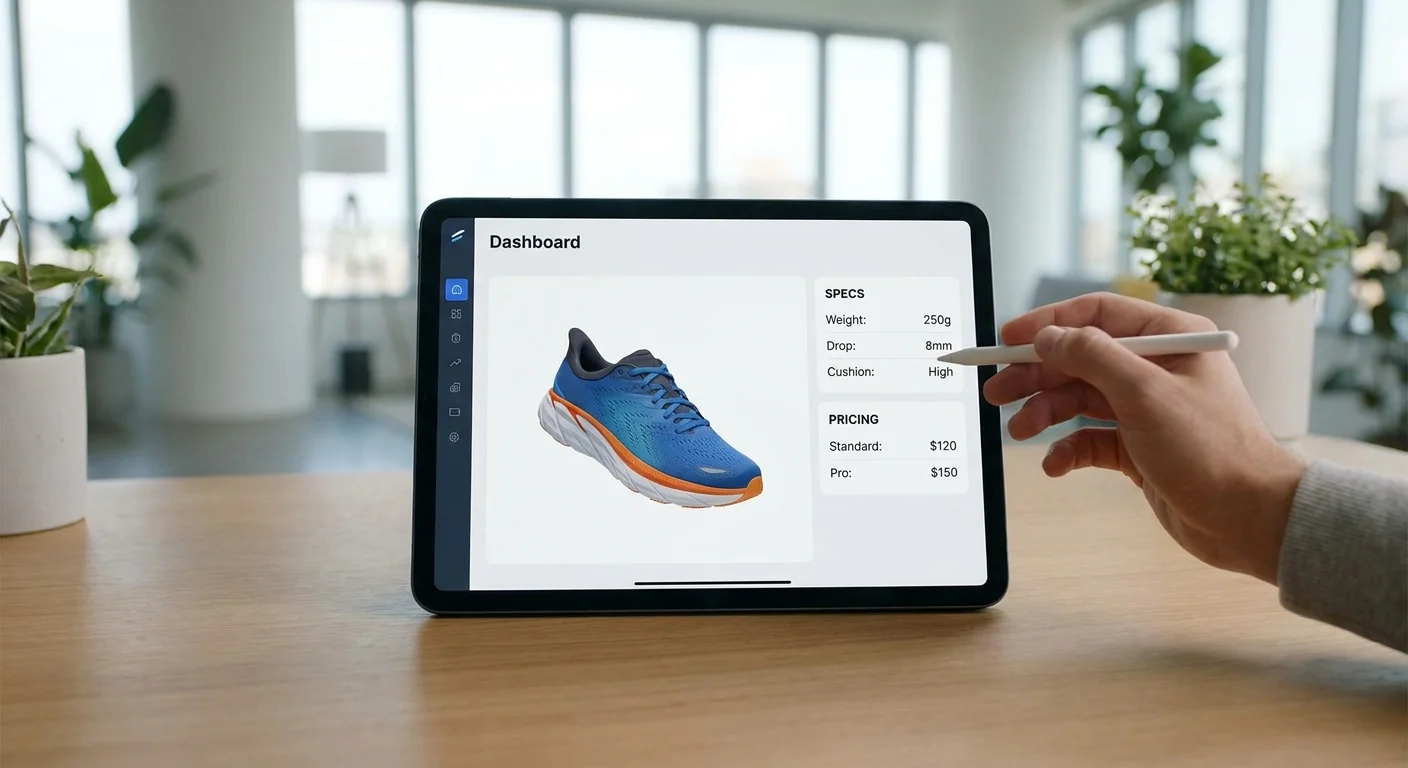
Visual assets drive sporting goods sales, as a technical jacket requires lifestyle photography, 3D renderings of the waterproofing technology, and PDF care manuals. Managing these assets in a separate silo from your product text creates manual matching workflows that slow down your time-to-market. Combining your text fields with a Digital Asset Management system ensures that every high-resolution photo links to the exact variant colorway automatically.
When systems remain separate, you download an image from a shared drive, rename the file to match a specific SKU, and upload it to your storefront. If the product changes, you must repeat the manual workflow, creating a bottleneck that fails under the volume of seasonal catalog updates. E-commerce managers end up scrambling to match lifestyle images to the correct variant right before a major product launch, often uploading the blue shoe image to the red shoe listing by mistake.
Your catalog software must link digital assets dynamically to the exact SKU they represent. PIMinto combines PIM and DAM natively, allowing you to upload a folder of high-resolution lifestyle images while the platform maps them directly to the corresponding child SKUs. Safety manuals attach to the parent product and cascade down to every variant. You do not need to buy a separate DAM system to handle your instructional videos or safety documentation. Every digital asset remains synced with the text data, so when you push a product live, the channels receive the description, the pricing, and the accurate visual media in one payload.
Criterion 4: API Syndication for Seasonal Agility
Sporting goods demand swings sharply based on weather patterns, event cycles, and school calendars, prompting retailers to front-load their inventory to combat supply chain disruptions. Large retailers regularly experience massive quarterly sales spikes during seasonal transitions, which places extreme stress on digital catalog managers to push heavy seasonal catalogs live. Aggressive seasonality forces catalog managers to onboard and spin up seasonal listings rapidly to meet inventory onboarding spikes across the industry.
Manual CSV exports buckle under this pressure, where a missing comma shifts your entire pricing column one cell to the left. Uploading that file means adult snowboards will display accessory prices, devastating your profit margins before anyone notices the error. Flat files also fail to communicate inventory stockouts back to your central system quickly, leading to overselling during peak events. Moving away from manual CSV exports is a best practice for modern retail operations.
Prioritize direct API connectors over flat-file exports so inventory updates, price adjustments, and content tweaks reflect in real-time on the digital shelf. PIMinto includes standard native connectors for Shopify, BigCommerce, WooCommerce, Wix, and Google Shopping with any paid subscription. You push error-free listings directly to major sales channels without paying for third-party middleware. Direct APIs syndicate your updates automatically without requiring a developer to write custom integration scripts for each storefront. Because the connection remains active, a price update in PIMinto reflects on Google Shopping without delay.
Criterion 5: Transparent Pricing for Unlimited Users
Catalog management tools often hide their total cost behind complex pricing models that penalize aggressive scaling as your brand grows across channels. Growing brands must figure out how to afford enterprise-grade syndication tools without being punished by user-seat fees or data-output paywalls.
Many legacy systems charge per-user seat fees, which becomes expensive during a busy seasonal transition when you need to bring on temporary contractors to format product descriptions. Seat fees force you to either share logins, which destroys your audit trail, or pay inflated monthly rates for temporary help. Other platforms impose data-output paywalls that allow you to store your catalog but charge overage fees when you syndicate that data to external channels. Expanding into three new marketplaces triggers those output paywalls, discouraging multichannel growth precisely when your peak seasons like back-to-school or winter sports begin.
Evaluate your software based on its total cost of ownership at full operational capacity, prioritizing transparent pricing PIM software that allows your team to expand freely. PIMinto provides a transparent pricing model that includes unlimited users and unlimited data outputs, letting you scale your multichannel syndication strategy without hitting artificial paywalls. Multichannel retailers can scale their operations during peak seasons without worrying about software overages. Originally developed to solve catalog bottlenecks for B2B clients, PIMinto emphasizes rapid deployment through free onboarding and data migration. You avoid setup costs entirely and deploy the system rapidly to cure operational drag.
Evaluation Checklist for Catalog Software
Use this matrix to map your specific operational bottlenecks to the features you must require during software selection.
| Your Operational Bottleneck | Required Software Feature | How to Test It During Evaluation |
|---|---|---|
| Messy Supplier Feeds | AI Data Normalization | Upload a raw vendor CSV containing messy text. Measure how many clicks it takes to standardize incoming sizing terms, converting "Lrg" and "Large" to "L". |
| Manual Image Matching | Native DAM Integration | Upload a lifestyle image folder and require the vendor to show it linking automatically to a specific child SKU, such as a red jacket variant. |
| Pricing Errors in Wholesale | Built-in Dealer Portals | Configure a B2B portal login. Verify that the wholesale user sees a 20% discount margin while the B2C feed keeps retail pricing hidden. |
| Seasonal Launch Delays | Direct API Syndication | Push a test Q1 winter sports product to a staging Shopify environment. Update the base price in the PIM and time the sync to the storefront. |
| Ballooning Software Costs | Unlimited User Model | Review the contract for hidden data-export limits, API transmission overages, or per-seat expansion fees triggered by Google Shopping exports. |
Managing complex data structures requires software that simplifies your operations rather than adding administrative overhead. Moving away from disorganized spreadsheets gives your team the infrastructure to launch seasonal inventory on time, ensure data accuracy across wholesale channels, and protect your margins.
Stop wrestling with variant chaos and manual spreadsheet uploads. PIMinto provides a central source of truth for organizing, enriching, and distributing your complex sporting goods catalogs. With unlimited users, native API connectors, and free onboarding, you can scale your operations without hitting enterprise paywalls. Start streamlining your product data today at PIMinto.com.
Modified on: 2026-08-05
Blogs you might like
-

Automotive Aftermarket PIM Software Guide
An aftermarket brake rotor can fit dozens of vehicles, replace three older part numbers, ship in two package sizes and need a California warning label. Multiply that by 20,000 SKUs, and the spreadsheet that used to run your catalog starts sending cus...
-

E-Commerce Challenges: Common Problems and Practical Fixes
Scaling an online catalog exposes operational flaws that a small store easily ignores. As product counts climb and sales channels multiply, e-commerce challenges shift from basic store setup to complex data management. Keeping up with orders and fulf...

Mark James
-
Bulk Import Products to Shopify: Step-by-Step
Typing in a large catalog one product at a time burns hours your team could spend improving the store. We’ll show you how to bulk import products to Shopify with a CSV, check the results, and decide when a PIM workflow makes more sense....
Mark James
-

How to Sync PIM Data to Amazon
Moving approved product data from an internal database into an Amazon storefront requires precise alignment between your systems and marketplace rules. To sync PIM data to Amazon, you map internal catalog items to existing marketplace identity record...
Mark James