PIM Number: Numeric Field or Product ID?
Author name: Mark James
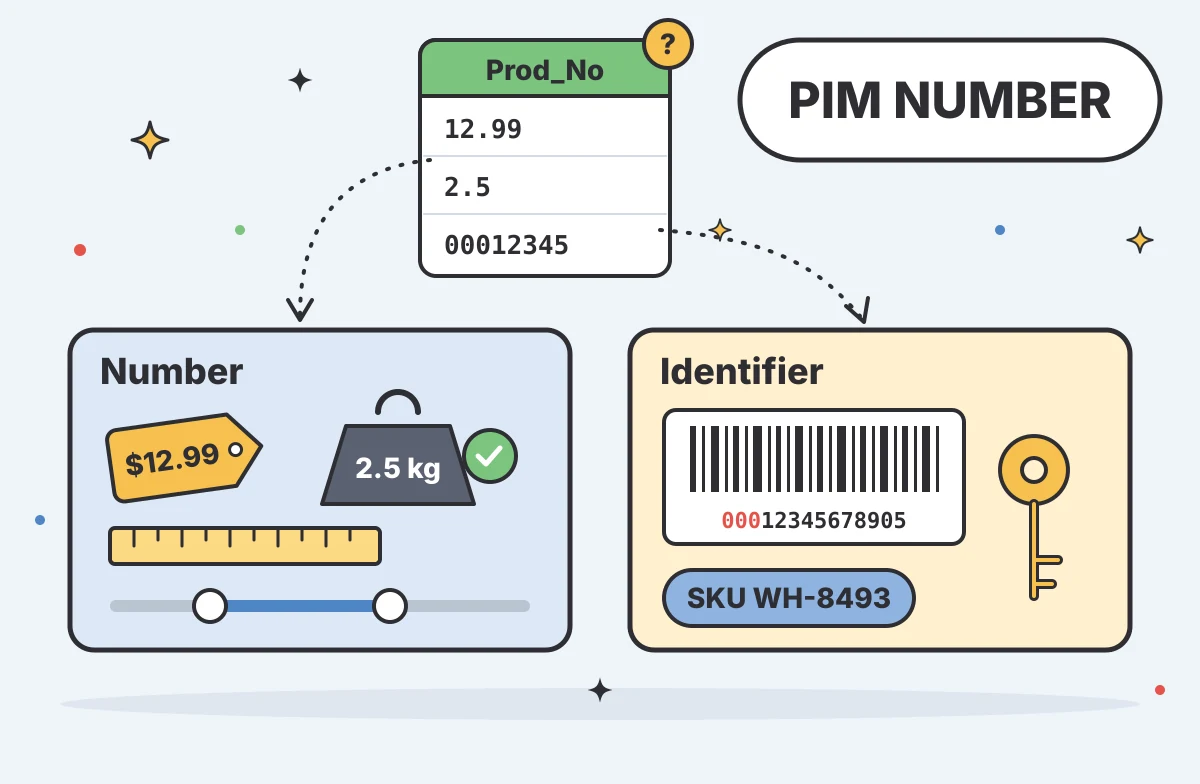
On the PIMinto platform, the term "PIM number" refers to a specific attribute type used to store numeric product data, rather than a universal product identifier. Fields containing prices, quantities, and dimensions belong in a number attribute. Unique tracking codes like SKUs, MPNs, and GTINs require different field configurations, serving separate structural roles in your catalog.
How a Number Attribute Functions
Operations leads migrating from disorganized spreadsheets often search for a single, standardized sequence to identify inventory across different software platforms. Industry documentation across various product management systems shows no such universal standard exists. Different vendors maintain their own internal terminologies, sometimes assigning system-level IDs or internal database keys to manage product relationships. Those arbitrary database keys do not transfer between platforms, holding no value for external sales channels.
Within PIMinto, the PIM Number Attribute Type documentation explains "Number" as a specific data type. It holds quantifiable values you can measure, calculate, or sort. When configuring a product catalog, you define the rules for every piece of information. Assigning the correct data type dictates how the software processes, validates, and syndicates that data to connected storefronts.
A product information management system applies a defined schema to catalog fields. Unlike a spreadsheet, where a cell may contain different kinds of values without an immediate error, a configured PIM field validates entries against its assigned type. Treating an identifier as a numeric data type restricts your ability to format it accurately, whereas treating a true measurement as raw text prevents e-commerce platforms from filtering it. You avoid these data model conflicts by separating what a product is measured by from how a product is identified. A supplier feed might include a column labeled with a vague numerical title, and classifying that column correctly prevents errors during syndication. Assuming a string of digits automatically requires a numeric field creates the risk of breaking your barcode formatting or overwriting your core lookup parameters. Clear data rules help maintain clean data across thousands of product variations.

Applying Number Attributes in a Product Catalog
A numeric attribute stores the physical and financial realities of your inventory. You can configure these fields to hold exact values like 12.99 for a price, 45 for an inventory count, or 2.5 for a shipping weight. Because the system recognizes the data as numeric, it enforces specific rules and behaviors that standard text fields ignore. This programmatic enforcement helps ensure downstream systems receive data in the expected format.
For example, if a B2B distributor lists industrial pipe fittings, the catalog requires distinct specifications for length, inner diameter, outer diameter, and pressure rating. Each of those specifications belongs in a number attribute. When customers navigate your storefront, they rely on faceted search menus to narrow down their options, and e-commerce platforms depend on this numeric data type to build those filtering sliders. As a shopper adjusts a slider to view products priced between $50 and $100, or filters for pipes with a diameter greater than two inches, the storefront expects the PIM to transmit strictly numeric data. Text-based approximations can fail in these computational scenarios because a storefront may not interpret a text field containing the phrase "two inches" alongside a field containing "2.5 in." as numeric values it can sort. It requires a pure numeric attribute to process the sorting logic.
Beyond customer-facing filters, numeric attributes drive backend operations. Logistics software relies on precise weight and dimensional numbers to calculate shipping rates dynamically. If packaging length, width, and height sit in standard text fields, the connected shipping API cannot calculate the dimensional weight of the carton. Directing those measurements into configured number attributes allows the system to transmit mathematical values to the freight carrier.
Financial data requires the same structural precision. Minimum advertised price, manufacturer suggested retail price, and unit cost all function as numerical attributes. Managing these figures in dedicated number fields allows pricing engines and enterprise resource planning systems to process the values correctly. You can configure a number attribute to accept decimals for precise currency values, or restrict it to whole integers for package quantities and case packs.
PIMinto allows administrators to define these exact constraints, dictating whether a field requires a whole number or accommodates floating-point decimals. The platform also offers a uniqueness setting for number fields, preventing two products from sharing the exact same value in that specific attribute. Applying a uniqueness constraint to a numeric field does not transform that attribute into your primary product identifier; it prevents data entry collisions for specific measurements. A localized compliance registration sequence might happen to be entirely numeric and legally required to be unique per item. Configuring a number attribute with a uniqueness constraint solves that specific compliance requirement without confusing the field with your primary inventory lookup code.
The structure of your product catalog determines how efficiently you can scale your operations. Using true number attributes for measurable data empowers sales channels to calculate shipping costs based on accurate weights. You enable inventory thresholds to trigger out-of-stock behaviors automatically when the quantity number reaches zero. Multichannel retailers move away from error-prone spreadsheets to gain this level of automated data validation.

Product Identifiers Serve a Different Structural Role
Identifiers function as the anchor for a product record. While they often consist entirely of digits, their purpose is lookup and reference rather than measurement. A SKU serves as the primary internal code for inventory tracking and system integrations, giving developers a distinct reference code to locate and update records when connecting external applications.
The API architecture demonstrates this distinction clearly. The PIMinto GET single Product by SKU endpoint uses the SKU as the unique lookup parameter to retrieve a specific product payload. The system queries the dedicated SKU field to find the exact match, pulling the associated number attributes and text descriptions into the JSON response. This programmatic behavior relies on the SKU acting as a structural identifier, distinct from the quantifiable attributes attached to it. Indexing the SKU column helps the system find matches efficiently.
Other codes serve external parties and require their own dedicated fields. A Manufacturer Part Number tracks the item back to the original factory floor, giving purchasing departments a direct reference for reordering. A Global Trade Item Number provides a globally unique barcode string for retail point-of-sale systems. Handling complex product variations and SKUs effectively means mapping these external codes to distinct text fields, preventing them from overwriting internal tracking logic.
Even when a GTIN contains 14 digits and zero letters, it remains a text string in practice. Because barcodes serve as identifiers rather than quantities, they aren't used in mathematical operations. Storing a GTIN as a number attribute can strip leading zeros, which can invalidate the barcode and sever the connection to third-party marketplaces like Google Shopping. Google enforces strict formatting for product feeds, rejecting items that present malformed global trade numbers. Keeping identifiers formatted as text strings preserves their exact character sequence and satisfies marketplace validation rules, ensuring the barcode on the physical box matches the barcode transmitted to the digital merchant center.
Other platforms manage identity through different database mechanisms. Systems like AtroPIM document a system-assigned Product ID distinct from external identifiers. Kodaris utilizes an internal PIM Product Code that may differ from manufacturer or customer-facing codes. Treat these models as examples of vendor-specific architecture rather than shared industry standards, as internal database keys operate behind the scenes to link relational tables. Businesses manage logic through SKUs and global trade numbers, leaving internal system IDs to the software backend. Relying on an arbitrary database sequence for external operations breaks integrations upon migrating to a new platform. Catalog operations require identifiers controlled by the business rather than system-generated numbers tied to a specific software vendor.
Applying Data Distinctions in Your Catalog
Translating these technical distinctions into a working product catalog requires a clear data mapping strategy. E-commerce and catalog operations leads frequently inherit messy data from multiple suppliers. A spreadsheet arrives with a column labeled "Prod_No." The operations team determines whether that column holds a measurable quantity, a sequential identifier, or a factory code before importing it into the central database.
Create a clear field map before initiating any data intake.
| Data Type | Catalog Use Case | Example Values | Recommended Field |
|---|---|---|---|
| Number | Physical measurements and financial values | 12.99, 45, 2.5 | Number Attribute |
| Internal Identifier | Primary system lookup and integration mapping | WH-8493, RELAY-12V | SKU Field |
| External Identifier | Marketplace validation and factory tracking | 00012345678905, AX-99 | Dedicated Text Field |
Direct price, package count, physical dimensions, and electrical ratings into configured number attributes. Assign the primary tracking code to the designated SKU field to ensure API lookups and system syncs function correctly, then direct manufacturer codes and global trade numbers into separate identifier fields configured as text.
Executing this map requires a data normalization phase. Migrating product data to a central hub like PIMinto establishes the foundation for all future supplier imports. You define these types correctly during onboarding to secure smooth distribution later. The software relies on this structured architecture to push updated listings accurately to Shopify, BigCommerce, WooCommerce, and Wix. If a supplier feed includes an internal code, a voltage rating, a package quantity, and a UPC, the operations lead separates them logically before the automated import runs.
The voltage and package quantity map directly to number attributes, enabling storefront filtering. The UPC maps to a distinct GTIN text field to preserve any leading zeros, while the supplier code maps to a dedicated reference field. Finally, the team generates a custom internal SKU for the primary identifier. This complete separation allows the product information management system to validate the voltage as a measurable number while treating the UPC as an exact lookup string.
Taking this structured approach eliminates the friction caused by disorganized spreadsheets. Enforcing data types reduces the manual corrections required before a seasonal product launch. E-commerce managers gain the confidence to syndicate catalogs across multiple channels simultaneously, knowing the data payload meets the exact requirements of each destination. With configured validation, the platform can flag or reject incompatible text submitted to numerical fields.
Proper field mapping also simplifies the long-term maintenance of your catalog. When a supplier updates their pricing file, the system maps incoming numeric values directly to the established number attributes. You avoid the cascading errors that occur when a system attempts to update a text-based identifier with a floating-point number, as clean architecture upfront prevents troubleshooting later.
For growing businesses dealing with complex product variations and sprawling SKUs, establishing this separation early acts as a structural necessity, allowing you to build a reliable single source of truth. As your product lines expand, the integrity of your filtering menus and API lookups remains intact. A well-organized product information management platform handles the complexity of these relationships. It frees your operations team to focus on expanding market reach rather than formatting spreadsheet columns, leaving the software to manage millions of attributes systematically.
Start Scaling with Clean Data Architecture
The distinction between a numeric measurement and a product identifier dictates how successfully your catalog performs across different sales channels. A number attribute handles the physical and financial data driving storefront filtering, while dedicated identifier fields maintain the precise character sequences required for API lookups and marketplace validation. Properly mapping these fields ensures your product data remains accurate, searchable, and ready for syndication to your storefronts.
PIMinto provides a centralized hub designed specifically for this level of architectural precision. The software moves e-commerce teams away from disjointed spreadsheets by offering clearly defined data types, an integrated digital asset management system, and connectors that Feed data to Shopify and use Sync to pull data from Shopify, along with Google Shopping. With included data migration and transparent pricing that supports unlimited users and data outputs, PIMinto gives growing B2B brands and multichannel retailers the infrastructure they need to scale. Build a cleaner catalog and streamline syndication by visiting piminto.com to start your 30-day full-featured trial.
Frequently Asked Questions
What is the difference between a PIM number and a SKU?
A PIM number attribute stores quantitative data that you measure or calculate, such as item weight, length, or price. A Stock Keeping Unit (SKU) functions as an alphanumeric string used as an internal identifier to track inventory and execute API lookups. Keeping these fields separate ensures accurate storefront filtering and prevents integration errors.
Should a UPC barcode be stored as a number attribute?
A Universal Product Code should be stored as a text string rather than a numerical data type. Mathematical operations aren't performed on barcodes, and storing them as numbers can strip leading zeros. Those zeros may be necessary to preserve the barcode's exact value, and changing it can cause merchant centers and third-party marketplaces to reject the product feed.
Can a number attribute include decimal points?
Software administrators can configure a numeric attribute to accept either floating-point decimals or whole integers, depending on the specific catalog requirement. Financial values and physical dimensions typically require decimal support for accuracy, while package quantities or case pack units usually restrict data entry to whole integers to maintain inventory integrity.
Why do e-commerce platforms need strict number attributes?
Storefront platforms depend on dedicated numeric data to power customer-facing tools like faceted search and filtering sliders. A website may not be able to sort or calculate a range accurately using text-based fields that mix digits with descriptive words. Transmitting raw numerical values allows the front-end software to filter products by price, dimension, or electrical rating accurately.
Modified on: 2026-11-21
Blogs you might like
-

Can PIMinto Get You Live Faster Than Akeneo?
PIMinto is a candidate for a faster standard rollout based on published estimates, but evaluating whether there are any Akeneo competitors with a faster implementation requires matching project scopes. The available evidence does not establish a univ...

Mark James
-

Refresh Existing Industrial Marketing Coverage
The concept of industrial marketing covers the trade in products and services between companies, especially those used in manufacturing. If you manufacture stamped steel enclosures and sell them to an automotive assembly plant, you are engaging in in...
Mark James
-
PCM vs PIM: What’s the Difference for E-Commerce Teams?
Evaluating software for your e-commerce stack requires decoding overlapping industry terms. When you compare pcm vs pim, the distinction comes down to how your team handles product data, media assets, and channel distribution. For growing e-commerce...
Mark James
-
Akeneo Activation vs. Inriver Syndicate Advance for U.S. Retail Channels
Getting approved product content, variants, and media to each retailer in the required format remains a persistent operational challenge. Merchandising teams need to know exactly how a platform handles this complex distribution before committing to a...
Mark James