Akeneo Alternative for Enterprise: PIMinto vs. Akeneo
Author name: Mark James

The Short Answer: PIMinto or Akeneo?
PIMinto warrants evaluation as an Akeneo alternative for enterprise teams that need centralized product data, a built-in digital asset manager, complex SKU handling, and core commerce publishing without a prolonged procurement cycle. Comparing these two platforms reveals a clear divergence in philosophy. PIMinto bundles product information management and digital asset management into a single subscription featuring public SKU-based pricing, unlimited users, and free migration assistance. This structure helps growing brands, distributors, and retailers replace disconnected spreadsheets with a unified system of record.
Akeneo offers a Product Experience platform with Supplier Data Manager for supplier-data onboarding as an add-on, enterprise governance, SIEM integration, and advanced rights management and specialized Activation for over 500 global sales channels, including marketplaces and retailers. These capabilities make Akeneo a strong candidate for workflows that require broad channel coverage and oversight controls, so match the software's complexity to your actual operational workflows.
Choose PIMinto for a Lower-Friction PIM-and-DAM Rollout
Businesses often overbuy enterprise software, acquiring massive composable architectures to solve straightforward catalog synchronization problems. PIMinto addresses this common misstep by providing a transparently priced path from disorganized folders to a structured database. You benefit from an environment where product data, high-resolution imagery, technical manuals, and marketing copy sit in one shared location. You can then push this unified data to primary commerce platforms, partner brand portals, and configured feeds, which can reduce the need for a web of third-party integration applications.
Choose Akeneo for Broader Enterprise Governance and Activation
For organizations managing approval workflows and supplier data, Akeneo's package comparison lists Supplier Data Manager as an add-on, collaboration workflows, channel-ready data governance, advanced rights management, and enterprise governance with SIEM integration. Its Activation product supports regional product variations and syndication to over 500 global sales channels, and each destination has its own formatting, category, and validation requirements. Because the comparison places these controls in the Advanced and Premium packages, organizations with these requirements should assess those tiers.

What Enterprise Teams Should Compare in a PIM
Procuring a catalog management system means evaluating how the software handles the physical reality of your company's data. Feature checklists rarely reveal how much manual effort your team will expend daily, so enterprise buyers need to test specific technical criteria before committing to a multi-year deployment.
Product Modeling and Digital Assets
An enterprise catalog relies on complex relationships because products belong to families, inherit technical attributes, feature translated descriptions, and split into multiple dimensional variations. Software has to map these connections accurately. A system that forces you to duplicate shared attributes across multiple color variants can increase the risk of data-entry errors. Digital assets also need to sit alongside this text data. High-resolution images, assembly videos, specification sheets, and safety certificates require secure storage and direct links to the relevant SKUs. Separating the product text from the product imagery creates two distinct maintenance workflows, which can increase the effort required to launch a new product line.
Channels, Collaboration, and Data Portability
Data trapped inside a database provides zero commercial value, so a functional PIM distributes approved records to the specific endpoints your business relies on. You will want to understand the technical differences between a native API connector, a partner-built app, a scheduled flat-file feed, and a custom integration. Native connectors can reduce custom maintenance, but confirm who owns updates, error handling, and ongoing support. Manufacturers share enterprise product data models with retail partners, which requires secure portals, role-based access limits, and detailed approval stages. You can verify data portability by requesting full JSON or CSV catalog exports to ensure you retain ownership of your accumulated records.
Governance, Security, and Total Cost
Software administration scales alongside team size. Large deployments require single sign-on capabilities, identity provider synchronization, and detailed audit logging to track which user altered a technical specification. Security teams review data residency, compliance certifications, and uptime guarantees before approving a vendor. Finally, procurement departments evaluate the true total cost of ownership, which extends far beyond the base software license. Accurate forecasting involves adding implementation fees, connector maintenance charges, data storage overages, third-party AI processing fees, and dedicated vendor support packages.

PIMinto: A Practical Akeneo Alternative
If you are moving away from tangled spreadsheets and disconnected file-sharing services, you might find PIMinto provides the required infrastructure. The software focuses on catalog consolidation, offering a unified workspace for product managers, marketers, and technical writers.
Centralize Product Data, Variants, and Assets
PIMinto removes the artificial separation between product facts and product files by combining a dedicated product information manager with a digital asset manager, a combination reflected in its published feature matrix. You can upload product imagery, schematic diagrams, and marketing videos directly to the relevant product record. The platform allows you to manage product variants and complex attributes for size, color, voltage, and material composition. You can also define custom attributes and model cross-sell or compatibility relationships across B2B and retail catalogs.
Publish to Core Commerce Channels
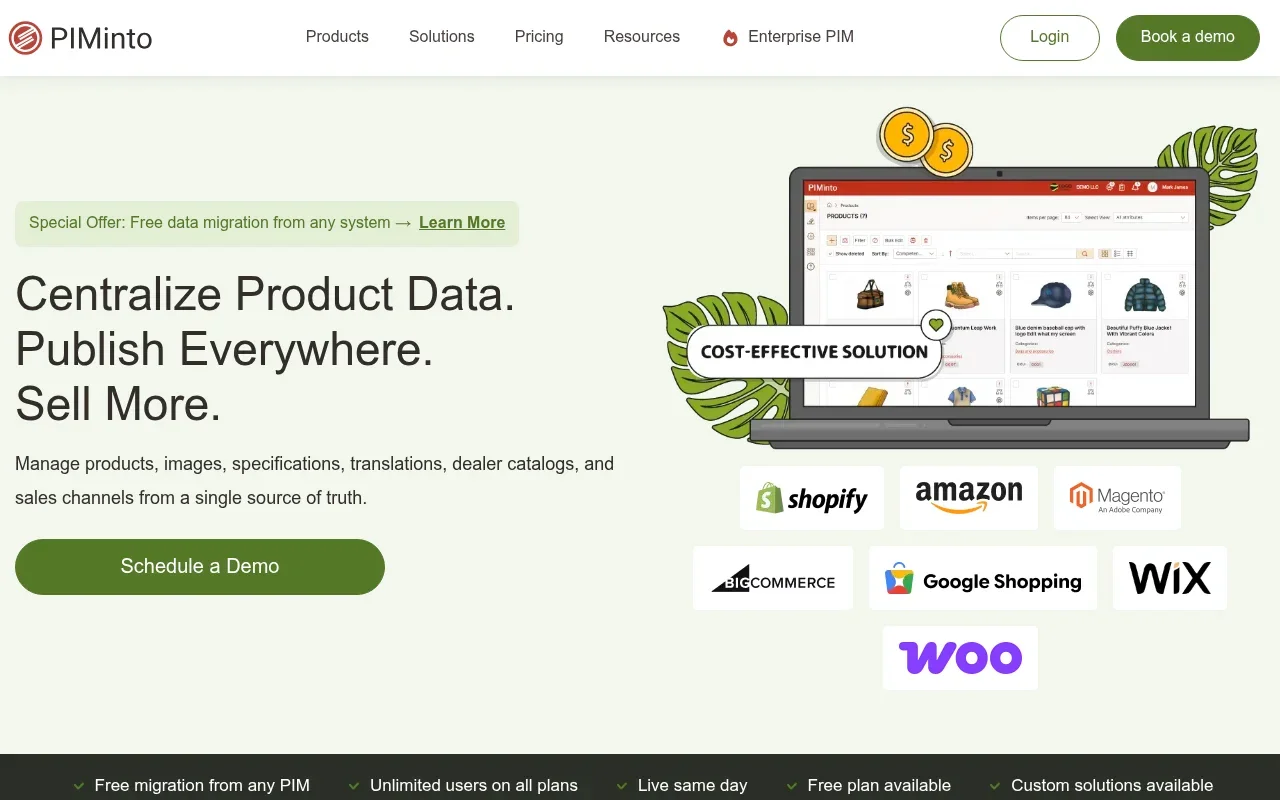
PIMinto limits manual repetition by distributing a single source of truth to multiple sales endpoints, providing connectivity for major commerce engines. Its published feature matrix lists built-in Shopify and BigCommerce connectors, while data exports and API options cover other destinations. Built-in brand portals also allow manufacturers to share curated asset collections with external dealers and distributors.
Reduce Migration and Adoption Friction
Software pricing opacity often stalls enterprise deployments, which is why PIMinto publishes its SKU-based subscription tiers directly. The Starter tier costs $0 per month for up to 1,000 SKUs. Essentials runs $300 for up to 10,000 SKUs, Premium is $600 for up to 50,000 SKUs, and Super costs $950 for up to 120,000 SKUs. The Extreme tier lists capacity up to 1,000,000 SKUs with custom pricing. The subscription comparison lists unlimited users and unlimited outputs across plans, and onboarding as included with free migration. PIMinto also offers an AI PIM Assistant for content generation and translation tasks. Its integration guide says you must supply an OpenAI API key, and OpenAI charges separately from the core subscription.
Akeneo: A Stronger Fit for Broad Enterprise Scope
Akeneo delivers a robust product-experience platform designed for global scalability and broad ecosystem integration. The software targets organizations managing fractured international catalogs, diverse supplier networks, and complex internal compliance mandates.
Flexible Product Experience Management
The Akeneo data model supports a wide range of catalog structures. The platform's package comparison lists composable products, attribute inheritance, translation and localization, reference entities, and a DAM with integrated CDN. Together, these features support localized product information and asset management for regional teams. The comparison also lists automated asset tagging and asset transformations, alongside its integrated CDN.
Activation, App Ecosystem, and Supplier Workflows
Akeneo lists an App Store and apps for SFCC, Adobe Commerce, and Shopify. Its Activation product supports over 500 global sales channels, including marketplaces and retailers. Akeneo also lists Supplier Data Manager as an add-on for supplier-data onboarding, so confirm the portal and approval controls included in your package.
Governance and Advanced Controls
Large-scale oversight requires granular security tools. The current Akeneo package comparison shows a starting price of $0 annually and lists the higher packages as call-for-quote tiers. Those quote-based packages list collaboration workflows, advanced rights management, channel-ready data governance, and SIEM integration. When evaluating Akeneo, request written, itemized pricing for software licensing, implementation hours, required third-party integration apps, and ongoing technical support limits.
PIMinto vs. Akeneo: Head-to-Head Comparison
Software evaluation requires a direct contrast of capabilities and costs. The following matrix compares the two platforms across the criteria most relevant to enterprise procurement.
Comparison Table for Enterprise Buyers
| Evaluation Criterion | Akeneo |
|---|---|
| Pricing Visibility | Starting at $0 annually, with higher packages listed as call for quote |
| User and Output Limits | One activation channel is listed for each package, while the comparison does not state package user or output limits. |
| Digital Assets | DAM with integrated CDN, automated asset tagging, and asset transformations |
| Commerce Connectors | Activation supports over 500 global sales channels, including marketplaces and retailers |
| AI Enrichment | AI-powered description generation and asset extraction are listed as Growth features |
| Onboarding Cost | Higher packages are call for quote, so implementation and migration scope require confirmation. |
| Catalog Scale | Akeneo cites customer environments with 60M+ products |
Where PIMinto Has the Lower-Friction Edge
PIMinto provides a highly accessible deployment path. The transparent pricing model allows you to calculate budget requirements without sitting through multiple sales qualification calls. The inclusion of unlimited users prevents artificial bottlenecks, allowing an entire marketing department, product team, and external photography agency to access the system simultaneously. By bundling core commerce connectors and offering free migration services, PIMinto targets the friction points that cause PIM implementations to stall.
Where Akeneo Has the Breadth Edge
Akeneo supports broad channel integration through its Activation capabilities. Activation maps product data to destination-specific formats and validation requirements and supports over 500 global sales channels. Akeneo also lists an App Store and apps for SFCC, Adobe Commerce, and Shopify, while its package documentation lists enterprise governance, SIEM integration, and advanced rights management with permissions by user, team, or scope. For highly regulated global organizations, evaluate these documented controls against each deployment's security and compliance requirements.
Which Platform Fits Your Business?
Matching the platform to your team prevents both costly over-engineering and frustrating functional gaps. Use the organizational profiles below to guide your procurement decision.
E-Commerce Managers and Multichannel Retailers
Retailers operating several storefronts frequently battle version-control problems. You might update a product dimension on one site, forget the second, and upload the wrong image to the third. PIMinto solves this operational friction by centralizing the catalog, attaching the correct digital assets, and pushing the approved record to every connected storefront simultaneously. The public pricing and free migration make it a logical starting point for mid-market retail teams.
B2B Manufacturers and Distributors
Industrial catalogs involve massive specification sheets, compatibility matrices, and rigorous certification documents. Manufacturers have to manage complex B2B product catalogs and distribute accurate technical data to dealer networks. PIMinto addresses these requirements through its listed DAM, product-variant, and brand-portal features. You can configure the exact dimensions, materials, and linked manuals a product requires. Evaluate PIMinto early in your search, subject to a strict internal review of specific external-user permissions and audit-logging requirements.
Global Enterprises With Strict Governance
Large international organizations face unique oversight challenges. They may require segmented workflows, supplier-data onboarding, identity management, and syndication to hundreds of retail channels. Akeneo's documented rights management and enterprise governance features, paired with 500+ activation channels, align well with the demands of an international enterprise catalog.

Validate the Decision Before You Migrate
Selecting an akeneo alternative for enterprise deployments requires practical testing rather than reading feature matrices. Force both platforms to handle your specific data models before signing a contract.
Run the Same Catalog Test in Both Platforms
Request a sandbox environment from both vendors to execute a defined procedure. Start by importing a raw, messy supplier spreadsheet directly into the system. Next, create a product family featuring multiple dimensions, colors, and material variants, adding localized marketing copy alongside channel-specific technical attributes. You will want to attach high-resolution product images and technical PDF manuals to the specific child SKUs. Once the data is in place, apply role-based editing permissions to a test user and route a product change through an approval workflow. Finally, trigger a publish event to a priority commerce channel, generate a Google Merchant Center feed, check the error logs for failed records, and execute a complete JSON catalog export to verify data portability.
Ask for Written Enterprise Commitments
Enterprise procurement requires specific technical guarantees. Request written documentation covering the following operational requirements:
- Single Sign-On (SSO), SAML, and SCIM identity provider support.
- Detailed audit logging and administrative history retention.
- Security certifications, data residency locations, and uptime commitments.
- API rate limits, webhook availability, and sandbox environment provisions.
- Maintenance responsibilities for primary commerce connectors.
- Exact asset storage limits, CDN delivery mechanics, and transformation capabilities.
- The specific scope, timeline, and data-mapping responsibilities included in the migration process.
- Clear outlines of all third-party AI processing charges and data-privacy handling.
Common Questions Before Switching
Evaluating a new platform naturally generates internal questions, and addressing these concerns early accelerates stakeholder consensus.
Is PIMinto a legitimate enterprise alternative?
Yes. The software's published feature matrix lists digital asset management, product variants, data exports, brand portals, and API access. It fits organizations prioritizing operational speed, accessible pricing, and unified core workflows.
Is PIMinto cheaper than Akeneo?
Akeneo lists a $0 annual starting tier and call-for-quote higher packages in its current package comparison. That public starting price gives a reference point, but compare the total cost of implementation, storage, support, and custom integrations before assessing savings.
Does PIMinto handle digital assets natively?
Yes. PIMinto lists built-in DAM alongside product variants and data export, so verify how images, videos, and documents map to records and variations in a demo.
Can a company migrate from Akeneo to PIMinto?
PIMinto's pricing materials list free migration assistance. Execute a thorough catalog assessment to define the exact timeline, field mapping, and taxonomy conversion required.
Does PIMinto's AI functionality carry extra costs?
Yes. PIMinto's AI integration guide says the AI PIM Assistant requires a separate OpenAI API key, and OpenAI charges separately for its use.
When should an organization choose Akeneo?
Akeneo deserves priority evaluation when your business requires documented enterprise governance and SIEM integration, supplier-data onboarding, deep enterprise rights management, or specialized syndication to 500+ retailer and marketplace channels.
See how PIMinto can migrate and organize your catalog, with free onboarding and data migration included. Request a catalog assessment and view the platform today.
Modified on: 2026-09-24
Blogs you might like
-

Jewelry Product Catalog Software: Managing Product Data, Line Sheets and B2B Catalogs
One engagement ring design can come in three metals, four center-stone weights and twelve ring sizes. Add natural and lab-grown versions, a wholesale price for boutiques and a separate price list for Europe, and a single design turns into hundreds of...
-
Beauty and Cosmetics Product Data Management: A PIM Guide for Brands
A lipstick launches in 20 shades. Each shade has its own barcode, swatch, product photo, shade description and stock status, and every retailer wants that information in a different spreadsheet. Six months later the brand adds a matte version and a m...
-

Food and Beverage Product Data Management: A Practical Guide for Brands and Distributors
A granola bar recipe changes: almonds replace cashews. The new label goes to print, but the allergen statement on your website, the spec sheet your distributor uses and the listing on an online grocery site still say "contains cashews." Nobody made a...
-
Multichannel Ecommerce Software: A Practical Guide
A shopper finds your product on Amazon, checks the price in your Shopify store and buys it on Walmart. Behind that one purchase sit three listings, one pool of stock and a product description that has to match everywhere. Multichannel ecommerce softw...