Best AI Product Description Generators in 2026
Author name: Mark James
Writing product descriptions at scale is one of those tasks that drains your team faster than almost anything else in e-commerce. The good news: AI tools have gotten genuinely good at it. Here are the eight best AI product description generators right now, and who each one is actually built for.
1. PIMInto — Best AI Product Description Generator for Multi-Channel Catalogs
PIMInto is a cloud-based Product Information Management (PIM) platform that generates AI-powered descriptions and pushes them directly to your sales channels. It's the most complete option on this list for e-commerce teams that need both content generation and channel distribution in one place.
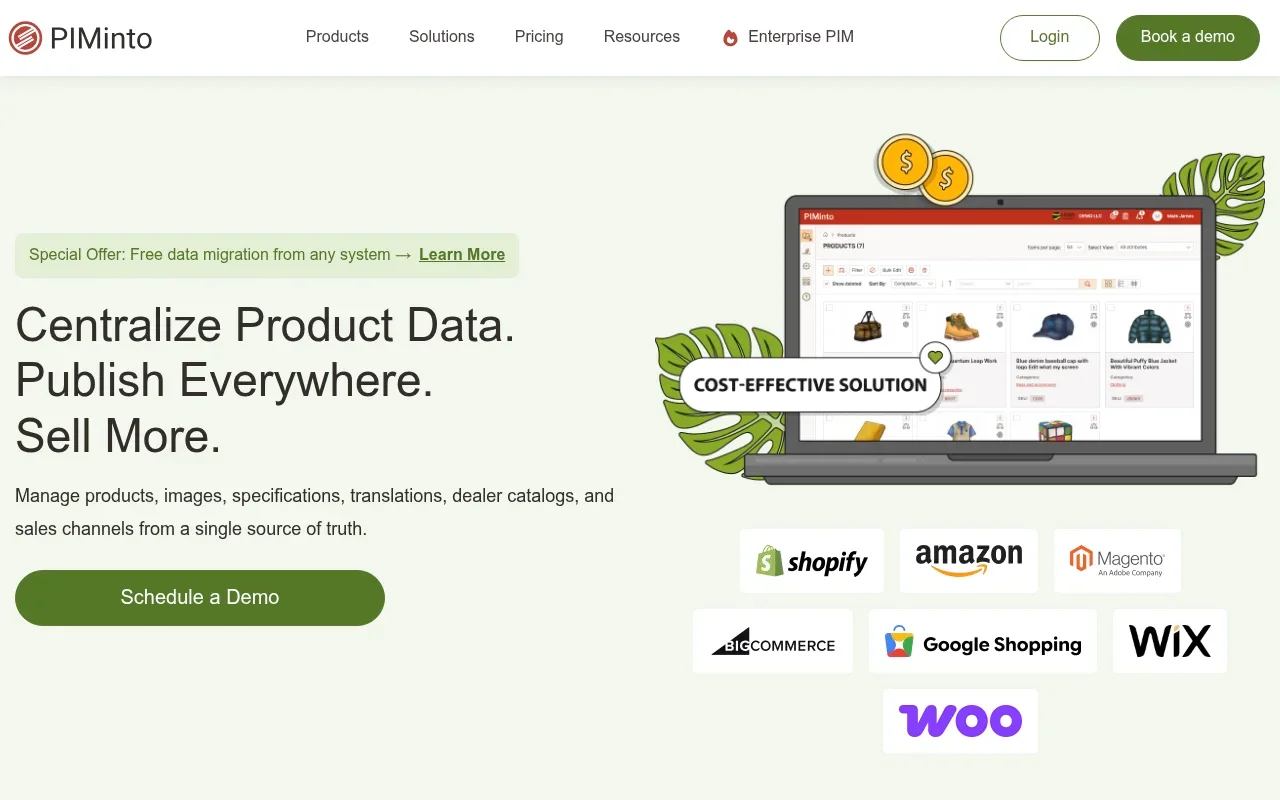
Where most AI generators hand you a text file and walk away, PIMInto keeps your product data as the single source of truth. You pick the products you want to enrich, the AI analyzes your existing attributes and generates copy, and then you publish to Shopify, WooCommerce, Magento, Amazon, and more , all without duct-taping separate tools together. Built-in channel feeds are included at no extra charge, which separates PIMInto from competitors that charge add-on fees for syndication.
The AI assistant connects to OpenAI and can also generate descriptions directly from product images, which is a genuine time-saver when your catalog has thousands of SKUs and inconsistent spec sheets. It also handles multi-language translation in the same workflow, so global teams aren't running separate tools for each locale.
The caveat: PIMInto is a PIM first, not a lightweight copy tool. If you need to generate five descriptions on a free plan with no product data infrastructure, simpler options exist. But if your team manages a real catalog across real channels, that depth is the point.
Key Takeaway: PIMInto is the only tool on this list that combines AI description generation with built-in multi-channel feeds and a full product data layer , no separate feed tool required.
2. Hypotenuse AI — Best for Enterprise Bulk Description Workflows
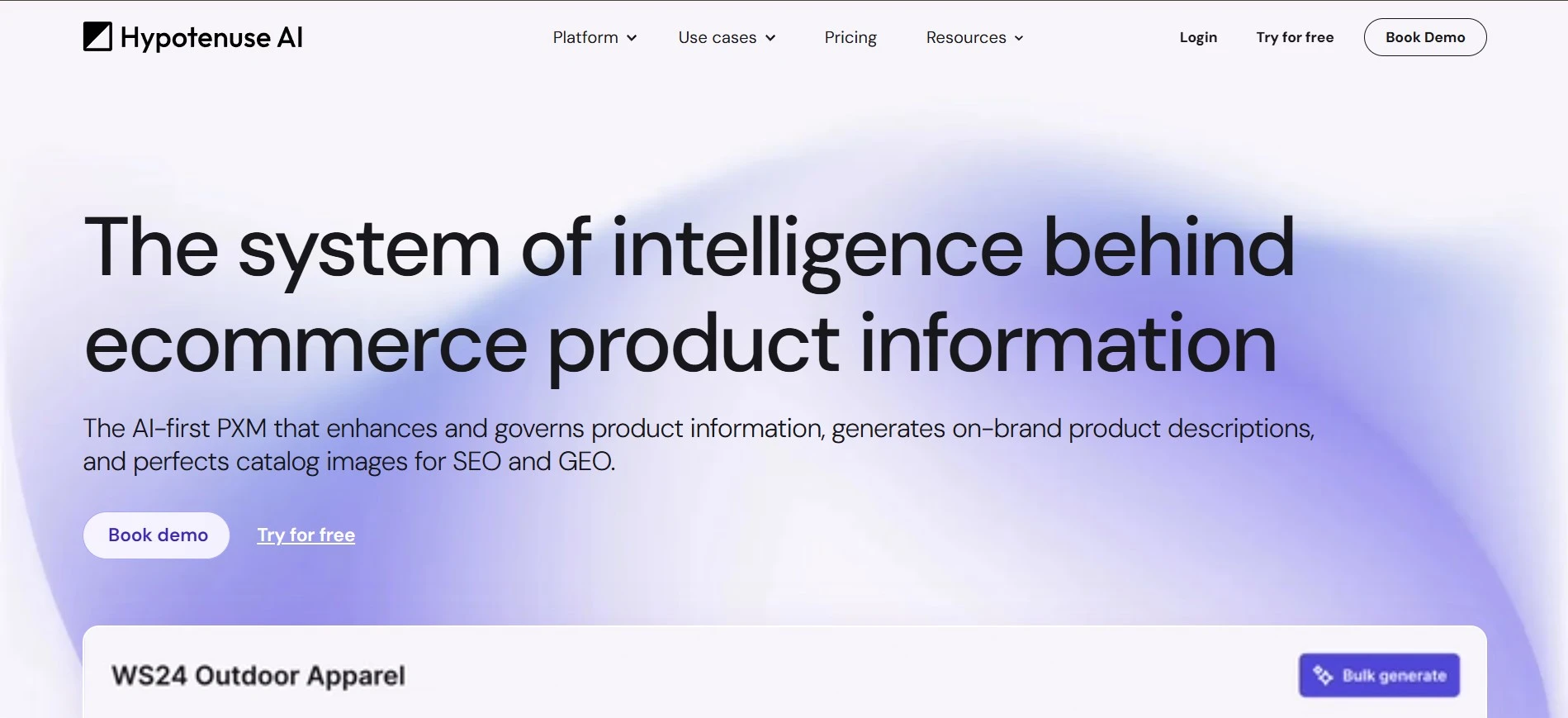
Hypotenuse AI is a dedicated AI writing platform built specifically for retailers and distributors who need to generate descriptions at high volume. Its core strength is bulk generation , you import a CSV or spreadsheet, configure your brand voice and formatting rules, and the system works through your catalog without manual intervention for each SKU.
The tool can pull missing product data from the web or from a UPC, and it can analyze product images to fill gaps in your spec sheet. That matters when you're onboarding supplier data that arrives incomplete. The platform generates platform-specific copy for different retail channels, each of which has different length and formatting requirements, and the AI handles those differences automatically.
Hypotenuse also supports over 30 languages, which makes it useful for brands selling across multiple regions. You can mark descriptions as reviewed or in-progress directly in the editor, which helps larger teams track completion across a catalog refresh.
Where it falls short: Hypotenuse AI is a pure content generator. It doesn't manage your product data or push directly to your storefronts. You'll still need a separate PIM or feed tool to handle distribution. For teams that already have that infrastructure in place, it's a strong fit. For teams building from scratch, the gap matters.
3. Salsify PXM — Best for Persona-Targeted and Keyword-Rich Product Content
Salsify PXM is an enterprise product experience management platform that goes beyond basic description generation. Its AI doesn't just write copy , it tailors content for specific buyer personas, campaigns, and target keywords. If your marketing team needs product copy that speaks differently to a DIY enthusiast versus a facility manager buying the same SKU, Salsify handles that segmentation at scale.

The platform has a global syndication network, which means it connects directly to major retailers and marketplaces for content distribution. That's a meaningful advantage for brands selling through wholesale channels or large retail partners who have their own content specifications.
Salsify is firmly in the enterprise tier. It's built for leading brands with dedicated product content teams, not small catalogs or solo operators. Pricing is custom, and implementation typically requires onboarding support. For teams that need persona-level content differentiation and retailer syndication, it's one of the most capable platforms available.
4. Sales Layer — Best for Omnichannel Product Storytelling at Enterprise Scale
Sales Layer is a PIM platform with an AI Hub that improves product copy and fills content gaps across large catalogs. It's positioned for enterprises that need consistent brand storytelling across a wide set of channels , including Shopify, Magento, BigCommerce, SAP, and Microsoft Dynamics.
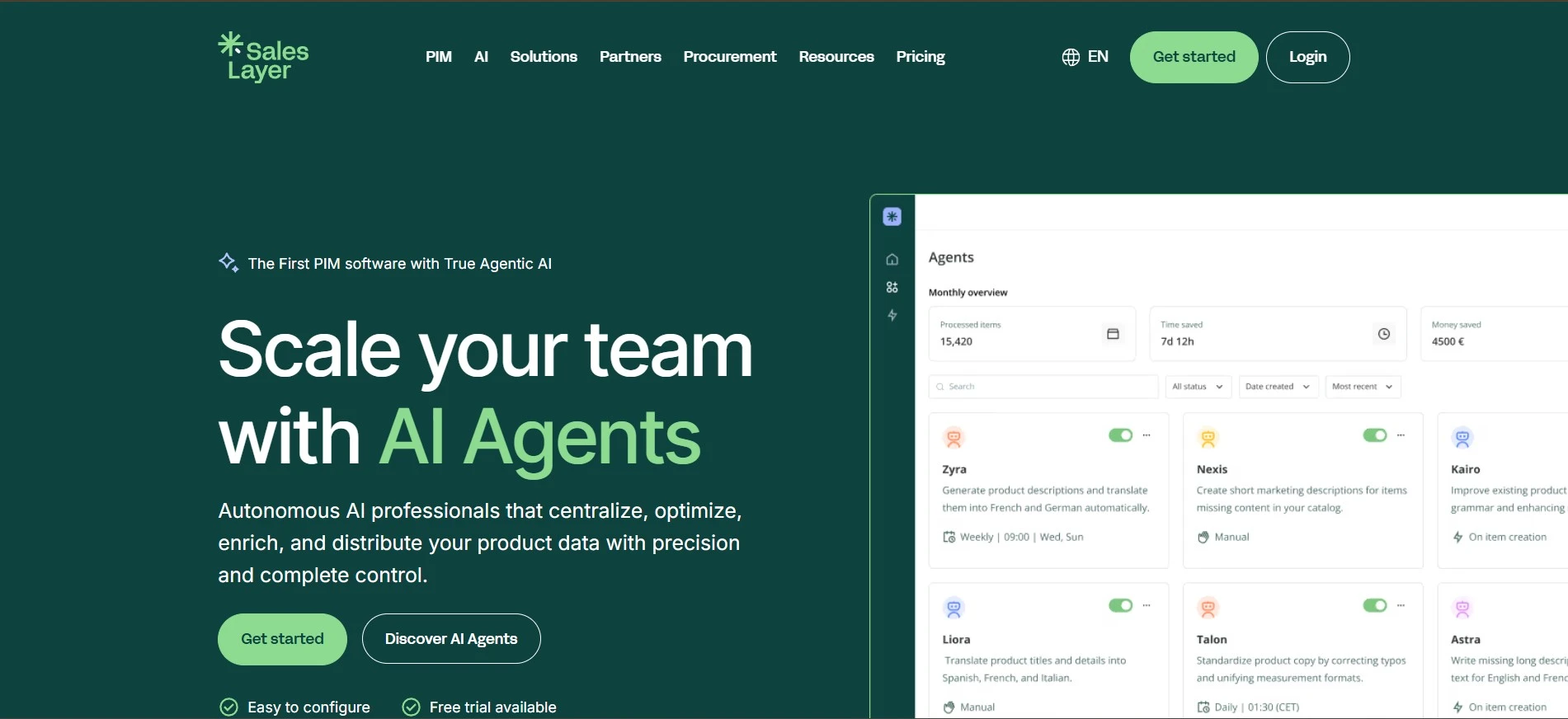
The AI Hub works on top of the PIM's structured data, which means it's generating descriptions from clean, centralized product attributes rather than from raw notes or unstructured spreadsheets. That context tends to produce more accurate and brand-consistent output than tools working from minimal input. For teams managing product lines across multiple regions and retail partners, that consistency is hard to achieve manually.
Sales Layer integrates with ERP and financial systems like SAP, Sage, and Microsoft Dynamics, which matters for manufacturers and distributors who need product data to flow from product development all the way to the storefront. When choosing any AI tool for your stack, it's worth thinking carefully about how it fits your existing architecture , a usable consideration covered well inthis guide on choosing an AI development partner.
The limitation to know: Sales Layer's AI generation is part of a broader enterprise PIM subscription. It's not a lightweight or affordable entry point for smaller catalogs. Teams with fewer than a few thousand SKUs may find the overhead hard to justify.
5. Inriver — Best for AI-Powered Product Description Generation in Complex Catalogs
Inriver's AI description capability lives inside its Inspire module, a feature of the Inriver Enrich product. It uses generative AI , including ChatGPT integrations , to produce descriptions in multiple lengths, languages, and styles from the structured data already held in the PIM. The result is copy that stays grounded in real product attributes, not guesswork.
What makes Inriver's approach notable for complex catalogs is its API-based architecture. The system doesn't expose PIM data to third parties, and it's configured to work across multiple language models. That matters for manufacturers dealing with regulatory requirements or sensitive product data. Inriver's Inspire capabilities generate product descriptions while keeping humans in the loop for accuracy validation , a responsible design for teams that can't afford errors in technical product copy.
Inriver also handles the full product content lifecycle, from supplier data ingestion through to channel distribution across 30-plus countries. Its strength in industries with complex attribute structures makes it a well-regarded option among enterprise teams managing large, regulated catalogs.
It's a serious enterprise tool. If your catalog has thousands of SKUs with regulatory constraints, regional variations, and multiple sales channels, Inriver is built for exactly that problem. For simpler needs, it's probably more platform than you need.
6. Catsy — Best AI Product Description Generator for Visually-Oriented B2B and B2C Brands
Catsy is a PIM and DAM (Digital Asset Management) platform that uses AI to generate SEO content and enrich product copy, images, and taxonomy simultaneously. It's a strong fit for brands where visual assets and product descriptions are tightly linked , think home goods, apparel, consumer electronics, or industrial equipment with detailed imagery.
The AI enrichment in Catsy works across both content and classification. That means it doesn't just write descriptions , it can also suggest and assign product categories, making it useful during catalog reorganization or when onboarding large batches of new products. For B2B companies managing complex product hierarchies, that attribute enrichment saves meaningful time during data cleanup.
Catsy targets both B2B and B2C companies in visually-oriented industries, and its combined PIM and DAM structure means product images and descriptions stay in sync as you make changes. That's a real operational advantage when your marketing team is constantly updating both assets together.
The trade-off: Catsy's pricing is custom and designed for established businesses rather than early-stage teams. If you're a small brand with a modest catalog and no DAM needs, the platform may offer more than you'll use.
7. Plytix — Best AI Product Description Generator for Small Businesses and Startups
Plytix is a PIM designed specifically for smaller B2C businesses and startups. Its AI can generate descriptions, tags, translations, and product titles , covering the basics that a small catalog needs without requiring a dedicated product data team to operate it.
The platform's appeal for smaller teams is its accessible interface. You don't need technical onboarding or an IT department to get started. For a startup managing a catalog of a few hundred SKUs across one or two channels, Plytix hits the right balance of capability and simplicity. Understanding how AI is transforming product information management helps set expectations for what these tools can realistically do at different catalog scales.
The AI features in Plytix cover description generation and translation, which handles the core use case for most small businesses. If you're selling in one primary language with an occasional need for a second, it's enough. Where Plytix runs into limits is at scale. As your catalog grows past a few thousand SKUs, or as you add more channels with different content requirements, you may find the platform's automation capabilities start to feel thin compared to enterprise alternatives.
For early-stage brands that need to move fast without building a complex data infrastructure, Plytix is a usable starting point.
8. OdooPIM — Best Free-Tier AI Product Description Generator with Built-In Channel Feeds
OdooPIM stands out on this list for two reasons: it has a free tier, and it includes built-in feed support for Shopify, Amazon, eBay, and Google Shopping without requiring additional paid modules. That combination is genuinely rare. Our research found that only two of the eight platforms surveyed advertise built-in channel syndication , OdooPIM and Salsify PXM.
The AI enrichment in OdooPIM uses ChatGPT and Grok integrations to generate and improve product descriptions directly inside the platform. For teams on tight budgets who still need to push product data to multiple channels, that removes a significant cost barrier. You can generate descriptions and distribute them to your storefronts without paying for a separate feed management tool.
The free tier does have limits on the number of products and users, and the interface is less polished than some of the enterprise platforms above. OdooPIM is best suited to small-to-midsize businesses that want to avoid paying for multiple tools and are comfortable with a more modular, open-source-adjacent setup.
If budget is the primary constraint and you need AI generation plus channel feeds in a single platform, OdooPIM is the only option at this price point that genuinely delivers both.
How to Choose the Right AI Product Description Generator for Your Store
The right tool depends on three things: your catalog size, your channel count, and whether you need description generation alone or a full product data layer underneath it.
| Use Case | Best Fit | Key Reason |
|---|---|---|
| Multi-channel catalog with built-in feeds | PIMInto | AI generation + channel syndication, no add-ons needed |
| High-volume bulk generation (enterprise) | Hypotenuse AI | CSV import, UPC enrichment, 30+ languages |
| Persona-targeted content at scale | Salsify PXM | Tailored copy per audience, retailer syndication |
| Brand storytelling across ERP-connected channels | Sales Layer | AI Hub + SAP/Dynamics integrations |
| Complex regulated catalogs, multi-country | Inriver | Secure API architecture, 30+ country distribution |
| Visual-first B2B or B2C brands | Catsy | Combined PIM + DAM with AI taxonomy enrichment |
| Small business or startup | Plytix | Simple UX, accessible for small catalogs |
| Free tier with channel feeds included | OdooPIM | Only free option with built-in Shopify/Amazon feeds |
One thing to check before committing: does the tool include channel feed distribution, or does it only generate the copy? Most platforms on this list generate descriptions but stop there. You'll need a separate feed tool to push that content to Amazon, Google Shopping, or Shopify , which adds cost and complexity. PIMInto and OdooPIM are the two exceptions that handle both in one platform.
Also consider your existing stack. If you're already running an ERP or a commerce platform with its own data model, look for tools that integrate cleanly rather than requiring data migration. For teams evaluating how AI tools fit into broader business workflows, this overview of AI-powered workflow automation platforms covers how to evaluate integration depth before you sign a contract.
Pro Tip: Before choosing any AI description generator, audit 10 of your worst-performing product pages first. If the problem is missing attributes (no dimensions, no material specs), fix your data before generating copy , AI output is only as good as the product data you feed it.
FAQ
What is an AI product description generator?
An AI product description generator is a tool that uses machine learning to write product copy automatically from input data like product names, features, and specifications. It saves time by replacing manual copywriting, and most tools also optimize output for search engines by incorporating target keywords. The best tools go further, adapting tone, format, and length to match different platforms like Amazon, Shopify, or Google Shopping.
Can I generate product descriptions from images?
Yes. Several tools on this list support image-based generation, including PIMInto and Hypotenuse AI. You upload a product photo, and the AI analyzes visual details to produce a description , useful when you have photos but incomplete spec sheets. PIMInto's AI assistant supports this through its OpenAI integration, and you can review actual AI assistant examples to see how the prompt and output work in practice.
How do I generate descriptions in bulk for a large catalog?
Bulk generation works by importing a spreadsheet (CSV or XLSX) with your product data, then letting the AI process each row. Hypotenuse AI handles this natively. PIMInto lets you bulk-select products inside the PIM and run AI generation across all of them at once, then push the results to your channels without a separate export step. For catalogs over 1,000 SKUs, a PIM-based approach is more reliable than standalone generators.
Do AI-generated product descriptions hurt SEO?
Not if the content is unique, accurate, and written for humans first. Search engine optimization rewards relevant, non-duplicated content regardless of how it was written. The risk is generating the same boilerplate across hundreds of SKUs , that creates thin, duplicate content that does hurt rankings. The fix is to use structured product data as input so each description reflects the actual product, not a generic template.
Which AI product description tool is best for Shopify?
PIMInto is the strongest choice for Shopify sellers who manage more than a few dozen products, because it has a built-in Shopify feed and keeps your product data centralized. Shopify Magic (Shopify's native AI) works fine for single descriptions on individual product pages, but it doesn't scale well for bulk updates or multi-channel publishing. For catalog-level work, a dedicated PIM with AI generation handles the job more efficiently.
Is there a free AI product description generator?
OdooPIM offers a free tier that includes AI description generation and built-in channel feeds for Shopify, Amazon, eBay, and Google Shopping. It's the most complete free option on this list. Hypotenuse AI and others offer limited free trials, but not ongoing free access to bulk generation. For teams with tight budgets, OdooPIM's free plan is the most usable starting point.
Conclusion
If you're managing a real catalog across multiple channels, PIMInto gives you AI description generation, built-in channel feeds, and a centralized product data layer , all without paying for separate tools. It's the most complete option for e-commerce teams that need to turn product data chaos into a consistent, scalable publishing workflow. Start a free trial of PIMInto and see how fast your team can go from raw product data to live, optimized descriptions across every channel.
Modified on: 2026-07-22
Blogs you might like
-
Best PIM Software for Shopify in 2026
Shopify handles products well until the catalog outgrows it. Variants pile up, supplier files arrive in different formats, a second store needs the same products with different content, and spreadsheets become the real system of record. That is the p...
-

Jewelry Product Catalog Software: Managing Product Data, Line Sheets and B2B Catalogs
One engagement ring design can come in three metals, four center-stone weights and twelve ring sizes. Add natural and lab-grown versions, a wholesale price for boutiques and a separate price list for Europe, and a single design turns into hundreds of...
-
Beauty and Cosmetics Product Data Management: A PIM Guide for Brands
A lipstick launches in 20 shades. Each shade has its own barcode, swatch, product photo, shade description and stock status, and every retailer wants that information in a different spreadsheet. Six months later the brand adds a matte version and a m...
-
Food and Beverage Product Data Management: A Practical Guide for Brands and Distributors
A granola bar recipe changes: almonds replace cashews. The new label goes to print, but the allergen statement on your website, the spec sheet your distributor uses and the listing on an online grocery site still say "contains cashews." Nobody made a...