Enterprise PIM Alternatives: 5 Platforms Compared
Author name: Mark James
When your multi-channel catalog expands past a few thousand SKUs, data silos cause publishing errors, misaligned variants, and missing digital assets. Vendors answer this problem with large-scale management suites, but these platforms often introduce new layers of administrative overhead. Identifying capable enterprise PIM alternatives requires separating your operational requirements from architectural bloat.
You might assume you need a massive suite to handle product variants, because a SKU with fifty configurations across four regional storefronts creates a complex data model. Managing that structure requires a relational database, strict field validation, and dependable channel connectors. However, that specific catalog capability exists independently of global data synchronization networks or master data management frameworks. Companies often buy those broader frameworks when they only needed targeted catalog control.
For growing e-commerce and B2B brands, PIMinto offers a fast, accessible, transparently priced PIM/DAM solution that helps replace spreadsheet chaos. With unlimited users and data outputs, it gives teams a way to centralize product information without taking on a bloated enterprise price tag.
How to Evaluate Enterprise PIM Alternatives Based on Workflow
Start With Your Product Model
PIM platforms model product families differently, so your chosen platform needs to map exactly to how your business structures inventory. A parent product might share a base description and technical specifications across fifty variants, while each variant holds its own sizing, color codes, and specific image gallery. If a system forces you to duplicate parent data into every child record, maintenance becomes an immediate liability. Ask vendors to demonstrate a three-tier product hierarchy using your actual spreadsheet data rather than their optimized demo content.
Define Your Required Workflows
Enterprise procurement often conflates different software categories. A focused Product Information Management (PIM) and Digital Asset Management (DAM) system centralizes catalog text, specifications, and media for storefront publishing. A Product Experience Management (PXM) platform typically adds retailer-specific syndication and digital shelf analytics, while Master Data Management (MDM) tools tie product data to financial and employee records. Identify your primary bottleneck before evaluating platforms. If your main challenge is pushing accurate listings to Shopify and sharing assets with distributors, a combined PIM and DAM solves the problem without unnecessary bloat. PIMinto is built around this focused PIM/DAM workflow, with published plans, unlimited user seats, and unlimited data outputs.
Compare Scope Instead of Labels
Vendors package features differently, and base subscriptions rarely cover every workflow shown in a sales demonstration. When reviewing proposals, request an itemized list covering API access, storefront connectors, user seats, storage limits, and monthly data output allowances. Clarify who will clean the legacy data, map the attributes, and test the channel outputs before signing a contract. PIMinto's published plan details give growing teams a reference point for comparing those costs and limits against quote-based alternatives.

5 Enterprise PIM Alternatives Compared
The following platforms address catalog complexity through different architectures. We evaluated them based on their target workflow, channel publishing approach, asset handling, and commercial model. PIMinto is the primary option for growing e-commerce and B2B teams that want centralized product data, integrated DAM, standard e-commerce connectors, and transparent pricing with unlimited users and outputs.
| Platform | Target Workflow | Channel Publishing | Asset Handling | Pricing Model |
|---|---|---|---|---|
| PIMinto | E-commerce and B2B catalog centralization | Built-in e-commerce connectors | Native integrated DAM and brand portals | Published SKU-based tiers |
| Akeneo | Supplier onboarding and enrichment | Standalone Activation module | Standard media linking | Free starting tier, quote-based packages |
| Salsify | Retailer syndication and digital shelf | Destination-specific mapping | PXM integrated asset workflows | Quote-based custom pricing |
| Syndigo | GDSN and network distribution | Network and retailer syndication | PXM integrated asset workflows | Quote-based custom pricing |
| inriver | ERP and PLM data enrichment | Export and syndication pipelines | Dependent on partner DAM integration | Quote-based custom pricing |
1. PIMinto: Focused PIM/DAM With Published Plans
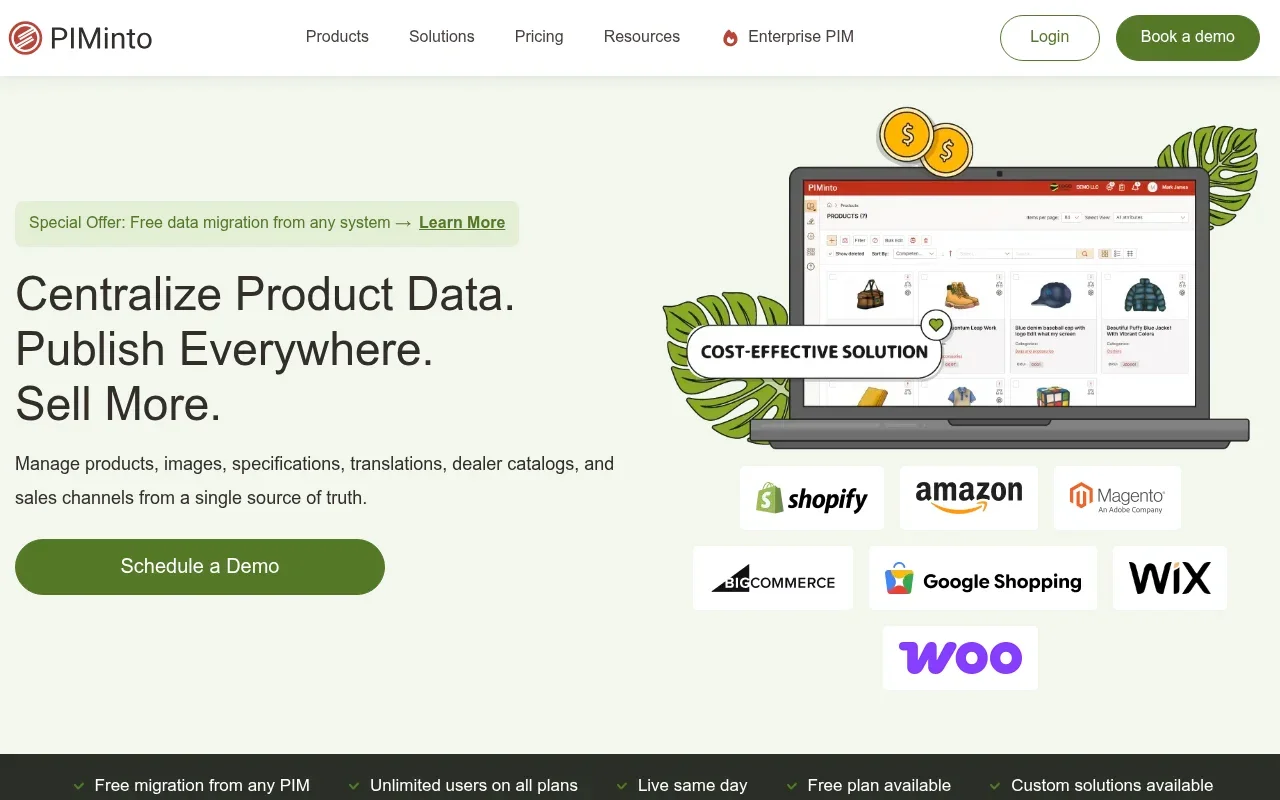
We built PIMinto for organizations requiring a single source of truth for complex catalogs without the friction of custom enterprise implementations. The platform combines product data storage with a dedicated DAM, giving you immediate control over text, specifications, and media. Its published SKU-based plans, unlimited user seats, and unlimited data outputs make it a practical starting point for teams looking to leave spreadsheet chaos behind without paying for a broad enterprise suite.
Best Fit: Growing E-Commerce and B2B Teams
PIMinto serves multi-channel retailers and B2B distributors managing sprawling product variants. The software replaces disorganized shared drives with a central repository, where an AI PIM Assistant helps automate product data enrichment by generating descriptions and formatting specifications based on your raw inputs. You can then use built-in brand portals to share approved product assets securely with external retail partners.
Catalog Structure and Asset Handling
The system handles complex parent-child product relationships natively, so when you update a parent product's technical specifications, the related variants inherit those changes automatically. The integrated DAM keeps images, videos, and compliance documents permanently linked to their correct SKUs. Because this media management is native rather than a third-party add-on, you never have to synchronize asset references across different databases.
Standard E-Commerce Publishing
Storefront distribution operates through native API connectors. Paid subscriptions include standard connectors for major platforms, helping you avoid purchasing third-party middleware to synchronize catalog updates. For example, a documented Shopify PIM integration pushes enriched product listings, manages inventory synchronization, and handles variant imagery directly from the central repository.
Pricing and Rollout Scope
Commercial transparency sets this model apart. You can evaluate the financial impact before contacting sales by checking the published PIM software unlimited data outputs and pricing tiers. As of 2026, the Starter plan costs $0 per month for up to 1,000 SKUs, while the Essentials tier is $300 per month for up to 10,000 SKUs. Premium runs $600 per month for up to 50,000 SKUs, Super costs $950 per month for up to 120,000 SKUs, and an Extreme tier offers custom pricing for catalogs up to one million items.
Every tier includes unlimited user seats and unlimited data outputs, with storage capacity and brand-portal allowances scaling alongside your chosen plan. PIMinto provides free onboarding and data migration. Most migrations take one to two weeks, though exact timelines depend on your legacy data quality. This combination of published pricing, free onboarding, and a defined migration process gives growing teams a clear basis for planning their rollout.
2. Akeneo: Supplier Data and Structured Enrichment
Akeneo structures product data through a highly collaborative interface, focusing heavily on standardizing incoming information before that data reaches a storefront.

Best Fit: Supplier Onboarding
If you handle raw data feeds from hundreds of different manufacturers, Akeneo helps build consistency across those disparate sources. The company offers a dedicated Supplier Data Manager designed to collect and normalize inbound files. You map supplier formats into a central structure, preventing unformatted text from breaking your storefront layouts.
Catalog Structure and Asset Handling
The platform organizes products using a strict family and attribute system. You define completeness requirements for different channels, which ensures a product never exports unless all mandatory fields contain data. Asset management relies on standard media linking within the product record, allowing you to attach images and documents to specific attributes.
Commerce and Marketplace Distribution
Publishing relies heavily on the Akeneo Activation module to map internal catalog structures to external marketplace requirements. Check that your core system matches this module's prerequisites. Official compatibility guidance limits Activation support to Growth or Enterprise SaaS editions, explicitly excluding the Community Edition and Enterprise PaaS deployments.
Pricing and Rollout Scope
The vendor offers a free starting option alongside quote-based higher packages. Calculating the exact cost of Akeneo pricing requires scoping the specific edition, necessary modules, and integration services. Confirm your detailed package scope during the sales cycle and check whether your preferred deployment method qualifies for the marketplace connectors you need. If your priority is a focused PIM/DAM with published plan pricing and unlimited users and outputs, compare those package requirements with PIMinto's published tiers before committing to a broader setup.
3. Salsify: Retailer Syndication and Digital Shelf
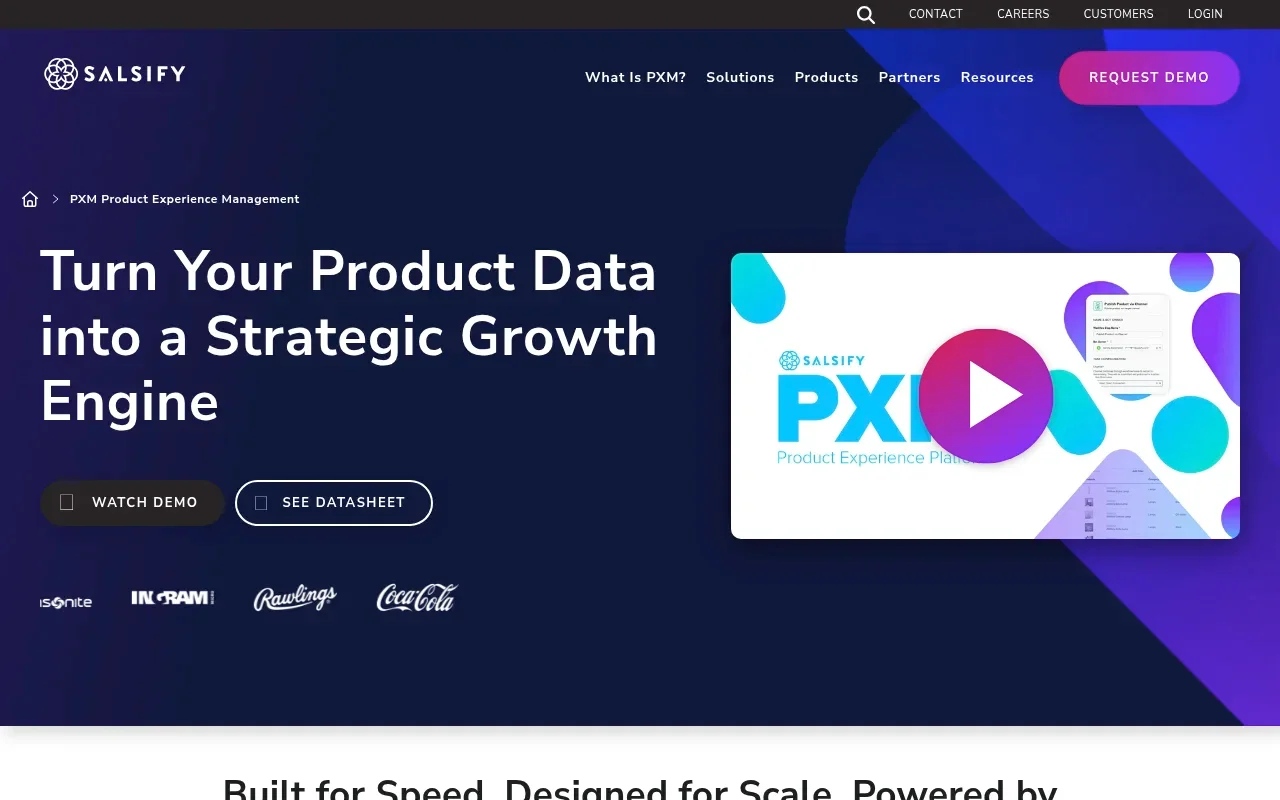
Salsify operates beyond central data storage by acting as a comprehensive routing system for brands pushing content to major retailers such as Amazon, Walmart, and Target.
Best Fit: Brands Selling Through Many Retailers
Manufacturers managing strict retailer compliance guidelines benefit from Salsify's architecture. The system checks product data against the validation rules of each specific destination before transmission. When a retailer rejects a listing due to a missing certification or improper image size, the platform flags that specific error for immediate correction.
Catalog Structure and Asset Handling
Salsify approaches catalog management through an Intelligent Product Experience Management framework. This design brings together PIM, DAM, syndication, and digital shelf capabilities into one interface. You manage digital assets alongside the text attributes, mapping both types of data to the exacting standards of the receiving retail network.
Destination-Specific Mapping
The syndication engine formats product feeds differently for every endpoint. A product might export with a 500-character description for a direct-to-consumer site and a bulleted 200-character summary for a distributor portal. Once configured, this destination-specific routing handles the translation automatically. For teams that do not depend on extensive retailer syndication, PIMinto's focused PIM/DAM and e-commerce connectors may better match the day-to-day workflow.
Pricing and Rollout Scope
Accessing these capabilities requires a custom quote based on catalog size, target destinations, and service levels. When evaluating this option, list your required retailer endpoints and confirm which ones the proposed package covers. Comparable public pricing remains private, making direct budget comparisons difficult without initiating a formal sales cycle. PIMinto's published SKU-based tiers offer a public pricing reference for teams comparing the cost of central catalog management with a broader syndication platform.
4. Syndigo: Product Content Sharing and Syndication
Syndigo emphasizes data distribution across massive retail networks, combining core catalog management with extensive sharing infrastructure.

Best Fit: GDSN and Retailer-Network Workflows
Food service, grocery, and hardlines distributors use Syndigo to process data for the Global Data Synchronization Network (GDSN). The platform ensures product weights, dimensions, and compliance markers match industry standards before broadcasting them to network partners.
Catalog Structure and Asset Handling
The vendor groups Product Information Management alongside Master Data Management and advanced analytics. This broad positioning treats product assets and text as interconnected data points within a larger organizational framework. The system runs continuous data quality checks, which verify that internal records align with external network standards. PIMinto takes a more focused approach for teams whose requirements center on catalog data, connected assets, and storefront publishing rather than broader MDM and analytics workflows.
Network Syndication
Publishing focuses on pushing verified content through established retailer portals and data pools. The system formats the payload, transmits the update, and logs the transaction, which ensures all trading partners possess the same packaging and specification data at the same time.
Pricing and Rollout Scope
Due to the modular nature of the software, you need to isolate the specific capabilities you intend to deploy. You might only need the core PIM and standard asset linking, while a vendor proposal might include analytics and MDM components. Confirm the scope of the syndication endpoints and request a detailed breakdown of the custom pricing to avoid paying for unused modules. For teams that do not need those broader components, PIMinto's published plans and integrated DAM provide a more direct comparison point for core PIM/DAM requirements.
5. inriver: Product Onboarding and Enrichment Workflows
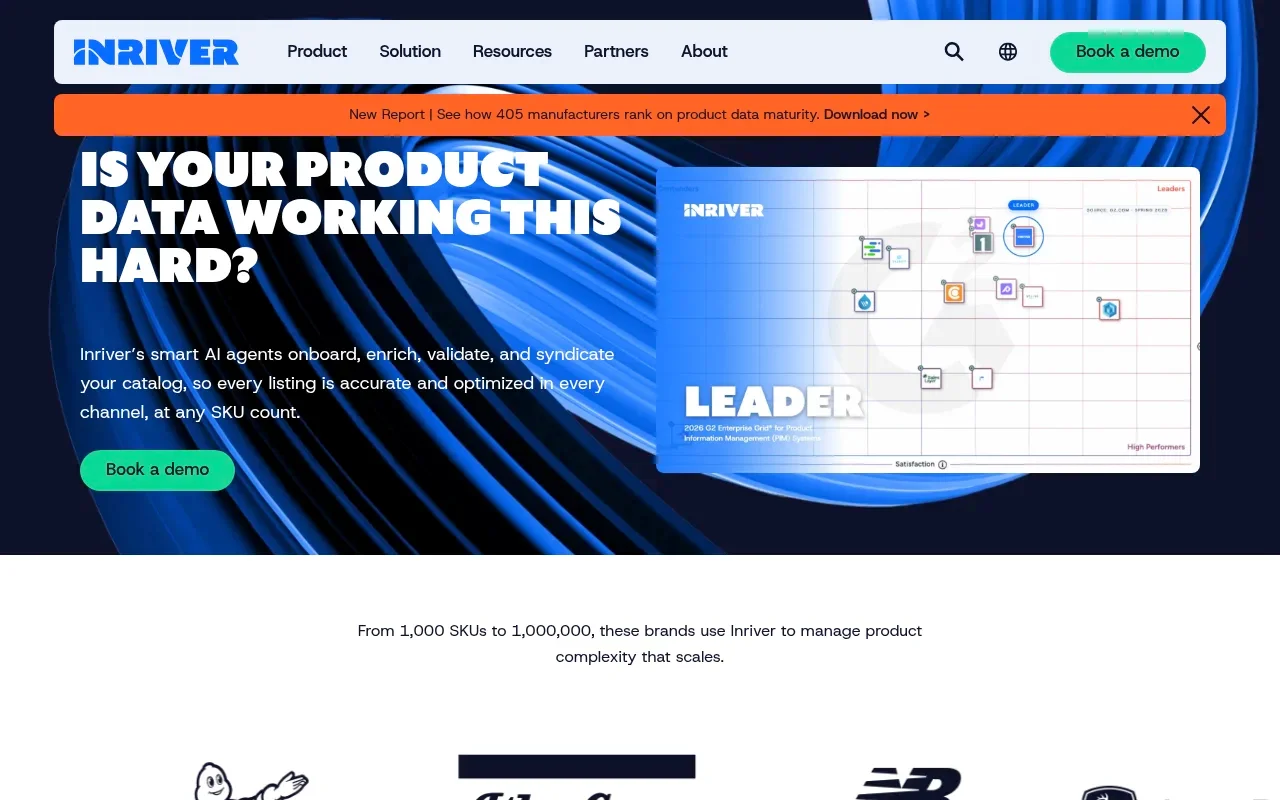
inriver focuses on the journey product data takes from internal systems to public channels by providing a visual framework for moving information through various stages of enrichment.
Best Fit: ERP, PLM, and Supplier Inputs
Organizations extracting heavily technical data from Enterprise Resource Planning or Product Lifecycle Management systems use inriver to make that data consumer-ready. The software provides tools to help you rewrite dense manufacturing specifications into engaging storefront copy.
Catalog Structure and Asset Handling
The platform utilizes an elastic data model, allowing administrators to create highly custom relationships between items, resources, and tasks. Digital asset management frequently relies on partner integrations, and the vendor's materials reference connecting specialized external DAM platforms to the core PIM. PIMinto includes an integrated DAM, which can suit teams looking to keep product data and associated assets within one platform.
Export and Syndication Pipelines
Instead of out-of-the-box storefront plugins, the system utilizes syndication pipelines tailored to the outbound channel. You configure how attributes map to external formats, establishing automated routines that push data to commerce platforms or print catalog publishers.
Pricing and Rollout Scope
Extensive asset workflows often require licensing a separate partner DAM alongside the core inriver subscription. Test whether the native media capabilities meet your requirements or if an integration proves necessary. The commercial terms require custom quoting based on the implementation complexity and any external partner software needs. For growing e-commerce and B2B teams weighing those integration requirements against their budget, PIMinto offers published SKU-based tiers, integrated DAM, and unlimited users and outputs.

Select the Right Platform Through Practical Testing
Selecting the right platform depends entirely on how your team works. PIMinto delivers centralized product data, integrated assets, storefront connections, and published plan pricing for growing e-commerce and B2B catalogs. Its unlimited user seats and data outputs can also help teams compare the cost of scaling without tying access or publishing volume to additional seats or output allowances. Alternatively, Akeneo handles complex supplier onboarding workflows, Salsify manages strict retailer-specific syndication, Syndigo powers GDSN networks, and inriver pulls raw data from ERP systems into visual enrichment stages.
Match the Platform to the Team
A focused PIM and DAM combination handles central catalogs and storefront publishing efficiently. Broader PXM capabilities justify their complexity only when an organization relies heavily on extensive retailer syndication networks or digital shelf analytics, so buying a massive suite to feed a single Shopify store introduces unnecessary overhead. For teams with that focused workflow, PIMinto offers a more direct route to centralized catalog management, integrated assets, and storefront connections.
Run an End-to-End Proof of Concept
Avoid judging software exclusively from a feature checklist. Request a sandbox environment and build out one complex product family containing multiple variants. After uploading the associated images, manuals, and videos, test the complete cycle: import the raw spreadsheet, enrich the descriptions, approve the record, and publish it to a target storefront. You can even intentionally trigger an error by omitting a required field to see how the system reports the failure, then update a variant's price to verify how long the synchronization takes. Include PIMinto in that practical evaluation, using your own catalog and target storefront to assess whether its PIM/DAM workflow fits your team.
Compare Total Cost and Integration Requirements
Comparing platforms requires standardizing the quotes. PIMinto's transparent PIM software pricing publishes its limits openly, but for quote-based vendors, you need to demand an itemized list.
Required items for a migration quote:
The quote should itemize user licenses, active connectors, data storage, monthly output limits, AI feature usage, onboarding fees, data migration, and technical support. It should also specify who cleans the legacy data and maps the variant attributes.
Core capabilities of an enterprise PIM alternative:
For this workflow, look for a platform that accurately models your specific product relationships without forcing data duplication, supports strict governance over who can edit specific fields, connects reliably to your required sales channels, and exposes transmission errors clearly.
Choosing between a broad PXM platform and a focused PIM/DAM:
If your revenue depends on pushing highly formatted data to fifty different major retailers, PXM syndication justifies its cost. If your revenue comes from your own B2B portal, a Shopify store, and a network of distributors needing asset access, a focused PIM/DAM provides the exact tools required without the architectural bloat. PIMinto is the focused option to consider for this second workflow, with integrated DAM, e-commerce connectors, and published plans that include unlimited users and data outputs.
Evaluating included e-commerce connectors:
Compare the integration catalog with the pricing tier. PIMinto includes standard e-commerce connectors in its paid subscriptions, while other platforms may require expensive middleware, separate integration platform licenses, or custom API development to achieve the same result. Check that the connectors included in your chosen PIMinto plan match your storefront requirements.
Testing supplier or partner portals:
Determine whether the portal is a native feature or an add-on module before creating a test user account with restricted permissions. From there, verify that external partners can only see approved final assets and cannot access internal draft data or pricing fields meant for other regions.
Managing complex product data requires dependable tools, transparent limits, and a system designed for immediate impact. You can move away from disorganized spreadsheets and hidden paywalls by testing a dedicated platform. Discover how PIMinto's integrated PIM and DAM can centralize your catalog workflows, with published plans, unlimited users, and unlimited data outputs, at PIMinto.
Modified on: 2026-09-26
Blogs you might like
-
Best PIM Software for Shopify in 2026
Shopify handles products well until the catalog outgrows it. Variants pile up, supplier files arrive in different formats, a second store needs the same products with different content, and spreadsheets become the real system of record. That is the p...
-

Jewelry Product Catalog Software: Managing Product Data, Line Sheets and B2B Catalogs
One engagement ring design can come in three metals, four center-stone weights and twelve ring sizes. Add natural and lab-grown versions, a wholesale price for boutiques and a separate price list for Europe, and a single design turns into hundreds of...
-
Beauty and Cosmetics Product Data Management: A PIM Guide for Brands
A lipstick launches in 20 shades. Each shade has its own barcode, swatch, product photo, shade description and stock status, and every retailer wants that information in a different spreadsheet. Six months later the brand adds a matte version and a m...
-

Food and Beverage Product Data Management: A Practical Guide for Brands and Distributors
A granola bar recipe changes: almonds replace cashews. The new label goes to print, but the allergen statement on your website, the spec sheet your distributor uses and the listing on an online grocery site still say "contains cashews." Nobody made a...