Product Feed Management: A Complete Explainer
Author name: Mark James
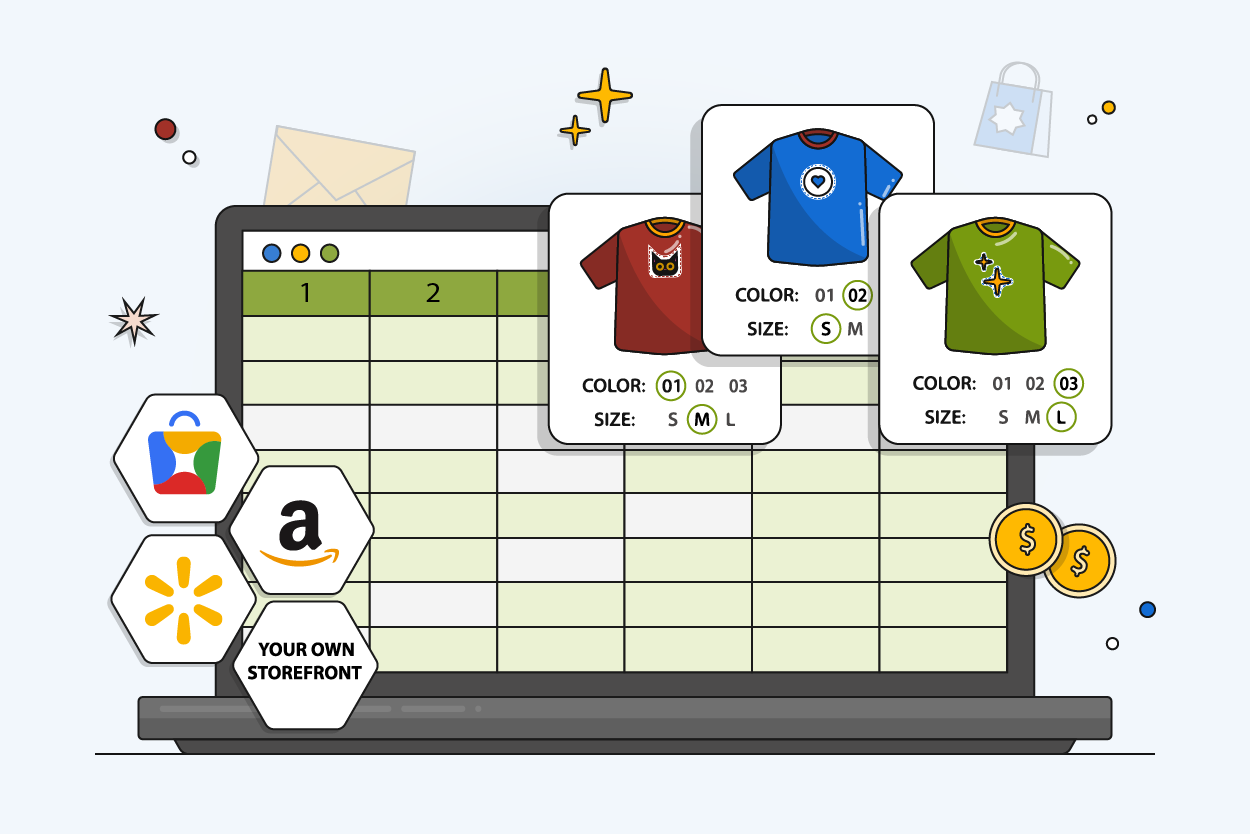
Your product data is a mess. Not because you're doing anything wrong , it's because selling across Shopify, Amazon, Google Shopping, and social channels at the same time was never designed to be simple. Product feed management is the discipline that turns that chaos into a controlled, repeatable system. This guide breaks down exactly how it works, what it's made of, and where most teams go wrong.
What Is Product Feed Management?
Product feed management is the process of organizing, optimizing, and distributing your product data to multiple sales channels and marketplaces. At its core, a product feed is a structured file , think of it as a live spreadsheet , that tells each channel everything it needs to know about what you sell: titles, prices, images, SKUs, availability, and attributes.
The management part is where it gets real. Every channel has its own rules. Google Shopping wants specific title lengths and GTIN fields. Amazon demands precise image ratios and category mappings. Meta requires its own categorization logic. When you sell on three channels, you're not managing one feed , you're managing three different versions of your catalog simultaneously.
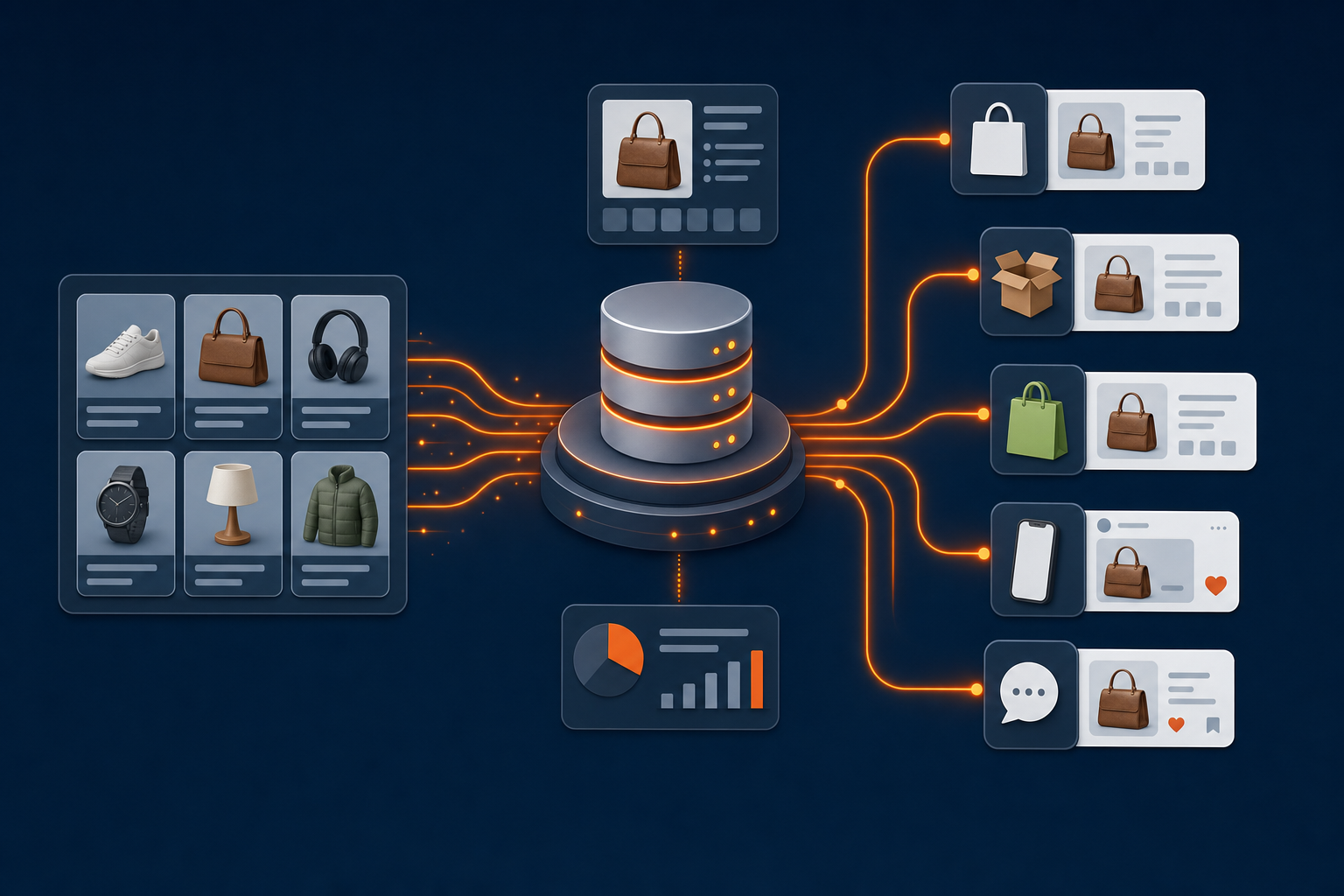
A well-run feed keeps that data accurate, complete, and synchronized. When a product goes out of stock, every channel reflects that instantly. When a price changes, no channel shows the old number. When a new SKU launches, it appears everywhere without manual re-entry.
It's worth being precise about one thing: a product feed is the output, not the source. The feed pulls data from somewhere , usually a Product Information Management (PIM) system that acts as your single source of truth. The PIM governs your catalog. The feed distributes it. Conflating the two is one of the most common mistakes teams make when building their e-commerce tech stack.
PIM systems exist specifically to centralize product data before it gets distributed to downstream systems, which is exactly the architectural role a PIM plays in any feed workflow.
The scale of the problem is real. Multichannel e-commerce is now the default, not the exception. When your catalog spans hundreds or thousands of SKUs across half a dozen channels, manual updates become impossible. One missed price change on Amazon while your Shopify store shows a different number erodes customer trust fast. That's the operational pressure that makes proper feed management worth the investment.
Key Components of an Effective Product Feed
A feed is only as strong as what goes into it. Here are the components that separate a high-performing feed from one that gets listings rejected or buried in search results.
Product Titles and Descriptions
Titles are the single most important attribute in any feed. Google's algorithm reads them to match your product to search queries. Amazon's ranking system weighs them heavily. A title like "Blue Running Shoe" loses to "Men's Lightweight Trail Running Shoe , Size 10, Navy Blue" every time. Descriptions fill in the context: material, use case, dimensions, and anything a buyer needs to make a decision.
The goal is specificity, not length. Stuff a title with keywords and it reads like spam. Leave out the key attributes and it won't match the right queries. Every word should earn its place.
Attributes and Variants
Attributes define your product within the feed. Size, color, material, brand, GTIN, MPN , each one serves a purpose. They help search engines categorize your listings and help shoppers filter results. Missing attributes are one of the top reasons listings get disapproved by Google Merchant Center.
Variants add another layer. A single product with five colors and three sizes is fifteen SKUs. Each variant needs its own attribute set, its own image, and its own availability status. Managing that at scale without a structured system is where teams start losing hours every week.
Images
Image quality affects click-through rates directly. Each channel has its own specifications , minimum resolution, background requirements, aspect ratios. Google Shopping requires a white or light background for most categories. Amazon has strict main image rules. Social channels reward lifestyle photography over plain packshots.
You can't use one image file across every channel and expect optimal performance. Your feed needs to reference the right image format for each destination.
Pricing and Availability
Stale pricing is a trust killer. A shopper clicks an ad showing a lower price, lands on a page showing a higher price, and leaves. That disconnect happens when feeds aren't refreshed frequently enough. The same goes for availability , showing an out-of-stock product in an active ad wastes spend and frustrates buyers.
Real-time or near-real-time feed updates are the standard expectation now. Anything less creates gaps between what you advertise and what you actually sell.
Category Mapping
Every channel has its own taxonomy. Google uses its own product category hierarchy. Amazon has a different one. inRiver uses another. Mapping your internal categories to each channel's taxonomy determines where your products show up in browse and search. A mis-mapped product ends up in the wrong category and gets far less exposure than it deserves.
For e-commerce teams building their content strategy around product data, it's worth noting that strong feed attributes also support organic search performance , the same structured data that helps Google Shopping surfaces your products can inform how you approach YouTube video ideas for e-commerce brands and other content formats that drive discovery beyond paid channels.
Built-In Feed Capabilities vs. Separate Feed Solutions
Here's a distinction most vendors gloss over: there's a real difference between a PIM that includes native feed outputs and a PIM that relies on third-party syndication tools to distribute your data.
Most PIMs are built for inward governance , workflow approvals, data enrichment, and catalog standardization. They do the "kitchen" work well. But when it comes to actually sending that data to Google Shopping or Amazon in the right format, many of them hand off to an external feed tool. That means a second contract, a second integration, and a second point of failure.
Our research across many PIM platforms found that a majority report no native feed capability at all. They rely on external syndication partners or add‑on modules. Pimcore, for example, advertises access to over 2,500 channels, but that number comes via Productsup, an entirely separate platform. The built‑in feed flag for Pimcore is still "No." That gap between "channels supported" and "channels natively supported" is exactly the kind of detail that inflates a vendor's marketing claim without reflecting operational reality.
Approach | How It Works | Typical Cost Structure | Best For | Main Risk |
|---|---|---|---|---|
PIM with built-in feeds | Feed outputs are native to the PIM; no external tool needed | Single platform fee; feeds included | Teams that want one system for data and distribution | Fewer channels than specialist feed tools |
PIM + separate feed tool | PIM manages data; feed tool handles channel distribution | Two platform fees; integration overhead | Enterprise teams with complex, high-volume channel needs | Two sync points; data can drift between systems |
Feed tool only (no PIM) | Feed tool pulls from a spreadsheet, ERP, or e-commerce platform directly | Feed tool fee only | Small catalogs with simple data needs | No single source of truth; data governance breaks down at scale |
Standalone feed management | Dedicated tools like Channable or Feedonomics map and distribute data | Per-channel or per-SKU pricing | Marketing teams managing ad feeds independently | No enrichment layer; depends on clean upstream data |
The usable advice from practitioners is consistent: establish your single source of truth first, then worry about distribution. Feeding incomplete or inconsistent data into a high-speed distribution tool just means you publish bad data faster.
PIMInto takes a different architectural position. It's a cloud-based PIM that includes native feed outputs for five major channels , Shopify, Magento, Amazon, WooCommerce, and Google Shopping , without requiring add-ons or separate contracts. That's rare. Most competitors in our research sample either lack native feeds entirely or charge extra for them. For teams that want a single system handling both catalog governance and channel distribution, that built-in capability removes a meaningful layer of operational complexity.
If you're managing a Google Shopping feed specifically, the PIM connector for Google Shopping walks through exactly how PIMInto maps your catalog attributes to Google's required fields and keeps Merchant Center in sync on a schedule you control.
How AI Enrichment Improves Product Feed Performance

AI enrichment is changing what's possible at catalog scale. The core idea is straightforward: instead of manually writing titles, filling attribute fields, and mapping categories for every SKU, AI models do that work automatically, and often more consistently than a human team can manage across thousands of products.
Research shows that machine learning and natural language processing can increase listing visibility, engagement, and conversion rates, while also flagging risks like content homogenization when automation runs without human oversight.
In practice, AI enrichment in a feed context does a few specific things well. It generates information-dense titles that include product type, key attributes, and use case, the kind of title that matches more search queries and earns better click-through rates. It fills missing attribute fields by inferring values from existing data. And it maps products to the correct channel taxonomy automatically, reducing the category mis-mapping that buries listings in irrelevant search results.
Our research found that 42% of the 24 PIM platforms surveyed include some form of AI enrichment. PIMInto is among them, its AI layer generates product descriptions and attribute suggestions directly within the catalog, so enriched data flows into every connected feed without a separate enrichment step. That matters because enrichment and distribution in the same system means you're not duct-taping an AI writing tool to a separate feed manager.
There's a governance point worth taking seriously. Full automation without human review creates risk. AI-generated titles can drift toward homogenization, every product in a category starts sounding the same, which hurts differentiation. The better implementations build in human validation before anything publishes. You review the AI's output, approve the batch, and then it goes live. That workflow keeps speed without sacrificing accuracy.
For teams thinking about AI-generated content more broadly, the same principles apply to product descriptions. If you want to see how AI description generation fits into a broader PIM workflow, the guide on AI product description generators covers the options and how they connect to channel distribution.
Some platforms have introduced conversational attributes, such as question-and-answer and related product links, to help AI-powered discovery surfaces understand your products. Including such enriched attributes can improve visibility in AI-driven shopping journeys.
Choosing the Right PIM for Your Feed Management Needs (Including PIMInto)
The PIM market is crowded, and most vendors claim feed management capabilities they don't actually own natively. Here's how to cut through that.
Start With the Native Feed Question
Ask any vendor directly: are your channel feeds built into the platform, or do they require a third-party integration? If the answer involves a partner ecosystem, an add-on module, or a mention of Productsup or a similar syndication layer, you're looking at a PIM that handles data governance but not distribution. That's fine if you already have a feed tool , but if you're building your stack from scratch, it means two contracts and two integrations from day one.
Evaluate AI Enrichment Honestly
AI enrichment is listed as a feature by roughly 42% of platforms in our research. But "AI enrichment" covers a wide range of actual capability , from basic auto-fill suggestions to full NLP-driven title generation with quality scoring. Ask to see it work on a sample of your own products before committing. The output quality varies significantly between platforms.
Platforms with confirmed AI enrichment in our research include PIMInto, Akeneo, Agility PIM, SAP Commerce Cloud, and Sales Layer. Catsy, Contentserv, and several others do not include it.
Match the Platform to Your Catalog Complexity
Enterprise platforms like inRiver are built for large teams with complex approval workflows and deep integration requirements , they connect natively to SAP, Shopify, and Amazon, but they're priced and scoped for that scale. For mid-market and growth-stage brands, that level of complexity adds overhead without proportional benefit.
PIMInto is positioned specifically for businesses that need an integrated PIM with native feed management without extra add-ons. It's the only platform in our research sample that pairs a free tier with built-in feeds for five major channels. That combination , no upfront cost to start, no separate feed tool required , is genuinely rare. Most platforms in the $8/user/month range that dominate the market don't include native feeds at all.
Think About Total Cost, Not Just Licensing
Pricing models in this space cluster around a flat per-user monthly fee. But the real cost includes the feed tool you'll need if your PIM doesn't include one, the engineering time to connect the two systems, and the ongoing maintenance when channel APIs change. PIMInto's SKU-based pricing and free entry tier change that math for smaller catalogs , you're not paying for seats you don't need, and you're not adding a feed tool on top.
For a side-by-side look at how different product feed management software options compare on features and channel support, that resource covers the competitive landscape in more detail.
The decision ultimately comes down to one question: do you want a PIM that governs your data and hands off to a separate distribution layer, or one that handles both in a single system? For most growing e-commerce teams, the second option reduces complexity and speeds up the time between "product is ready" and "product is live on every channel."
Automation tools that handle repetitive data tasks are a recurring theme across e-commerce operations. If you're evaluating broader workflow automation alongside your PIM selection, resources like this guide to marketing automation tools for small businesses cover complementary platforms that can work alongside your feed and PIM setup.
FAQ
What is the difference between a PIM and a product feed management tool?
A PIM is your internal catalog system , it stores, enriches, and governs your product data. A product feed management tool takes that data and formats it for external channels like Google Shopping or Amazon. The PIM is the source; the feed tool is the distributor. Some PIMs, including PIMInto, include native feed outputs so you don't need a separate tool.
How often should product feeds be updated?
Pricing and availability should update as frequently as your platform allows , hourly is common for active catalogs. Attribute and content updates can follow a daily or weekly schedule depending on how often your catalog changes. Stale feeds cause price mismatches and out-of-stock ads, both of which waste ad spend and damage buyer trust.
Why do so many PIM platforms require add-ons for feed management?
Most PIMs are architected for inward data governance , enrichment, approval workflows, and catalog standardization. Building native API connections to dozens of channels is a separate engineering problem. Rather than solve it in-house, most vendors partner with syndication platforms and charge for that layer separately. PIMInto is one of the few that includes native feeds as part of the core product.
What attributes are most important in a product feed?
Title, price, availability, and GTIN are the foundation , missing any of these will get listings disapproved on most channels. Beyond that, category mapping, high-quality image URLs, and brand name drive discoverability. For Google Shopping specifically, additional attributes like product type, color, size, and material improve match rates and click-through performance significantly.
Can AI replace manual feed optimization?
AI handles the repetitive, high-volume parts well , generating titles, filling missing attributes, and mapping categories at scale. But it works best with human review before publishing. Fully automated feeds without oversight risk content homogenization and occasional factual errors. The right setup uses AI to do the heavy lifting and humans to validate before anything goes live.
Do I need a separate feed tool if I already have a PIM?
It depends on whether your PIM includes native channel feeds. If it does, you may not need a separate tool. If it doesn't , which is the case for 83% of platforms in our research , you'll need a feed management layer on top. PIMInto includes built-in feeds for Shopify, Magento, Amazon, WooCommerce, and Google Shopping, which removes that dependency for those five channels.
Conclusion
Product feed management works when your underlying catalog is clean and your distribution layer is reliable. Get the data right first , complete attributes, accurate pricing, proper category mapping , then make sure your PIM can push that data to every channel without a separate tool adding cost and complexity. PIMInto handles both sides natively, with a free tier to start and built-in feeds for the five channels most e-commerce teams need. If you're ready to see how it fits your catalog, explore the 2026 guide to e-commerce product catalog management as a usable next step.
Modified on: 2026-07-30
Blogs you might like
-

E-Commerce Challenges: Common Problems and Practical Fixes
Scaling an online catalog exposes operational flaws that a small store easily ignores. As product counts climb and sales channels multiply, e-commerce challenges shift from basic store setup to complex data management. Keeping up with orders and fulf...

Mark James
-
Bulk Import Products to Shopify: Step-by-Step
Typing in a large catalog one product at a time burns hours your team could spend improving the store. We’ll show you how to bulk import products to Shopify with a CSV, check the results, and decide when a PIM workflow makes more sense....
Mark James
-
How to Sync PIM Data to Amazon
Moving approved product data from an internal database into an Amazon storefront requires precise alignment between your systems and marketplace rules. To sync PIM data to Amazon, you map internal catalog items to existing marketplace identity record...
Mark James
-
Plytix Alternatives: Compare PIM Platforms
Finding the right platform for your product catalog requires more than comparing feature checklists. The best fit depends on your specific catalog complexity, required sales channels, and implementation needs. When evaluating Plytix alternatives, you...
Mark James