Best Product Listing Software for Multichannel Catalogs
Author name: Mark James
Product data chaos is a silent revenue killer. The right product listing software gives your team one source of truth, then sends accurate content to each channel without the spreadsheet chase. Here are six named options, with PIMInto first for teams that want built-in feeds, AI enrichment, bulk editing, and a free tier.
Table of Contents
- PIMInto
- Sales Layer, Native connectors and AI enrichment for complex catalogs
- Plytix, A usable option for small and midsize e-commerce teams
- OdooPIM, Open-source flexibility with bulk editing and feeds
- Akeneo, Structured product experience management with a free community edition
- Apimio, Channel-ready listings with AI content enrichment
- Product Listing Software Comparison: Features, Feeds, and Best-Fit Use Cases
- FAQ
- Conclusion
1. PIMInto
PIMInto is cloud-based Product Information Management software for teams that need to organize catalog data once and publish it across multiple sales channels. It fits digital marketers, e-commerce managers, content teams, and analysts who need control without adding a separate feed system.
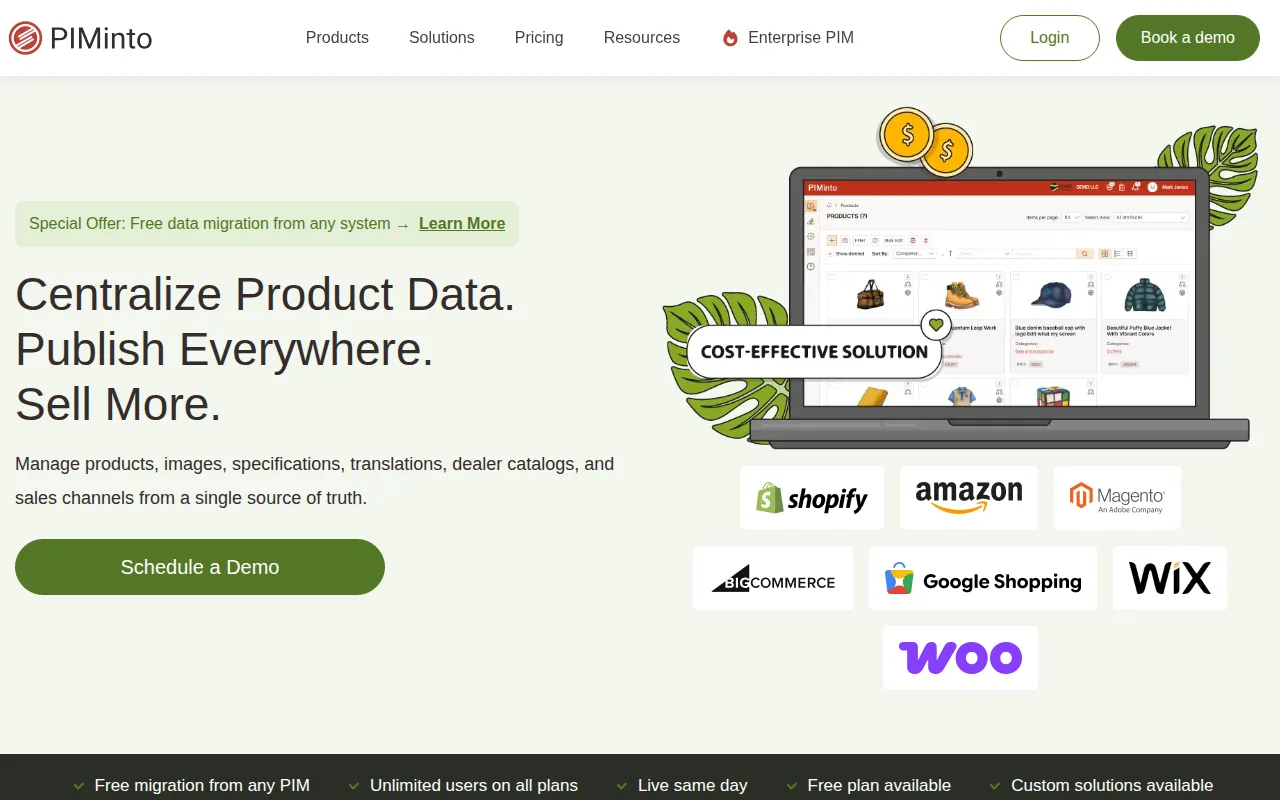
PIMInto connects product data with channels such as Shopify, Magento, Amazon, and WooCommerce. It also supports distribution across sales channels, so a change to a product record can become the approved source for each listing rather than another manual copy-paste task.
A PIM is different from a feed by itself. A feed carries data to a destination, while a PIM holds the product record that feeds use. Our plain-language explanation of PIM software covers that distinction in more detail.
The strongest case for PIMInto is the combination. PIMInto brings those functions together with built-in feeds for Shopify, WooCommerce, Google Shopping, and other channels.
That matters when a supplier changes a material field across hundreds of SKUs. Your team can update the catalog in bulk, review the result, and send the corrected data through the right channel output. Speed saves you time because the work happens at the source.
We'd still ask you to check channel fit before rollout. Map your fields, confirm variant rules, and test a small group of products first. A clean workflow depends on clean source data, even when the software helps you fix gaps.
For retail teams, our PIM for Retail overview shows how the same product record can support store and marketplace needs. Start with one category and one channel, then expand once the quality checks hold.
2. Sales Layer, Native connectors and AI enrichment for complex catalogs
Sales Layer is a PIM aimed at manufacturers with detailed catalogs, distributor networks, and B2B sales needs. It is a fit when a SKU carries deep technical data rather than a short consumer description.

Its documented native connectors cover e-commerce platforms, marketplaces, distributors, ERP systems, and SAP Ariba. That mix matters when product information must reach procurement teams as well as online stores.
Sales Layer also describes AI Agents that automate enrichment, translation, categorization, and quality checks. For a manufacturer with many technical fields, those checks can help flag missing information before a listing reaches a buyer.
The platform's manufacturing use case is especially strong around technical attribute depth and B2B catalog work. A product may need certifications, dimensions, compliance data, diagrams, or a fitment relationship. A basic storefront tool can struggle with that structure.
Its published comparison also frames implementation speed as a strength for manufacturing teams. Still, connector setup takes planning. Native does not mean every field maps itself, and your ERP or supplier data may need cleanup before import.
on technical catalogs and PIM connectors for the specific features behind this use case.
Choose Sales Layer when complex B2B catalogs are the main problem. If your priority is a low-cost setup with built-in retail feeds, compare that requirement against PIMInto before you commit.
3. Plytix, A usable option for small and midsize e-commerce teams
Plytix is a PIM designed for small and midsize businesses that need product data in one place. It is a sensible option when the team has outgrown spreadsheets but does not want an enterprise-heavy rollout.

The platform's product data model can hold core identifiers, technical attributes, media, channel copy, pricing fields, variants, and product relationships. That gives a growing team one place to manage the details that turn a bare SKU into a usable listing.
Plytix also supports organized product-data workflows. These can help a manager find incomplete products or prepare a channel-specific group.
That distinction is useful in daily work. Say your team needs every product with an approved image and complete dimensions. An organized workflow can help the team review records against those conditions and support a sales handoff.
Its main limitation is fit.
Teams considering this option should review Plytix's product information management documentation and test a real category. Use your own variants and supplier fields, not a polished demo catalog.
Plytix makes sense when ease of use is the buying trigger. If bulk catalog changes and direct channel feeds matter more, put those requirements beside PIMInto's feature set.
4. OdooPIM, Open-source flexibility with bulk editing and feeds
OdooPIM is a product information tool with built-in feeds, bulk editing, and an open-source community edition. It suits teams that already work in the Odoo ecosystem or want more control over how catalog data connects to operations.

Bulk editing is the useful part for a manager facing a large price or attribute change. Instead of opening products one at a time, the team can apply an approved change across a product group. The result still needs review, especially when variants share related fields.
OdooPIM also lists pre-built connectors for Shopify, WooCommerce, Magento, and ERP systems. Feed coverage can reduce the need for manual exports, but connector depth matters more than the headline count. Ask which fields sync, how often updates run, and what happens when a record fails validation.
The community edition can lower licensing cost, yet open-source software shifts more responsibility to your team. Hosting, setup, maintenance, and custom work may require technical help. Free software is not the same as free operations.
OdooPIM is a good match for organizations that want catalog control close to their ERP. For a broader explanation of how catalog systems move data through a channel, our product syndication guide covers the handoff.
Pick OdooPIM when your existing Odoo setup is central to the business. If you want a cloud PIM with feeds and enrichment ready in one place, compare implementation effort before deciding.
5. Akeneo, Structured product experience management with a free community edition
Akeneo is a PIM for mid-market and enterprise brands, manufacturers, distributors, and retailers with complex catalogs. It focuses on structured product experience management, which means the system helps govern the content shoppers see across channels.

A supplier-data workflow can extract, map, and normalize supplier information before it enters the catalog.
That workflow can help when suppliers send inconsistent files. Instead of handing every spreadsheet to an analyst, the team can map incoming fields to the catalog structure and review the result before publication.
Akeneo includes built-in feeds for channel distribution. Its API-first approach can fit a composable commerce stack, where the PIM connects to storefronts, marketplaces, ERP systems, DAM tools, and custom services.
The Community edition is a notable entry point because it has zero licensing fees. That does not remove the cost of hosting, implementation, integration work, or internal administration. Your total cost depends on who owns those tasks.
Akeneo is strongest when governance and catalog complexity lead the decision. It may be more system than a small team needs for a few channels. For larger operations, our enterprise PIM software resource gives another angle on scale, permissions, and catalog control.
Review Akeneo's own description of structured product data and channel mapping before a technical evaluation. Test supplier imports and approval rules with a difficult category, not your easiest one.
6. Apimio, Channel-ready listings with AI content enrichment
Apimio combines catalog management with product feed tools and AI content enrichment. It is a strong fit for teams that spend too much time fixing feed errors after products reach a shopping channel.
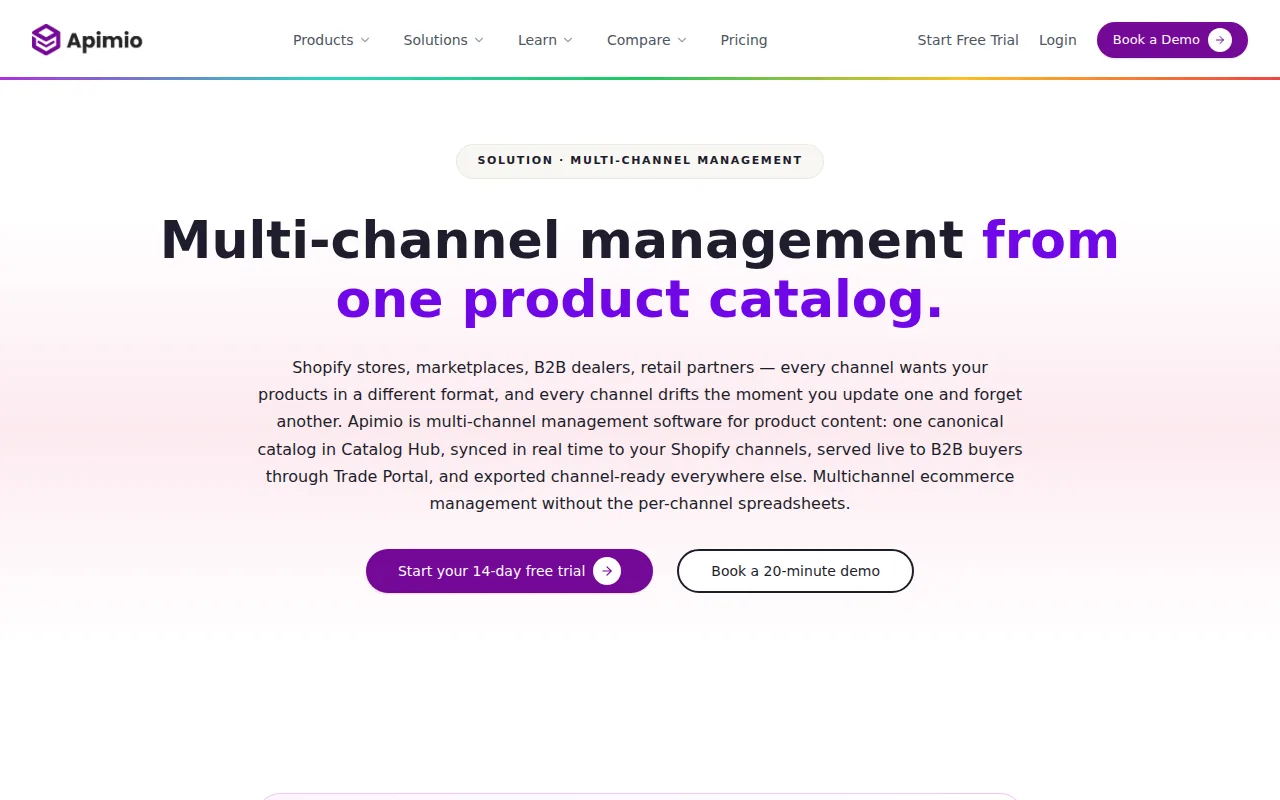
Its documented channel coverage includes Google, Meta, Pinterest, TikTok, Bing, Amazon, and Walmart. The workflow differs by channel. Some outputs use hosted feeds, while Amazon and Walmart can use marketplace-formatted files for upload.
Apimio's feed health tools check issues such as missing GTINs, long titles, invalid availability values, small images, and price mismatches. Those checks can catch a problem before a campaign sends traffic to a listing that the channel rejects.
Its AI layer can draft descriptions, meta titles, SEO titles, alt text, translations, and product-type suggestions. The vendor says outputs are based on structured catalog attributes and reviewed before they are committed. That is a better operating model than asking a general chatbot to invent product claims.
Apimio also separates internal fields such as wholesale price, minimum order quantity, case pack, and lead time from public feed data. That boundary can help protect trade information when the same catalog supports retail and wholesale work.
The caveat is scope. Apimio's feed features and pricing plans can vary by plan, and some marketplace connections use files rather than live APIs. Confirm the exact channel workflow your team needs before you migrate.
For teams focused on content quality, our article on product content management software explains how enrichment fits beside catalog governance. Apimio is worth testing when feed rejection work is eating the week.
Product Listing Software Comparison: Features, Feeds, and Best-Fit Use Cases
The best product listing software depends on where your catalog work breaks. A PIM should hold the source record, while a feed or connector sends the right version to a destination. Treating those as the same job can leave your team with accurate transport but poor source data.
Product information can include identifiers, attributes, media, prices, variants, and relationships. The business definition of a product and its information shows why a listing is more than a title and price.
Software | Best fit | Useful strength | Watch before buying |
|---|---|---|---|
PIMInto | Teams seeking one catalog source with channel outputs | Built-in feeds, AI enrichment, bulk editing, and a free tier | Test your category model and channel mappings |
Sales Layer | Manufacturers and complex B2B catalogs | Native connectors and AI Agents for enrichment and checks | Plan technical data imports and connector setup |
Plytix | Small and midsize e-commerce teams | Catalog management for small and midsize businesses | Check deep attribute and B2B requirements |
OdooPIM | Odoo-centered operations | Open-source edition, feeds, and bulk editing | Budget for technical ownership beyond licensing |
Akeneo | Mid-market and enterprise catalog governance | Supplier data workflows, channel mapping, and APIs | Assess implementation and hosting needs |
Apimio | Teams managing shopping feed quality | Pre-publish checks and AI content enrichment | Confirm hosted feed and file-based channel needs |
AI appeared in 14 of 15, while bulk editing appeared in only one platform and a true free tier appeared in only one. Those figures point to a simple buying rule: do not assume that an AI label includes bulk catalog control.
Check four things in a live test:
Can you update a large product group without opening each SKU?
Can the system keep variants and relationships intact?
Can approved data reach each target channel without a second source of truth?
Can your team see missing fields before publication?
Our product catalog software comparison can help you extend that review to taxonomy, imports, and channel workflows. For a focused PIM evaluation, our PIM software overview explains how PIMInto approaches centralized catalog control.
Choose PIMInto when you want the shortest path between a governed catalog and multiple channel outputs. Choose a more specialized option when manufacturing depth, open-source ownership, or feed diagnostics is the main constraint.
FAQ
What is product listing software?
Product listing software helps teams manage product content and publish it across sales channels. The best systems hold a central record for each SKU, then adapt fields for stores, marketplaces, and shopping feeds. A PIM is usually the source of truth, while a feed is the delivery format sent to a channel.
What is the best product listing software for Shopify?
The best product listing software for Shopify depends on catalog size and channel needs. PIMInto is a strong first option when you want a PIM with built-in feeds, AI enrichment, and bulk editing. Apimio may fit teams focused on feed diagnostics, while Plytix suits many small and midsize catalog teams.
Does product listing software replace a PIM?
Product listing software can include PIM functions, but a feed tool alone does not replace a PIM. A feed moves data to a channel, while a PIM stores attributes, media, variants, and approved content. Check where the system keeps the master record before you buy another publishing tool.
Can product listing software update many SKUs at once?
Some product listing software supports bulk editing, but you should verify it in a live demo. Bulk editing lets a team change a field across a product group, then review the result before publishing. This matters for supplier updates, seasonal copy changes, and catalog fixes that affect hundreds of records.
How to compare product listing software?
Compare product listing software by source-of-truth design, channel coverage, bulk editing, validation, variant handling, and ownership cost. Test one difficult category with real supplier data. Then confirm how the tool handles failed syncs, missing fields, approvals, and channel-specific formatting.
Conclusion
For most multichannel teams, PIMInto is the clearest starting point because it combines catalog management with built-in channel feeds, AI enrichment, bulk editing, and a free tier. Load one product category, map your key fields, and run a test sync before moving the rest of the catalog.
Modified on: 2026-09-17
Blogs you might like
-

Automotive Aftermarket PIM Software Guide
An aftermarket brake rotor can fit dozens of vehicles, replace three older part numbers, ship in two package sizes and need a California warning label. Multiply that by 20,000 SKUs, and the spreadsheet that used to run your catalog starts sending cus...
-

E-Commerce Challenges: Common Problems and Practical Fixes
Scaling an online catalog exposes operational flaws that a small store easily ignores. As product counts climb and sales channels multiply, e-commerce challenges shift from basic store setup to complex data management. Keeping up with orders and fulf...

Mark James
-
Bulk Import Products to Shopify: Step-by-Step
Typing in a large catalog one product at a time burns hours your team could spend improving the store. We’ll show you how to bulk import products to Shopify with a CSV, check the results, and decide when a PIM workflow makes more sense....
Mark James
-

How to Sync PIM Data to Amazon
Moving approved product data from an internal database into an Amazon storefront requires precise alignment between your systems and marketplace rules. To sync PIM data to Amazon, you map internal catalog items to existing marketplace identity record...
Mark James